
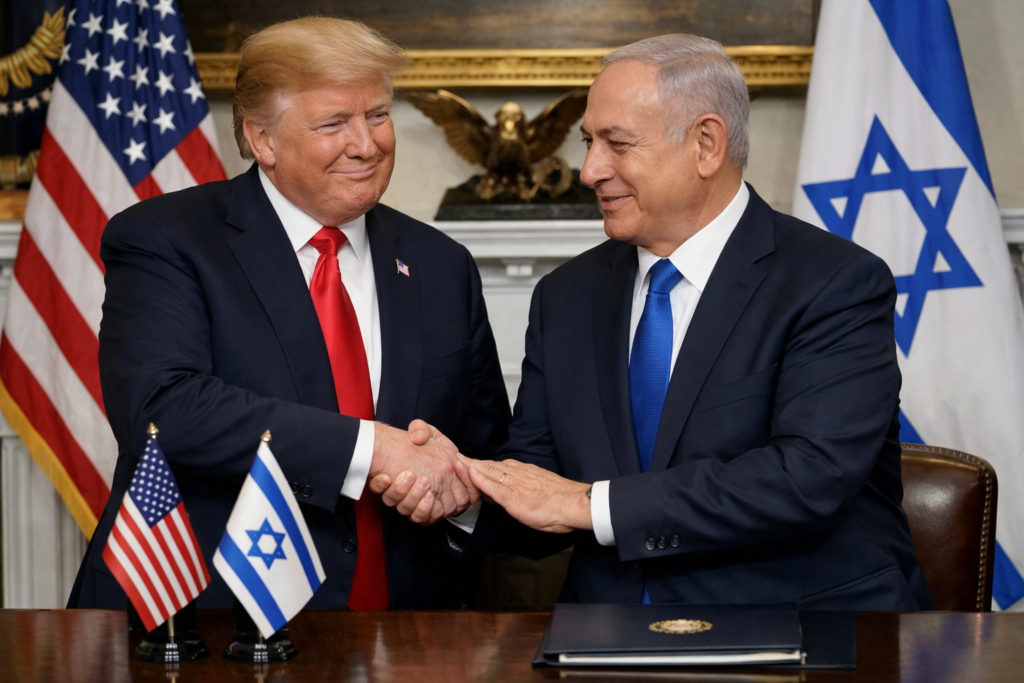
Image Credentials: Image Title: Netanyahu Joins Trump’s Gaza “Board of Peace” Despite ICC Warrant and Domestic Trials Source: (sora.openai) Date: January 2026. Attribution: This image was created using AI-generated imagery (sora.openai) and does not depict a real-world scene.
By Open Chronicle News Desk | January 21, 2026
TEL AVIV / WASHINGTON – Israeli Prime Minister Benjamin Netanyahu has formally accepted an invitation from U.S. President Donald Trump to serve as a founding member of the newly proposed international “Board of Peace” for Gaza. The announcement, made by the Prime Minister’s Office on Wednesday, signals a major alignment between the two leaders on the future of Gaza, even as Netanyahu faces significant legal challenges both at home and abroad.
The board, a central pillar of Trump’s 2026 foreign policy agenda, aims to manage the post-conflict reconstruction and governance of the Gaza Strip, often bypassing traditional United Nations frameworks.
Acceptance Amid Legal Turmoil
Netanyahu’s decision to join the board comes at a precarious moment for the Israeli leader. He remains subject to an active arrest warrant issued by the International Criminal Court (ICC) in 2024 for alleged war crimes. Furthermore, just hours after the announcement, Netanyahu was scheduled to appear in a Tel Aviv court for his ongoing domestic corruption trial, where he faces charges of bribery, fraud, and breach of trust.
Supporters of the move argue that his participation on the board provides a platform to defend Israel’s security interests and counter the legitimacy of international legal actions against him.
A Controversial Global Panel
The “Board of Peace” is quickly becoming a flashpoint for global diplomacy. While Trump has also extended invitations to leaders such as Turkey’s Recep Tayyip Erdoğan and Russia’s Vladimir Putin, the board’s structure, including a $1 billion membership fee for permanent status, has drawn sharp criticism from Western allies like Canada and France.
For Netanyahu, the board offers a strategic alternative to European-led peace initiatives. By joining, he ensures Israel has a direct hand in Trump’s “deal-making” approach to the Middle East, which emphasizes economic reconstruction and regional normalization over traditional statehood negotiations.
Regional Skepticism
The inclusion of Netanyahu has already sparked backlash from Palestinian authorities and several regional players who view the board as a one-sided endeavor. Critics in Turkey, a nation that has been deeply vocal against Israeli military actions in Gaza, suggest that Netanyahu’s presence undermines any claim of impartiality for the board.
As the World Economic Forum continues in Davos, the formation of this “Board of Peace” is expected to be a major topic of President Trump’s special address later today, where he is likely to name additional members who have agreed to the $1 billion “entry fee.”