
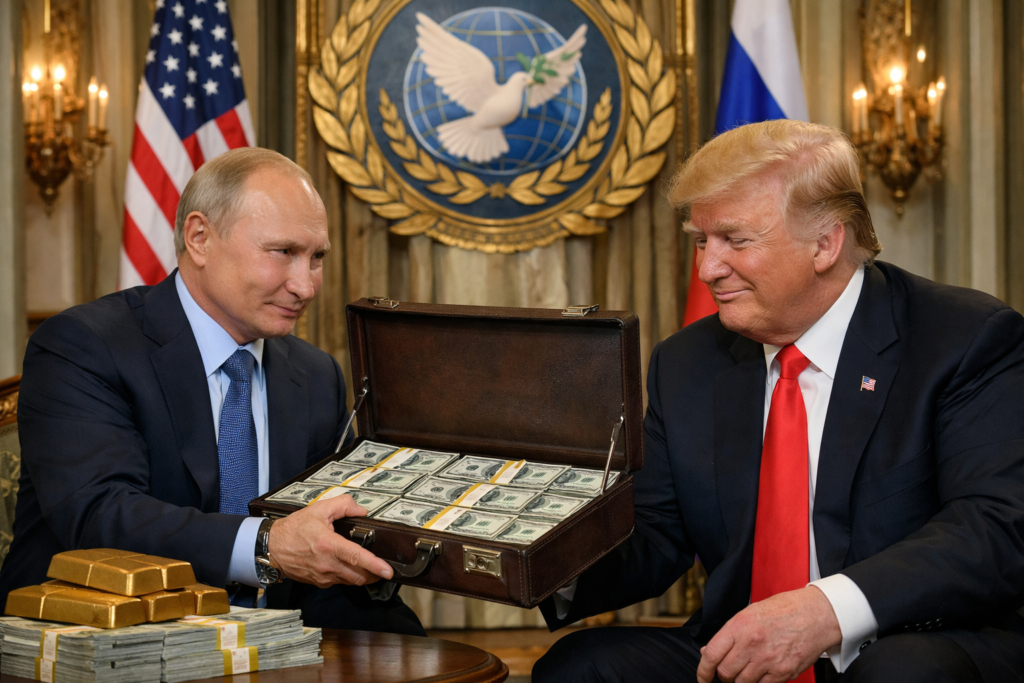
Image Credentials: Image Title: Putin Pledges $1 Billion in Frozen Assets to Secure Seat on Trump’s “Board of Peace” Source: (sora.openai) Date: January 2026. Attribution: This image was created using AI-generated imagery (sora.openai) and does not depict a real-world scene.
By Open Chronicle News Desk
MOSCOW / DAVOS – In a move that has stunned international observers and added a new layer of complexity to the “pay-to-play” controversy surrounding the White House’s latest diplomatic venture, Russian President Vladimir Putin has announced that Moscow is prepared to pay $1 billion to join Donald Trump’s “Board of Peace.”
The announcement, made during a meeting of the Russian Security Council on Wednesday, suggests that the Kremlin intends to use assets currently frozen by the United States to cover the “permanent membership fee” outlined in the Board’s controversial draft charter.
Financial Alchemy: Using Frozen Funds
According to President Putin, the $1 billion contribution would be drawn from the Russian sovereign assets that were immobilized by the previous U.S. administration following the invasion of Ukraine.
“We could send 1 billion US dollars from Russian assets frozen during the previous US administration to the Board of Peace,” Putin stated, noting that he has instructed the Foreign Ministry to coordinate this position with international partners.
The proposal presents a unique legal challenge for the Trump administration: accepting the money would essentially require the “unfreezing” of Russian funds, a move that critics argue would undermine years of Western sanctions and provide the Kremlin with a backdoor to financial rehabilitation.
The $1 Billion Club
The “Board of Peace,” officially launched this week on the sidelines of the World Economic Forum in Davos, was initially presented as a transitional body to oversee the rebuilding of Gaza. However, its leaked charter reveals a much broader global mandate and a tiered membership structure:
-
Three-Year Membership: Granted to invited nations at no initial cost.
-
Permanent Membership: Reserved for nations that contribute $1 billion in cash within the first year.
While several Western nations, including France and Norway, have declined invitations—citing concerns that the Board seeks to bypass the United Nations—a bloc of eight Muslim-majority countries and leaders from Argentina, Hungary, and Belarus have already signaled their intent to join.
Strategic Implications
For President Trump, Putin’s interest in the Board offers a potential victory for his “transactional diplomacy” model. For President Putin, it offers a seat at a high-level table chaired personally by Trump, potentially rivaling the influence of the UN Security Council, where Russia’s power has been increasingly challenged.
White House officials have not yet confirmed if they will accept funds from frozen accounts to satisfy the membership fee. However, U.S. Special Envoy Steve Witkoff is expected to meet with Russian representatives in Moscow tomorrow to discuss the logistics of the “Board of Peace” and its role in future conflict resolution.
As the Board prepares for its inaugural meeting, the inclusion of a sanctioned world leader via seized assets is likely to remain the most contentious issue of the 2026 Davos summit.