
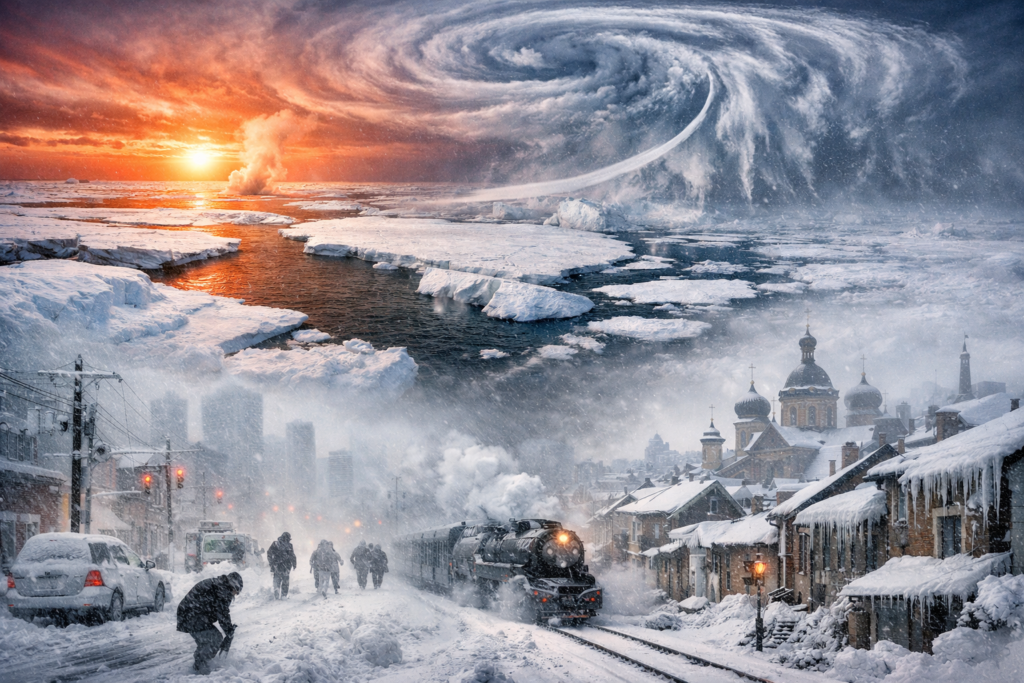
Image Credentials: Image Title: Warming Arctic Triggers Historic Deep Freeze Across United States and Eastern Europe Source: (sora.openai) Date: January 2026. Attribution: This image was created using AI-generated imagery (sora.openai) and does not depict a real-world scene.
By Open Chronicle News Desk
GENEVA — A paradox of the climate crisis is unfolding this week as record-breaking warmth in the Arctic has triggered a brutal and “exceptional” cold wave across the United States and Eastern Europe. Meteorologists warn that the destabilization of the polar vortex, driven by the rapid heating of the North Pole, is pushing sub-zero temperatures into regions ill-equipped for such extreme conditions.
In the United States, a massive Arctic air mass has descended from the northern plains, plunging the Midwest and Northeast into a deep freeze. Major cities have recorded temperatures 15 to 25 degrees below seasonal averages, straining power grids and forcing the closure of schools and government offices. In Eastern Europe, countries including Poland, Romania, and the Baltic states are facing similar conditions, with heavy snowfall and biting winds causing significant travel disruptions and energy spikes.
Climate scientists point to a phenomenon known as “Arctic Amplification.” As the Arctic warms at a rate nearly four times faster than the rest of the planet, the thermal gradient that keeps the polar vortex stable is weakening. This allows the jet stream to become “wavy,” spilling frigid polar air much further south than usual.
🚨 **A CATASTROPHIC, ONCE-IN-A-GENERATION ICE STORM IS EXPANDING RIGHT NOW – AND MILLIONS HAVE NO IDEA WHAT’S ABOUT TO HIT THEM**
"Now is the time to prepare."
Meteorologists are using words they almost never use: **catastrophic**. "Once in a generation." Not because of snow… pic.twitter.com/9QWqVyQM4O
— dogechat (@dogechatX) January 22, 2026
“What we are seeing is the breakdown of traditional weather boundaries,” said a spokesperson for the World Meteorological Organization (WMO). “While the global average temperature continues to rise, the redistribution of that heat is creating these localized pockets of extreme, dangerous cold.”
The human and economic toll of the freeze is mounting. In the U.S., officials have linked several fatalities to the cold, primarily due to exposure and traffic accidents on icy roads. In Eastern Europe, authorities are working to ensure heating supplies remain stable amid the ongoing geopolitical tensions that have already complicated the continent’s energy security.
As the cold wave persists, environmental agencies are reiterating the urgent need for infrastructure adaptation. The “exceptional” nature of this event suggests that while these deep freezes may seem contradictory to global warming, they are, in fact, a direct and increasingly frequent consequence of a planet out of balance.