
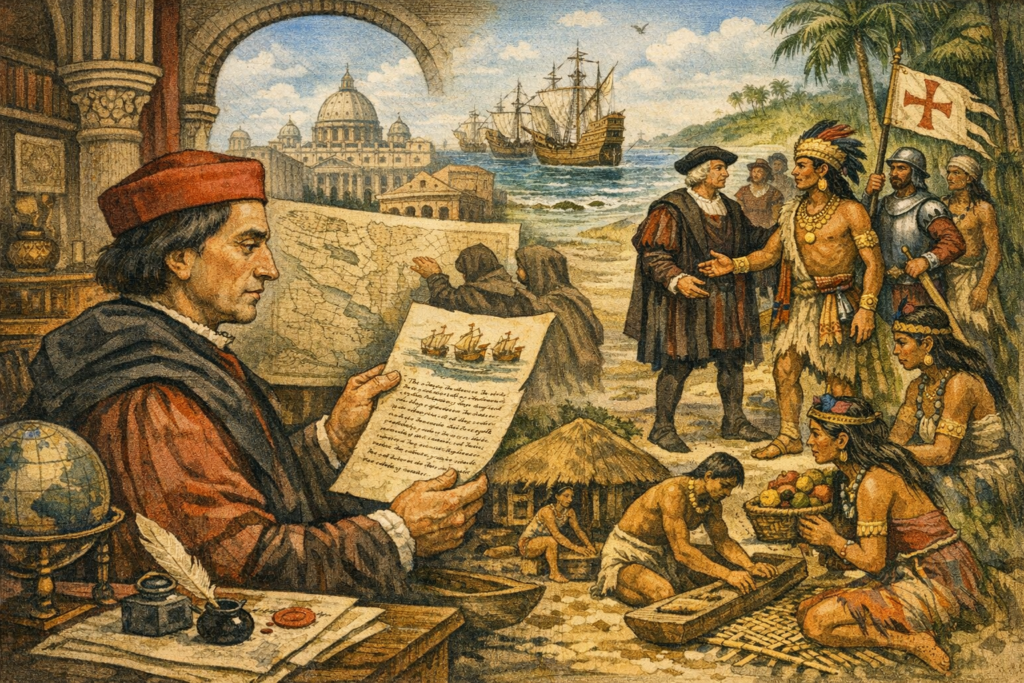
Image Credentials: Image Title: The First Glimpse: Decoding Columbus’s 1493 “Epistola” Source: (sora.openai) Date: January 2026. Attribution: This image was created using AI-generated imagery (sora.openai) and does not depict a real-world scene.
By Open Chronicle History Desk | January 31, 2026
In the spring of 1493, a slim document began circulating through the courts of Europe, igniting a “media frenzy” that would forever alter the map of the known world. Published in Rome, the Epistola de insulis Indie supra Gangem (Letter on the Islands of India Beyond the Ganges) was Christopher Columbus’s first public account of his voyage across the Atlantic.
While the Admiral of the Ocean Sea believed he had reached the outskirts of Asia, his descriptions of the people he encountered, the Taíno of Hispaniola and the Caribbean, offered a stark, often misunderstood portrait of a civilization that was far more sophisticated than the “naked” simplicity he reported.
Columbus’s famous observation, that the inhabitants “always go as naked as they came into the world”, became a foundational trope in colonial literature. It framed the Indigenous peoples as “innocent” or “primitive,” serving a dual purpose: it made them appear ripe for conversion to Catholicism and suggested they lacked the “civility” of European legal and social structures.
However, modern archaeological evidence and closer readings of contemporary accounts, such as those by the priest Andrés Bernáldez and later Bartolomé de las Casas, reveal a culture deeply invested in regalia and social hierarchy:
-
Cotton and Weaving: While Columbus noted that some women wore “a veil of cotton,” the Taíno were actually skilled weavers. They produced cotton hammocks (hamacas), belts, and even elaborate “cotton reliquaries” used to house the remains of ancestors.
-
The Nagua: Married women typically wore a cotton skirt called a nagua, the length of which denoted their social status.
-
Body Adornment: The “nakedness” Columbus saw was often a canvas for complex body art. The Taíno used vegetable dyes like bixa (red from the achiote plant) and jagua (black) to paint intricate designs. These were not merely decorative; they provided protection from the sun and insects and signaled tribal affiliations.
-
Jewelry and Rank: The Caciques (chiefs) and Nitaínos (nobles) wore a gold or copper-gold alloy disc known as a guanín on their chests. They also wore necklaces of stone, shell, and bone beads, and magnificent headdresses made of tropical feathers.
The Taíno were described by Columbus as “well-formed,” with “handsome bodies” and skin the color of the “Canarians”, neither black nor white, but olive or coppery. A distinctive physical trait noted by the Spaniards was the flattened forehead, a result of intentional cranial deformation in infancy. To the Taíno, this was a mark of beauty and perhaps a way to strengthen the skull for spiritual or practical reasons.
“Their hair is short and coarse… they wear the hairs brought down to the eyebrows, except a few locks behind, which they wear long and never cut.” — Journal of Christopher Columbus, 1492
Bibliography
- Columbus, Christopher. Epistola Christofori Colom: cui [a]etas nostra multum debet: de insulis Indie supra Gangem nuper inventis. Translated by Leandro di Cosco. Rome: Stephan Plannck, 1493.
- Columbus, Christopher. The Journal of Christopher Columbus (During His First Voyage, 1492-93). Edited by Clements R. Markham. London: Hakluyt Society, 1893.
- Las Casas, Bartolomé de. History of the Indies. Translated and edited by Andrée Collard. New York: Harper & Row, 1971.
- Ostapkowicz, Joanna, and Lee Newsom. ““Gods Adorned with the Embroiderer’s Needle”: The Materials, Making and Meaning of a Taino Cotton Reliquary.” Latin American Antiquity 23, no. 3 (2012): 300-326.
- Umoren, Imaobong. “How Christopher Columbus’s Brutal Enslavement of Indigenous Caribbeans Set the Tone For the ‘New’ World.” Literary Hub, October 23, 2025. https://lithub.com/how-christopher-columbuss-brutal-enslavement-of-indigenous-caribbeans-set-the-tone-for-the-new-world/.
- Wilson, Samuel M. The Indigenous People of the Caribbean. Gainesville: University Press of Florida, 1997.