
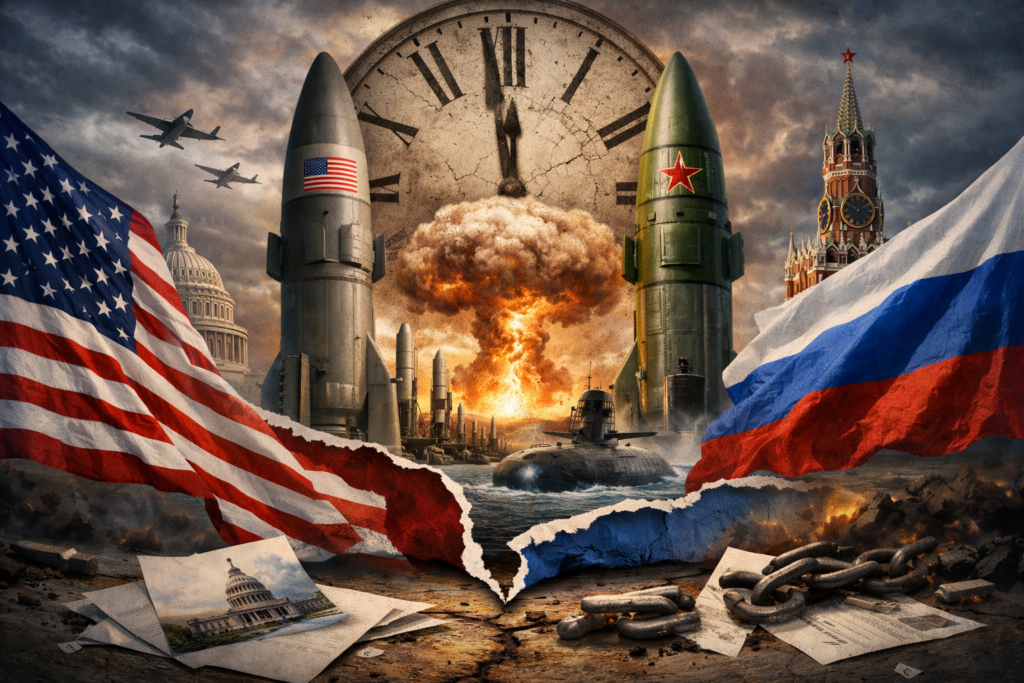
Image Credentials: Image Title: Ominous Milestone Approaches as Last U.S.-Russia Nuclear Arms Treaty Set to Expire Source: (sora.openai) Date: February 2026. Attribution: This image was created using AI-generated imagery (sora.openai) and does not depict a real-world scene.
By Open Chronicle Staff
WASHINGTON, D.C. — For the first time in over half a century, the world’s two largest nuclear powers are poised to operate without a single mutually agreed constraint on their strategic arsenals. On February 5, the New START (Strategic Arms Reduction Treaty) between the United States and Russia will officially expire, marking what experts call the end of a cornerstone in global security architecture.
The expiration of the treaty leaves the path to an unconstrained nuclear arms race wide open. Since the height of the Cold War, a series of bilateral agreements has successfully reduced the American and Russian stockpiles from a staggering 30,000 warheads each to the current treaty limit of 1,550 deployed warheads. With that legal ceiling removed, the guardrails that prevented a return to mass accumulation are effectively gone.
A Dialogue in Silence
The treaty, which entered into force in 2010, provided more than just numerical limits. It mandated extensive data exchanges and on-site inspections—a mechanism that allowed both nations to verify the other’s compliance 18 times a year.
However, the cooperative spirit required to maintain these inspections evaporated during the COVID-19 pandemic and was never fully restored. Russia subsequently refused to resume inspections, citing the geopolitical fallout from its war in Ukraine. While both sides have continued to abide by the 1,550-warhead limit in principle, the official dialogue on “strategic stability” has fallen silent.
“Neither side is demonstrating any urgency to re-engage on this matter of mutual existential interest,” says Lynn Rusten, a former U.S. nuclear negotiator and CEPA senior fellow. “Both are now poised, for the first time in decades, to build up their strategic nuclear arsenals rather than reducing them together.”
A Global Chain Reaction
The vacuum left by New START comes at a time of unprecedented nuclear complexity. China is currently expanding its arsenal at a rate far exceeding previous intelligence estimates, while North Korea’s missile programs continue to advance without diplomatic interference.
In Europe, the sense of insecurity is palpable. Nations long known for their pacifist stances, such as Sweden, are now reportedly discussing nuclear defense options with traditional nuclear-armed allies like the U.K. and France. The crumbling of the U.S.-Russia architecture is perceived by many non-nuclear states as a failure by the major powers to uphold their disarmament obligations under the Nuclear Non-Proliferation Treaty (NPT).
The Risks of “Luck”
As the February 5 deadline looms, there is little indication of a last-minute breakthrough. Russian President Vladimir Putin has proposed a one-year extension of the current limits, a move initially met with some interest by President Trump, who has since suggested he could negotiate a “better” deal after the treaty lapses.
Analysts warn that the technical complexity of these negotiations means any new agreement could take years to finalize. In the interim, the lack of transparency increases the risk of miscalculation. The integration of AI and cyber capabilities into command-and-control systems only complicates the landscape, raising the stakes of an accidental launch.
“At some point, the element of luck that has helped ensure the nuclear peace over the past 80 years will run out,” Rusten warns. Without New START, the world enters an era where the only limit on the world’s deadliest weapons is the self-restraint of the leaders who possess them.