
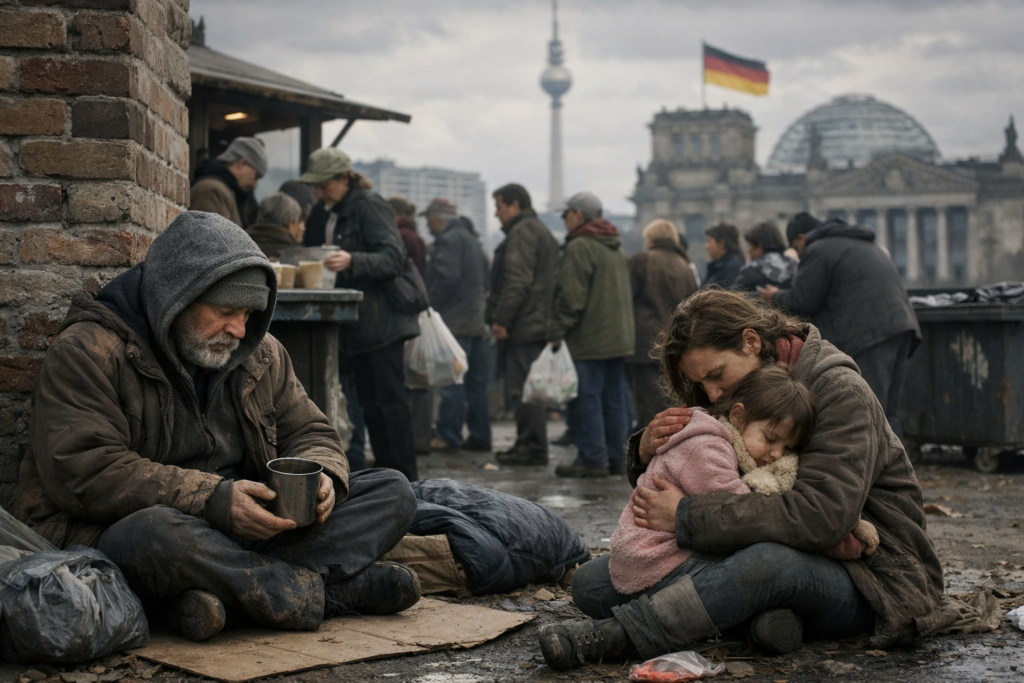
Image Credentials: Image Title: ECB Holds Rates Steady Amidst Fragile Growth and Inflation Uncertainty Source: (sora.openai) Date: February 2026. Attribution: This image was created using AI-generated imagery (sora.openai) and does not depict a real-world scene.
By Open Chronicle Staff with Agencies | February 5, 2026
BERLIN – In a sobering revelation for Europe’s largest economy, new data from the Federal Statistical Office (Destatis) confirms that poverty is tightening its grip on Germany. Approximately 13.3 million people, representing 16.1% of the population, are now living below the at-risk-of-poverty threshold, a marked increase from previous years that highlights a widening social divide.
The figures, released this week, underscore a persistent upward trend in economic vulnerability. While Germany has long been viewed as the continent’s industrial powerhouse, the “at-risk-of-poverty” rate (defined as an income below 60% of the national median) has climbed from 15.5% in the preceding year. When broader metrics such as social exclusion and material deprivation are included, the number of affected individuals surges to 17.6 million, or roughly 21.2% of the country.
Inspiriert von wahren Lebensgeschichten und symbolisch mit KI nachgestellt!
Deutschland war einmal ein reiches Land, heute leben hier rund 13 Millionen Menschen unterhalb der Armutsgrenze.
Vom Staat und der Regierung im Stich gelassen!KI Video: @fragmentio auf TikTok pic.twitter.com/LUrwvTrMxA
— Lexa 🇩🇪 (@rebew_lexa) October 26, 2025
A Shifting Threshold
For a person living alone in 2025, the poverty threshold is now set at a net monthly income of €1,446. For a household consisting of two adults and two children under the age of 14, that figure rises to €3,036. Despite these adjustments to account for inflation, many citizens find themselves unable to keep pace with the rising costs of housing, energy, and essentials.
Demographics at Risk
The report identifies specific groups bearing the brunt of the economic strain:
-
The Unemployed: This remains the most vulnerable bracket, with a staggering 64.9% poverty risk rate.
-
Single Parents: At 28.7%, single-parent households continue to face systemic hurdles, often juggling multiple low-wage jobs while managing childcare costs.
-
Solo Dwellers: Nearly 31% of individuals living alone are classified as at-risk, nearly double the national average.
-
The Elderly: Poverty among retirees is also on the rise, currently sitting at 19.1%. Advocacy groups warn that “old-age poverty” is becoming a permanent fixture of the German social landscape, as fixed pensions fail to cover the soaring costs of urban living.
Social Security Under Pressure
The findings have ignited a fierce debate in the Bundestag regarding the efficacy of the “Citizens’ Income” (Bürgergeld) and other social safety nets. While the government implemented a 12.1% increase in social security payments at the start of 2024, critics argue that the subsequent freeze in 2025 and the rising cost of living have neutralized these gains.
“It is a bitter feeling when, at the end of the month, all you have left is bread and butter,” said Lisbeth C., a single mother from Saxony, in a testimony shared by human rights observers. Her story is becoming increasingly common in a nation where the “working poor”, those who are employed but remain below the poverty line, now account for 6.5% of the workforce.
As the “Tafel” food bank networks report record numbers of clients, the German government faces mounting pressure to address the structural causes of inequality. For now, the “Open Chronicle” observes a nation at a crossroads, where the promise of prosperity is increasingly out of reach for one in every six citizens.