
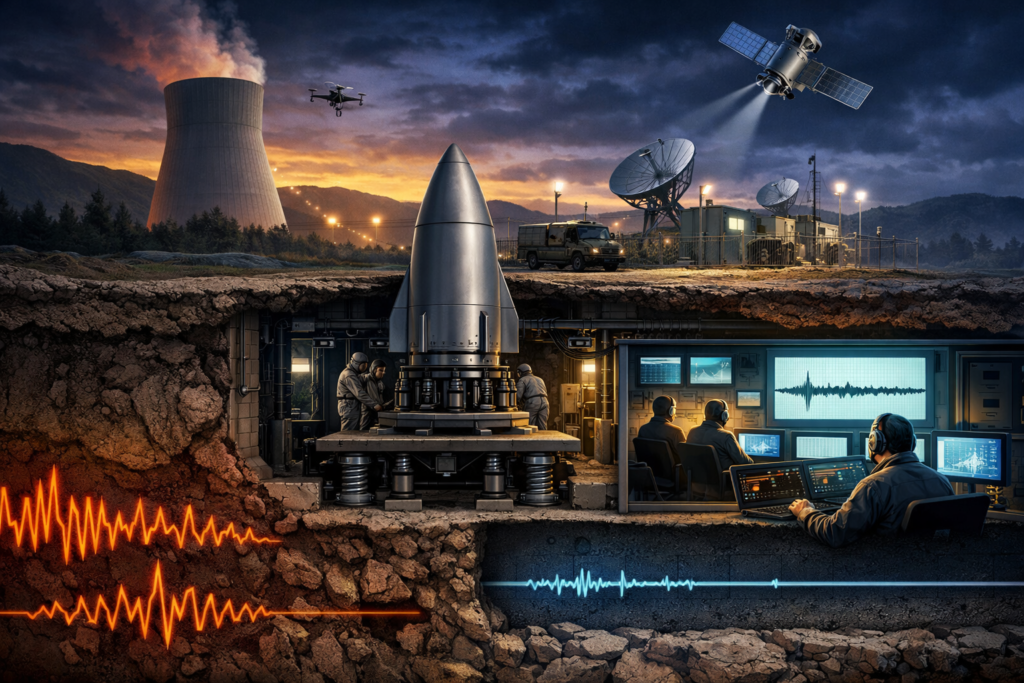
Image Credentials: Image Title: Seismic Silence: The Stealth Science of ‘Decoupling’ Challenges Global Nuclear Oversight Source: (sora.openai) Date: Feb 2026. Attribution: This image was created using AI-generated imagery (sora.openai) and does not depict a real-world scene.
By Chronicle Staff with Agencies
Lop Nor — A sophisticated method of underground concealment known as “decoupling” has emerged at the center of a growing international debate over nuclear transparency. Recent reports suggest that advanced nations may be utilizing this “seismic silence” technique to mask low-yield nuclear detonations, potentially bypassing the world’s most sensitive monitoring networks.
The Mechanics of Muffling
At its core, decoupling is a physics-based evasion strategy. In a standard “coupled” test, a nuclear device is placed in direct contact with solid rock. When it detonates, the energy is efficiently transferred into the ground, creating powerful P-waves and S-waves that can be detected thousands of miles away by the International Monitoring System (IMS).
Decoupling subverts this process. By suspending the explosive device within a massive, pre-excavated underground cavern filled with air or low-density gas, the initial blast wave is forced to travel through the air before hitting the cavern walls. This buffers the energy transfer, spreading the explosive force radially and muffling the vibration. Experts estimate that decoupling can reduce a test’s detectable seismic magnitude by a factor of 50 to 100, effectively making a small nuclear explosion look like a routine mining blast or a minor tectonic shift.
The Kazakh Connection
The controversy gained momentum following the re-analysis of data from the PS23 Makanchi primary seismic station in Kazakhstan. Located in a low-noise environment once used to monitor Soviet tests, the station’s 11-element array detected a suspicious event originating from the Lop Nor facility in June 2020.
U.S. officials, including Assistant Secretary of Nuclear Infrastructure Christopher Yeaw, recently pointed to declassified waveforms from that event. Analysts noted a distinct lack of shear wavesthe hallmark of natural earthquakes, and a high-frequency spectral signature associated with contained explosions. Despite the signal being suppressed to a magnitude of roughly 2.75, the “double-pulse” signature suggests a deliberate attempt to hide a low-yield test under the guise of industrial activity.
Geopolitical Fallout
The revelations have sparked a sharp diplomatic exchange. China has vehemently denied the allegations, labeling them “false slanders” intended to justify a potential return to testing by the United States. Beijing maintains that it adheres to a voluntary moratorium on nuclear testing, a stance it has held since 1996.
However, the timing of these findings is critical. With the New START treaty set to expire and global tensions rising, the ability to covertly develop advanced, low-yield warheads through decoupled testing threatens the foundation of the Comprehensive Nuclear-Test-Ban Treaty (CTBT). Although signed by major powers, the treaty remains unratified by several, leaving a “gray zone” in international law.
A New Era of Verification
As nuclear arsenals are projected to grow, with some estimates suggesting China could reach 1,000 warheads by 2030, the “science of silence” poses a direct challenge to global security. For non-signatory nations like India, the development of regional surveillance to counter these stealth techniques has become a priority.
The debate over decoupling underscores a sobering reality: as monitoring technology improves, so too does the science of evasion. Restoring global trust may now depend less on seismic sensors and more on the transparency of the nations that possess them.
The Grand Strategy Institute
Continue Exploring Strategic Analysis
Return to The Grand Strategy Institute for strategic assessments, long-form analysis and research examining geopolitics, military affairs, international security, emerging technologies and the changing international order.
← Back to The Grand Strategy Institute