
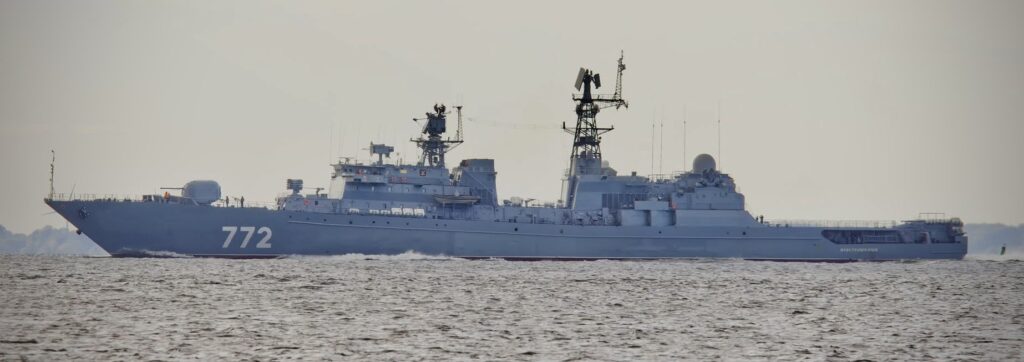
Image: from Russia Maritime Watch X @RFNOSBlog (Russian frigate RFS Neustrashimy)
By Chronicle Staff with Agencies
THE HAGUE — The Netherlands’ top intelligence agencies have issued a stark warning regarding an “aggressive” escalation in Russian hybrid warfare, cautioning that Moscow is moving beyond digital espionage toward physical sabotage that could cripple vital European infrastructure.
In a joint report released Thursday, the General Intelligence and Security Service (AIVD) and the Military Intelligence and Security Service (MIVD) stated that the threshold for Russian interference has shifted significantly. While previous years focused heavily on disinformation and hacking, the services are now observing active preparations for physical disruptions within the Netherlands and across the continent.
Sabotage in the “Gray Zone”
According to the AIVD, the current threat landscape exists in a “gray area” between peace and open conflict. The agencies highlighted several alarming trends, including the disruption of air traffic via drones, damage to undersea data cables, and the distribution of incendiary packages designed to catch fire during air transit.
“Various Russian hybrid activities have been observed, including preparations for sabotage,” the agencies stated in the report. They warned that the failure of vital sectors, such as energy, water, or telecommunications, could “severely disrupt society” and sow widespread panic.
One specific case cited by an AIVD spokesperson involved a man instructed to mail two packages to North America, an operation believed to have been orchestrated by Russian intelligence to test or execute sabotage via the global logistics chain.
Strategic Objectives
The Dutch intelligence community believes the Kremlin’s objectives are fourfold: to influence domestic European politics, to sow internal division, to disrupt the flow of military aid to Ukraine, and to weaken public support for the war effort.
“The price has to go up,” said Erik Akerboom, head of the AIVD, during a briefing to Parliament. He argued that simply identifying the perpetrators is no longer enough to deter Moscow. Peter Reesink of the MIVD added that the ambiguity of these “hybrid” attacks is a deliberate tactic, one that may eventually require a military-level response if critical infrastructure is hit.
Rising Physical Confrontations
The report coincides with a period of increased military friction. In recent months, Dutch F-35 fighter jets were scrambled to intercept Russian drones and aircraft entering Polish and Estonian airspace. Closer to home, the Royal Netherlands Navy has been closely monitoring Russian frigates and cargo ships lingering near Dutch wind farms and communication lines in the North Sea.
The Navy’s newest supply ship, the Zr. Ms. Den Helder was recently deployed to escort the Russian vessel Neustrashimy out of the Dutch Exclusive Economic Zone, highlighting the constant surveillance required to protect maritime interests.
As the threat turns from “online to physical,” Dutch officials are calling for enhanced security measures for private companies managing critical utilities, warning that the “silent war” currently being waged in the shadows could soon have very loud consequences for the Dutch public.
The Grand Strategy Institute
Continue Exploring Strategic Analysis
Return to The Grand Strategy Institute for strategic assessments, long-form analysis and research examining geopolitics, military affairs, international security, emerging technologies and the changing international order.
← Back to The Grand Strategy Institute