
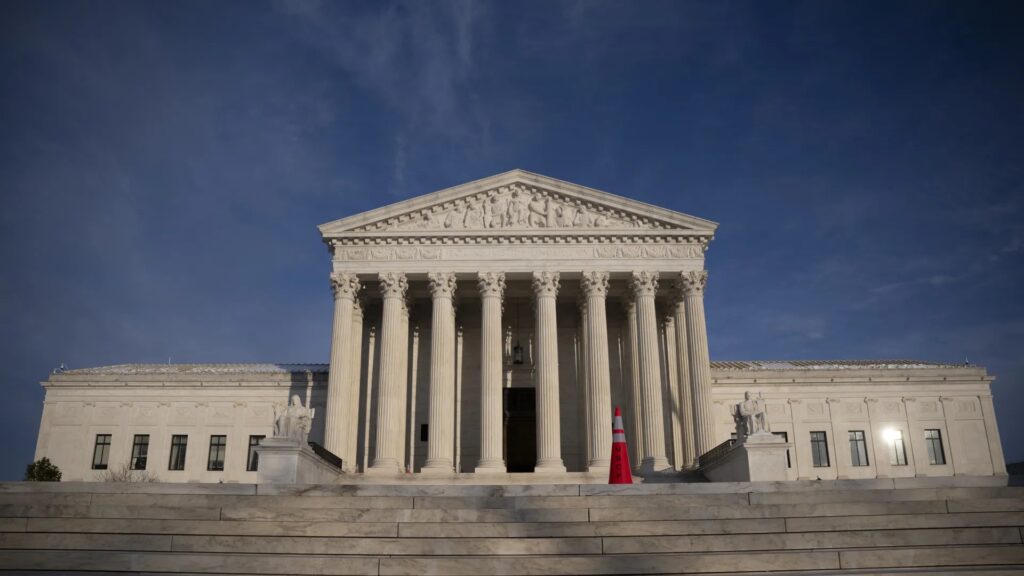
Image: from The Horizon X @Horizon_Reports
THE OPEN CHRONICLE | Truth through time. Integrity in every word.
By Open Chronicle Staff | United States
WASHINGTON — In a landmark defense of the separation of powers, the Supreme Court ruled 6-3 on Friday that President Donald Trump overstepped his constitutional authority by unilaterally imposing sweeping global tariffs under the guise of a national emergency.
The decision in Learning Resources et al. v. Trump effectively guts a central pillar of the administration’s “America First” economic agenda, nullifying billions of dollars in duties that had been levied on imports from China, Mexico, Canada, and beyond. Writing for the majority, Chief Justice John Roberts issued a stinging rebuke of executive overreach, clarifying that the power to tax and regulate trade remains a strictly legislative prerogative.
In a 6-3 decision the Supreme Court Strikes down Trump tariffs
The decision does not affect all of Trump's tariffs but invalidates those implemented using an emergency law pic.twitter.com/spoRYOpxwl— We told you So (@terri4436166795) February 20, 2026
A “Blank Check” Denied
At the heart of the case was the International Emergency Economic Powers Act (IEEPA) of 1977. The administration had argued that the statute, originally designed to allow the President to freeze assets and regulate transactions during foreign crises, granted him a “blank check” to impose “reciprocal” and “trafficking” tariffs.
“The authority to ‘lay and collect taxes, duties, and imposts’ is lodged exclusively in the hands of the legislature,” Chief Justice Roberts wrote. He was joined by the Court’s three liberal justices, along with Justices Gorsuch and Barrett. In a notable concurrence, Justice Gorsuch emphasized that Congress never “clearly surrendered” its fundamental role in setting trade policy.
Justices Thomas, Alito, and Kavanaugh dissented, arguing that the broad language of the IEEPA should have allowed the President more latitude to address modern economic threats.
The $130 Billion Question
The ruling has immediate and chaotic implications for the U.S. Treasury. Since 2025, the administration has collected an estimated $130 billion in duties under the now-invalidated orders. State governors and industry leaders have already begun demanding comprehensive refunds for American businesses and consumers who bore the brunt of these costs.
“This is more than a legal victory; it’s an economic lifeline,” said a spokesperson for a coalition of small businesses involved in the suit. “These tariffs were a tax on the American people, and the Court has finally pulled the plug.”
Market Turmoil and Executive Fury
While the ruling provides relief to importers, it has sparked fresh uncertainty in global markets. Analysts warn that the loss of his preferred economic tool has left the President in a volatile state. As reported earlier today, the President reacted to the news with a defiant address from the White House, suggesting he might pursue even more extreme measures, such as total embargos, to bypass the Court’s ruling.
Legal experts anticipate a wave of follow-on litigation as the government determines how, or if, to return the billions in collected revenue. For now, the Court has drawn a clear line in the sand: the President may manage emergencies, but he cannot rewrite the tax code from the Oval Office.