
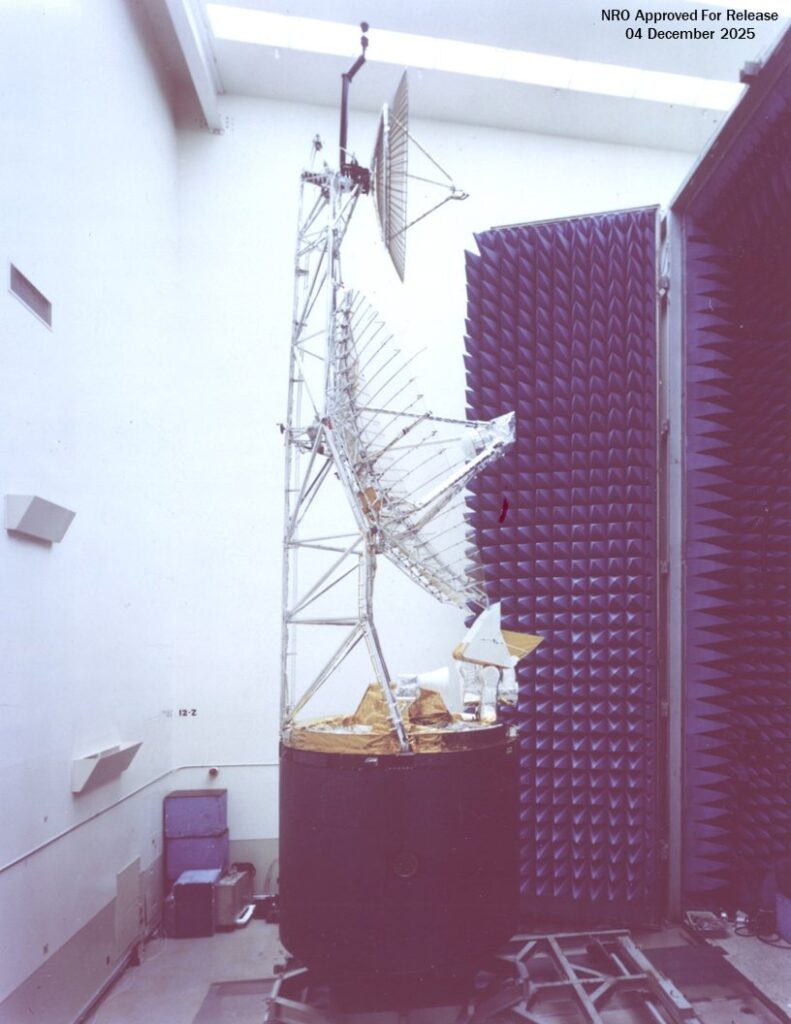
Image: from DutchSpace X @DutchSpace
By Open Chronicle Staff February 23, 2026
WASHINGTON, D.C. — For more than three decades, it was one of the most guarded secrets of the Cold War—a silent sentry drifting in the darkness of space, listening to the electronic heartbeat of America’s adversaries. On Friday, the National Reconnaissance Office (NRO) finally stepped out of the shadows, officially declassifying the existence and historic mission of the Jumpseat signals intelligence satellite.
The declassification, announced by NRO Director Chris Scolese, sheds new light on “Project EARPOP,” a pioneering effort to monitor the Soviet Union from an unconventional vantage point.
First (public) look at the Jumpseat electronic intelligence satellites secretly deployed in orbit from 1971 to 1987.
Chronology: https://t.co/zV5HFHcc48 https://t.co/LU4qx5cRX7 pic.twitter.com/egybyKwL8w— Anatoly Zak (@RussianSpaceWeb) January 28, 2026
A New Orbital Frontier
Launched between 1971 and 1987, the Jumpseat constellation consisted of eight satellites (mission numbers 7701 to 7708). Unlike previous reconnaissance systems that operated in Low-Earth Orbit (LEO), Jumpseat was the United States’ first generation of signals-collection satellites to utilize a Highly Elliptical Orbit (HEO), also known as a Molniya orbit.
This egg-shaped trajectory allowed the satellites to “dwell” for long periods over the high northern latitudes of the Soviet Union. From this distant perch, Jumpseat could intercept critical electronic emissions that LEO satellites might miss.
“The historical significance of Jumpseat cannot be understated,” said Dr. James Outzen, Director of the NRO’s Center for the Study of National Reconnaissance. “Its orbit provided the U.S. a new vantage point for the collection of unique and critical signals intelligence from space.”
Cold War Eavesdropping
The program’s primary mission was to monitor the development of foreign offensive and defensive weapon systems. Jumpseat specialized in two vital subsets of intelligence:
-
Communications Intelligence (COMINT): Intercepting and analyzing messages.
-
Foreign Instrumentation Signals Intelligence (FISINT): Intercepting the telemetry and tracking signals of foreign missiles and radars.
This data was crucial for building an “electronic order of battle,” helping U.S. analysts understand the capabilities of Soviet air defenses, long-range missiles, and atomic weapons during the height of the Cold War.
Legacy and Declassification
Developed by the U.S. Air Force under the NRO’s “Program A,” the satellites were built by Hughes and launched via Titan IIIB rockets from Vandenberg Space Force Base. Despite their age, the satellites proved remarkably resilient; the final Jumpseat units remained in service until 2006, operating in a transponder mode toward the end of their lives.
Director Scolese noted that acknowledging the program now is consistent with the NRO’s obligation to transparency, where national security allows. “Publicly acknowledging limited facts will not cause harm to our current and future satellite systems,” Scolese stated, adding that Jumpseat served as the “progenitor” for the advanced HEO programs in use today.
As the NRO continues to embrace commercial space partnerships, the declassification of Jumpseat serves as a reminder of the massive, government-only endeavors that once defined the silent war for information in the stars.