
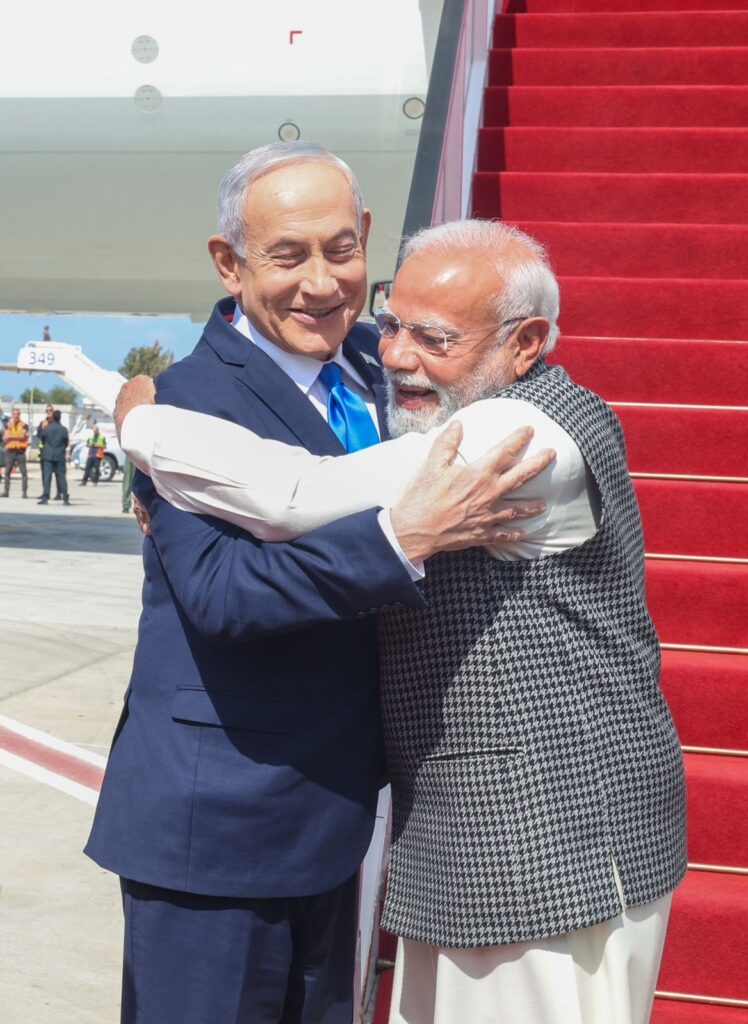
Image: from MK Senthil #ViksitBharatAmbassador X @MkSenthilSalem1
By Open Chronicle Staff with Agencies
Wednesday, February 25, 2026
JERUSALEM — Prime Minister Narendra Modi touched down at Ben Gurion Airport on Wednesday, beginning a landmark two-day state visit to Israel that signals a profound shift in the geopolitical architecture of the Middle East and South Asia.
The visit, Modi’s second since his 2017 groundbreaking trip, was met with an extraordinary ceremonial welcome. Israeli Prime Minister Benjamin Netanyahu and his wife, Sara, personally greeted the Indian leader on the tarmac with a warm embrace, a gesture typically reserved for the closest of strategic allies.
🇮🇱🇮🇳Indian Prime Minister Narendra Modi has arrived in Israel for a two-day visit, his first since the war in Gaza began.
Modi is expected to address Israel's parliament, the Knesset, and hold meetings with Prime Minister Benjamin Netanyahu and President Isaac Herzog. There is… pic.twitter.com/0wozE0J99i
— News.Az (@news_az) February 25, 2026
A New Regional Axis
The centerpiece of the visit is Netanyahu’s ambitious proposal for a “Hexagon of Alliances.” Speaking ahead of the visit, the Israeli premier described a new strategic axis involving six key pillars: India, Israel, Greece, Cyprus, and select Arab and African nations.
“We are creating an entire system,” Netanyahu stated during a cabinet meeting. “An axis of nations that see the reality, the challenges, and the goals in the same way, in contrast to the radical axes.”
#WATCH | Tel Aviv, Israel: PM Narendra Modi meets Israeli Prime Minister Benjamin Netanyahu in Tel Aviv
PM Modi is on a 2-day state visit to Israel
(Source: DD) pic.twitter.com/1UW2IRAfmy
— ANI (@ANI) February 25, 2026
The proposed “Hexagon” is seen by defense analysts as a counter-weight to both the radical Shiite influence in the region and emerging Sunni extremist threats, positioning India as a “global power” anchor in the eastern Mediterranean and Middle Eastern security framework.
Addressing the Knesset
In a historic first, Prime Minister Modi became the first Indian leader to address the Israeli Parliament, the Knesset. In honor of his arrival, the building was illuminated in the saffron, white, and green of the Indian tricolor.
During his address, Modi emphasized the “unshakable bond” between the world’s largest democracy and the Jewish state. While the atmosphere inside was celebratory, the visit was not without tension. Outside the chamber, some opposition lawmakers threatened a boycott to protest Netanyahu’s domestic policies, while back in New Delhi, opposition leaders urged Modi to address the ongoing humanitarian crisis in Gaza during his closed-door talks.
Defence, Tech, and ‘Sudarshan Chakra’
Beyond the high-level diplomacy, the visit has a heavy focus on “hard” security and cutting-edge technology:
-
Missile Defense: Reports suggest India is exploring the integration of Israeli “Iron Dome” components into its own indigenous Sudarshan Chakra air defense shield.
-
The Tech Frontier: New memoranda of understanding (MoUs) are expected in Artificial Intelligence (AI), quantum computing, and semiconductor manufacturing.
-
Agriculture and Water: High-tech irrigation and desalination projects remain a cornerstone of the bilateral “Strategic Partnership.”
A Perilous Moment
The visit comes at what international observers call a “perilous moment.” With U.S.-Iran negotiations set for Geneva this Thursday and ongoing regional volatility, the deepening of the Indo-Israeli “personal friendship” between Modi and Netanyahu sends a clear message of stability to global markets and rival regional powers.
Prime Minister Modi is scheduled to visit Yad Vashem, the World Holocaust Remembrance Center, on Thursday before concluding his trip with a massive community event for the Indian diaspora in Israel.
Explore International Relations
Discover more reporting and analysis on diplomacy, international security, global governance and the changing balance of power.
Return to International Relations →