
Image: from Royal Navy X @RoyalNavy
By Open Chronicle Defence with Agencies
OFF THE COAST OF WALES — In a stark demonstration of modern naval warfare, the Royal Navy destroyer HMS Duncan has successfully repelled a sustained 72-hour barrage of drones and missiles during a high-intensity combat exercise off the British coast.
The Portsmouth-based Type 45 destroyer was pushed to its limits at the Aberporth Range in Cardigan Bay as part of Exercise Sharpshooter. The drill was designed to simulate the “saturation” tactics increasingly seen in global hotspots, forcing the crew to defend critical national infrastructure against a relentless wave of aerial and surface threats.
Over three days, the warship’s sensors tracked and engaged swarms of drones—some traveling at speeds exceeding 200mph—alongside simulated cruise and ballistic missiles. The scenario mirrored the real-world conditions faced by HMS Diamond in the Red Sea last year, where British sailors engaged Houthi-launched projectiles to protect international shipping lanes.
Ready to fight. Ready to protect.#RoyalNavy destroyer @HMSDuncan battled an onslaught of drones, aircraft and missiles off the coast of Wales to ensure the ship is ready to defend against whatever modern naval threat is thrown against her.
Read more: https://t.co/h86dbcZtjy pic.twitter.com/5Lhy8t3dlk
— Royal Navy (@RoyalNavy) February 26, 2026
Commander Dan Lee, HMS Duncan’s Commanding Officer, praised the resilience of his crew under the artificial “fog of war.”
“Sharpshooter was an invaluable opportunity to test our systems and our people in a demanding environment,” Commander Lee said. “The ship’s company rose to every challenge, delivering successful layered-defence engagements while simultaneously dealing with realistic damage-control scenarios.”
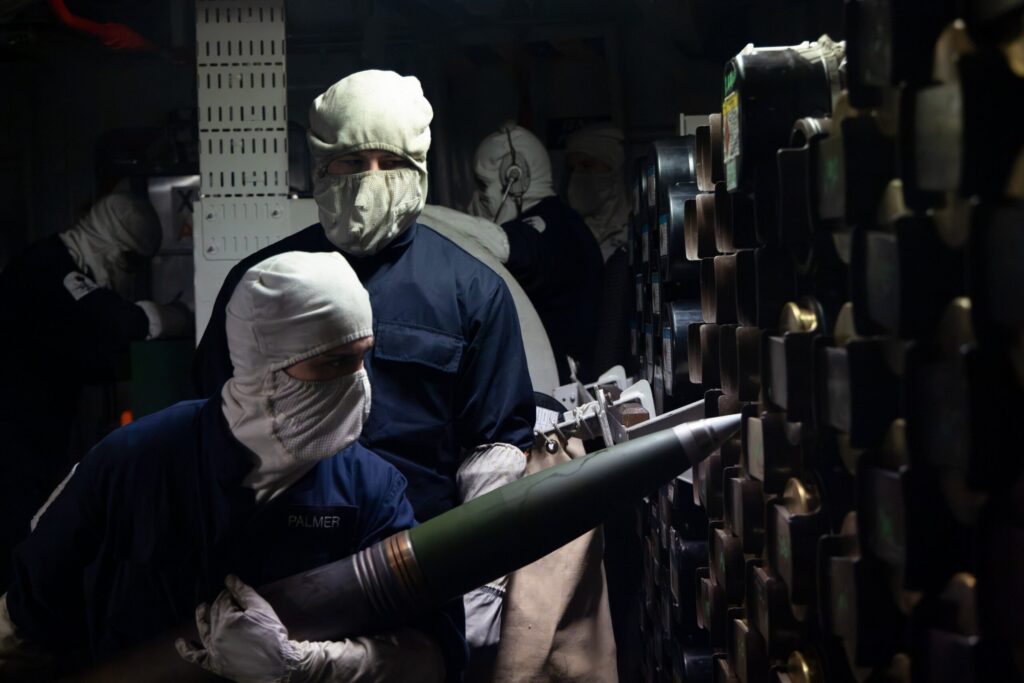
The defense of the vessel involved a sophisticated “layered” approach. The ship’s Wildcat helicopter, from 815 Naval Air Squadron, utilized Martlet air-to-surface missiles, while the destroyer itself deployed its 4.5-inch main gun, 30mm cannons, and the Phalanx automated “Gatling gun” system. Additionally, the crew conducted virtual launches of the Sea Viper air defense system, the ship’s primary shield against high-altitude threats.
The exercise was not merely a test of weaponry but of endurance. Crew members operated on “Defence Watches,” a grueling high-readiness rotation, while engineers worked around the clock to repair simulated battle damage and equipment faults in real-time.
Petty Officer James Ings, who oversees the 4.5-inch gun, noted the intensity of the live-fire drills. “We put more than 200 rounds down it,” he said. “The 30mm gun threw up a few faults, but that’s engineering, you figure it out, and you get it working again. It was good to see it doing what it’s meant to do.”
The exercise was supported by defense giants QinetiQ and Inzpire, utilizing “Hammerhead” uncrewed surface vessels and “Banshee Whirlwind” aerial targets to provide the most realistic threat profile possible.
As global maritime threats evolve, the Royal Navy maintains that such rigorous testing is essential. For the crew of HMS Duncan, the message from the Welsh coast was clear: they are ready for the frontline.