
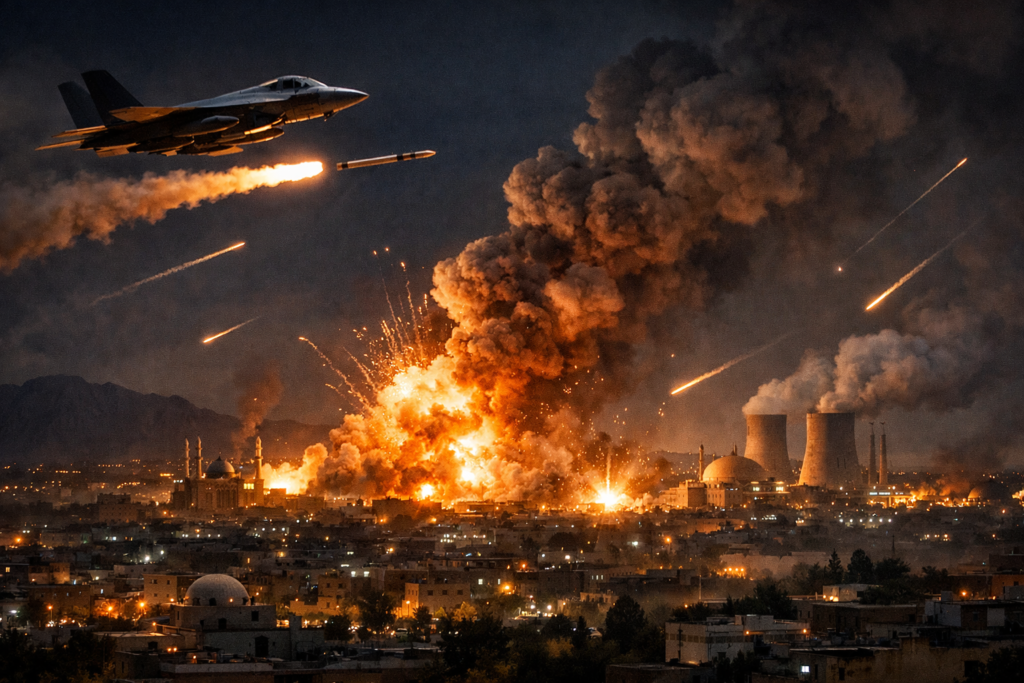
Image Credentials: Image Title: IRAN IN TURMOIL: REPORTS CLASH OVER FATE OF SUPREME LEADER AFTER JOINT US-ISRAELI STRIKES Source: (sora.openai) Date: Feb 2026. Attribution: This image was created using AI-generated imagery (sora.openai) and does not depict a real-world scene.
By The Grand Strategy Institute
In a dramatic escalation of regional tensions, the United States launched preemptive military strikes against Iranian targets on February 28. Senior administration officials stated the move was a necessary intervention to thwart an imminent missile attack and address Tehran’s refusal to accept a permanent freeze on its nuclear ambitions.
During a background briefing with reporters, officials under the Trump administration argued that a “dual threat”, comprising a massive ballistic missile mobilization and a collapsing diplomatic track, left the President with “no choice” but to authorize kinetic action.
According to the administration, U.S. intelligence recently detected preparations indicating that Iran was readying its missile arsenal, particularly in its southern belt, for use against U.S. forces and regional allies.
One senior official claimed that acting preemptively was the only way to mitigate a high-casualty scenario.
“The risk posed by Iran’s ballistic missile arsenal had become intolerable. Waiting for a first strike would have resulted in a catastrophic loss of life,” the official stated.
Since the U.S. strikes began, the White House reports that Iranian forces have retaliated by targeting civilian infrastructure, including hotels and airports in Kuwait and the United Arab Emirates, alongside U.S. military installations in the region.
The military action follows months of back-channel diplomacy aimed at securing what the administration called a “real deal.” U.S. negotiators had reportedly sought an agreement that would:
-
Permanently block nuclear weapon acquisition.
-
Dismantle Iran’s regional proxy networks.
-
Place strict limits on ballistic missile development.
In a bid to reach a compromise, Washington offered to support a civilian-only nuclear program, including the provision of free nuclear fuel on a long-term basis. Officials say Iran flatly rejected the offer, insisting on maintaining its own uranium-enrichment capabilities.
The administration’s justification for the strike also rested on technical intelligence regarding Iran’s nuclear breakout time. Officials highlighted several “red flags” that led to the collapse of talks:
-
Enrichment Levels: Iran has allegedly stockpiled uranium enriched to 20% and 60% purity, levels that can be quickly converted to weapons-grade material.
-
Advanced Hardware: Intelligence indicates Iran has successfully developed IR-6 centrifuges, significantly increasing its enrichment capacity.
-
The Seven-Page Proposal: Iranian negotiators reportedly presented a plan that envisioned enrichment levels far exceeding the limits of the 2015 JCPOA, but refused to leave a physical copy for U.S. review.
While acknowledging that a short-term “stop-gap” agreement might have been possible, officials argued such a deal would have failed to address the long-term threat. President Trump authorized the strikes after being briefed on findings from the International Atomic Energy Agency (IAEA) suggesting that research material was being diverted for non-civilian use.
The White House has not yet taken questions regarding the specific scale of the strikes or the projected duration of the campaign, stating that further public comments will be issued in the coming days.
The Grand Strategy Institute
Continue Exploring Strategic Analysis
Return to The Grand Strategy Institute for strategic assessments, long-form analysis and research examining geopolitics, military affairs, international security, emerging technologies and the changing international order.
← Back to The Grand Strategy Institute