
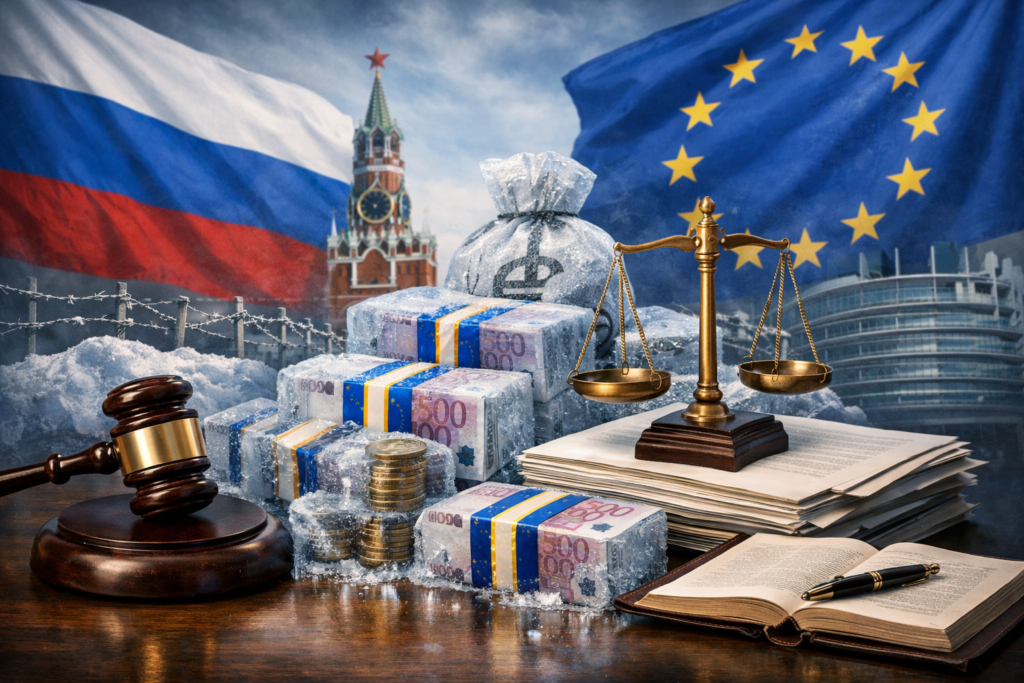
Image Credentials: Image Title: Russian Central Bank Sues EU Over €210 Billion Asset Freeze Source: (sora.openai) Date: March 2026. Attribution: This image was created using AI-generated imagery (sora.openai) and does not depict a real-world scene.
OPEN CHRONICLE | “The Truth in Every Detail”
By Open Chronicle Staff with Agencies
LUXEMBOURG — The Central Bank of Russia (CBR) has launched a high-stakes legal battle against the European Union, filing a lawsuit to challenge the “indefinite immobilisation” of approximately €210 billion in sovereign assets. The move, announced Tuesday morning, marks a major escalation in the economic warfare between Moscow and the West.
The lawsuit, submitted to the EU General Court on February 27, targets a regulation adopted by the Council of the European Union on December 12, 2025. This regulation transitioned the freeze from a temporary six-month renewal cycle to an open-ended block, effectively holding the funds hostage until Russia ceases its invasion of Ukraine and pays war reparations.
A Breach of Sovereign Immunity?
In a defiant statement, the CBR argued that the EU’s actions strike at the heart of global financial stability and the rule of law.
“The regulation violates the basic and inalienable rights to access justice, the inviolability of property, and the principle of sovereign immunity of States and their central banks,” the bank stated.
The Russian legal team further alleges “serious procedural violations,” claiming Brussels bypassed the requirement for unanimity, typically needed for foreign policy decisions, by using a qualified majority under Article 122 of the EU Treaties. This “emergency” provision was originally designed for natural disasters or severe energy supply crises, rather than geopolitical sanctions.
The Battle Over Euroclear
The vast majority of the frozen funds, roughly €185 billion, are held at Euroclear, a Brussels-based depository. Moscow has already initiated separate proceedings against Euroclear in Russian courts, seeking 18.2 trillion rubles (approx. $232 billion) in damages.
EU officials, however, remain steadfast. European Commission President Ursula von der Leyen previously stated that the measure sends a “powerful message” that Russia’s costs for the war will continue to rise. The EU argues that the invasion has caused “serious economic impact” within the bloc, justifying the use of emergency powers to prevent Russia from tapping into the funds to fuel its war machine.
Deadlock in Brussels
The legal challenge comes at a sensitive time for the EU. While member states have agreed on the asset freeze, they remain divided on how to use the interest generated by those funds. Countries like Hungary have mirrored Russia’s complaints about the lack of unanimity, while Belgium has expressed concern that aggressive seizure could undermine the euro’s status as a global reserve currency and trigger massive retaliatory lawsuits against its financial institutions.
With Moscow categorically ruling out the payment of reparations to Kyiv, the €210 billion remains in a legal and diplomatic limbo that could take years for the Luxembourg courts to resolve.