
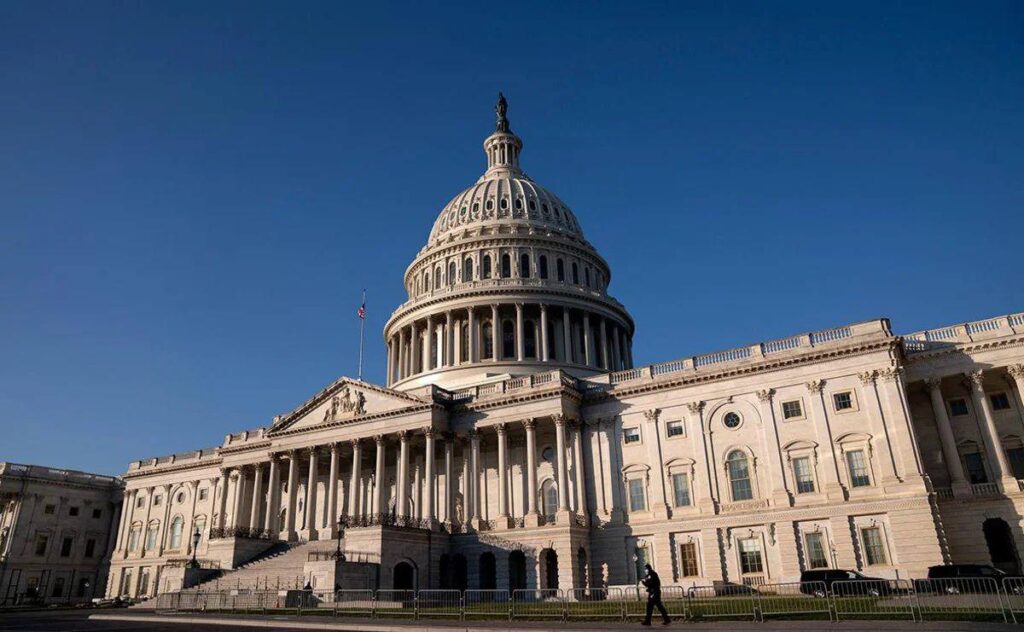
Image: from Sprinter Press X @SprinterPress
By Open Chronicle Staff with Agencies | Wednesday, March 4, 2026
WASHINGTON, D.C. — The United States Senate is set to hold a high-stakes procedural vote today on a bipartisan measure designed to strip President Donald Trump of his authority to conduct further military strikes against Iran without explicit congressional approval.
The resolution, spearheaded by Senator Tim Kaine (D-Va.) and supported by a small cohort of Republicans, including Senator Rand Paul (R-Ky.), invokes the 1973 War Powers Resolution. It marks the first formal attempt by lawmakers to reclaim constitutional war-making authority since “Operation Epic Fury” began five days ago, a conflict that has already claimed the life of Iran’s Supreme Leader and resulted in the first American casualties of the campaign.
🚨BREAKING: Speaker Mike Johnson just ABSOLUTELY DESTROYED the Democrats for handing Iran a massive win by pushing a War Powers vote to tie Trump’s hands mid-fight!
“The IDEA some members would play along with that plays RIGHT into the hands of the enemy! I believe we have the… pic.twitter.com/8HXN2e0pWt
— Gunther Eagleman™ (@GuntherEagleman) March 3, 2026
A Constitutional Crisis in Real-Time
The push for the vote comes as the White House continues to bypass traditional legislative hurdles. During his second term, President Trump has ordered military strikes in eight different countries without seeking a formal declaration of war from Congress, arguing his inherent power as Commander-in-Chief allows for unilateral action to protect national security.
“The Constitution says we are not supposed to be at war without a vote of Congress,” Senator Kaine told reporters. “This is a colossal mistake that risks pulling us into another endless conflict.”
Conversely, Republican leadership has largely closed ranks around the President. Senate Majority Leader John Thune (R-S.D.) and Senator Lindsey Graham (R-S.C.) have both signaled their opposition to the resolution. “We should let him finish the job,” Graham stated, referring to the ongoing joint U.S.-Israeli air campaign that has already struck over 1,000 targets across Iran.
The Numbers Game
Despite the urgency felt by some on Capitol Hill, the resolution faces steep odds. With Republicans controlling both chambers, the measure is expected to fail. Even if it were to pass, it would face a certain presidential veto. Overriding such a veto requires a two-thirds majority in both the House and Senate, a threshold Congress has never reached in the history of the War Powers Act.
In the House, Speaker Mike Johnson (R-La.) has been even more blunt, likening any attempt to curb the President’s military flexibility to “siding with the enemy.” A parallel vote in the House is scheduled for Thursday.
Shifting Objectives
The debate in Washington unfolds against a backdrop of shifting rhetoric from the White House. While President Trump initially urged Iranians to “take back your country”, implying a goal of regime change, he has more recently characterized the strikes as a preemptive necessity to destroy Iran’s nuclear and long-range missile capabilities.
On Tuesday, the President took to Truth Social to boast that U.S. munition stockpiles have “never been higher,” suggesting the military is prepared for a protracted engagement despite his previous campaign promises to end “forever wars.”
As the Senate prepares to cast its ballots, the world remains on edge. Whether this vote serves as a meaningful check on executive power or merely a symbolic gesture, it underscores a deepening divide in the American government as the fires of war spread across the Middle East.