
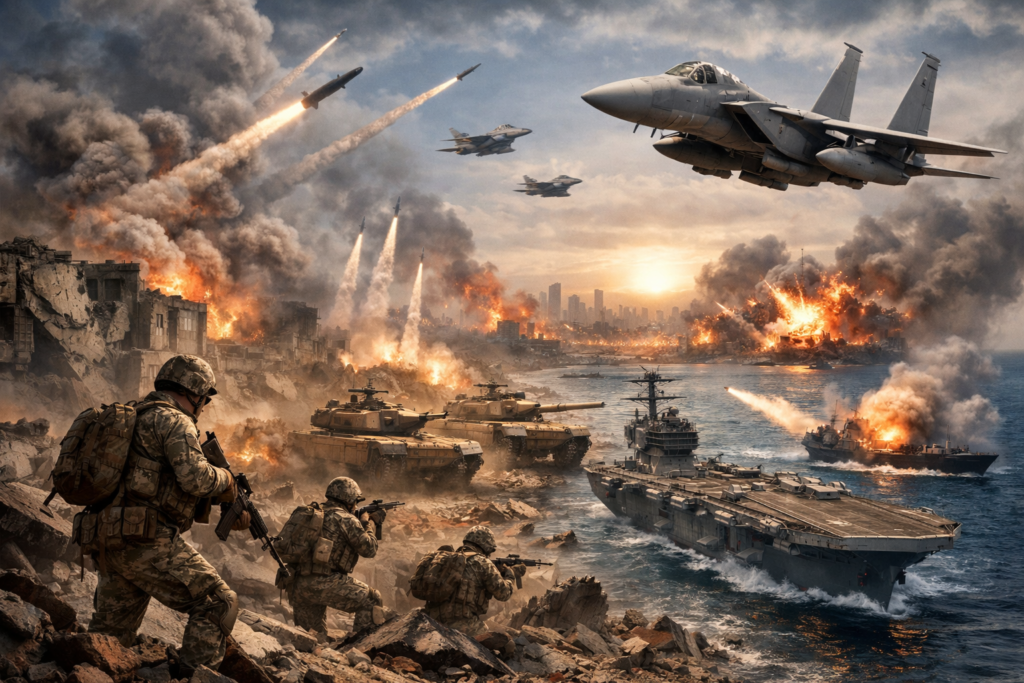
Image Credentials: Image Title: Middle East Escalation Risks Global Conflict Source: (sora.openai) Date: March 2026. Attribution: This image was created using AI-generated imagery (sora.openai) and does not depict a real-world scene.
By José Carlos Palma * | The Grand Strategy Institute
The spiraling violence in the Middle East could trigger a broader international confrontation, cautioning that miscalculation among major powers may carry consequences far beyond the region.
The remarks come as US President Donald Trump intensifies military operations against Iran in coordination with Israel, prompting retaliatory strikes across the Gulf and raising fears of a wider geopolitical rupture.
The risk of escalation lies not only in direct hostilities between Israel and Iran but in the involvement of global powers with competing interests in the region.
The protracted campaign could draw in actors such as Russia and China, either diplomatically or through indirect support, transforming a regional conflict into a confrontation with global implications.
NATO, formally the North Atlantic Treaty Organization, has not signaled collective military involvement in the current crisis. However, several member states are closely monitoring developments, particularly as missile and drone exchanges threaten Gulf energy infrastructure and international shipping lanes.
President Trump has framed the US operation as necessary to dismantle Iran’s missile capabilities and prevent long-term security threats. He has indicated that the campaign could extend beyond initial projections if objectives are not achieved.
Washington insists the strikes are not aimed at regime change, yet the scale of operations and reported targeting of strategic sites have fueled speculation about broader ambitions.
Iran’s leadership, including the powerful Islamic Revolutionary Guard Corps, has vowed continued retaliation. Tehran has also warned of consequences for countries facilitating US or Israeli operations.
The United Kingdom faces a complex balancing act. Prime Minister Keir Starmer has so far resisted direct participation in bombing raids, emphasizing de-escalation and diplomatic channels.
Yet Britain’s longstanding alliance with the United States, as well as its NATO commitments, places London in a sensitive strategic position. Any direct attack on UK assets or personnel in the region could alter that calculus.
The greatest danger lies in incremental escalation, where limited strikes gradually expand in scope, eventually crossing thresholds that compel alliance obligations.
The Strait of Hormuz remains a focal point of concern. Any disruption to the narrow waterway, through which a significant share of global oil exports flows, would have immediate economic consequences and heighten military tensions.
Energy markets have already shown volatility amid threats to infrastructure and shipping routes. Analysts warn that sustained instability could exacerbate inflationary pressures worldwide.
Beyond the economic impact, the danger of misreading intent. In a crowded battlespace involving US, Israeli, Iranian, and Gulf forces, along with proxy groups, a single misinterpreted action could trigger disproportionate retaliation.
The crisis also unfolds against a backdrop of intensified great power competition. Russia maintains close ties with Iran, while China has expanded its economic and diplomatic footprint in the Middle East.
Although neither Moscow nor Beijing has indicated direct military involvement, both have criticized Western actions and called for restraint. Their responses could shape the trajectory of diplomatic efforts at the UN and beyond.
Diplomats continue to press for renewed negotiations, particularly on Iran’s nuclear program and regional security architecture. However, as military operations expand and rhetoric hardens, the window for compromise appears to be narrowing.
Avoiding a broader war will depend on disciplined political leadership and clear communication between adversaries. In an environment defined by rapid escalation and fragile trust, even limited missteps could carry outsized consequences.
As tensions mount, the world watches closely, aware that what began as a regional confrontation now carries the potential to reshape global security dynamics.
The Grand Strategy Institute
Continue Exploring Strategic Analysis
Return to The Grand Strategy Institute for strategic assessments, long-form analysis and research examining geopolitics, military affairs, international security, emerging technologies and the changing international order.
← Back to The Grand Strategy Institute