
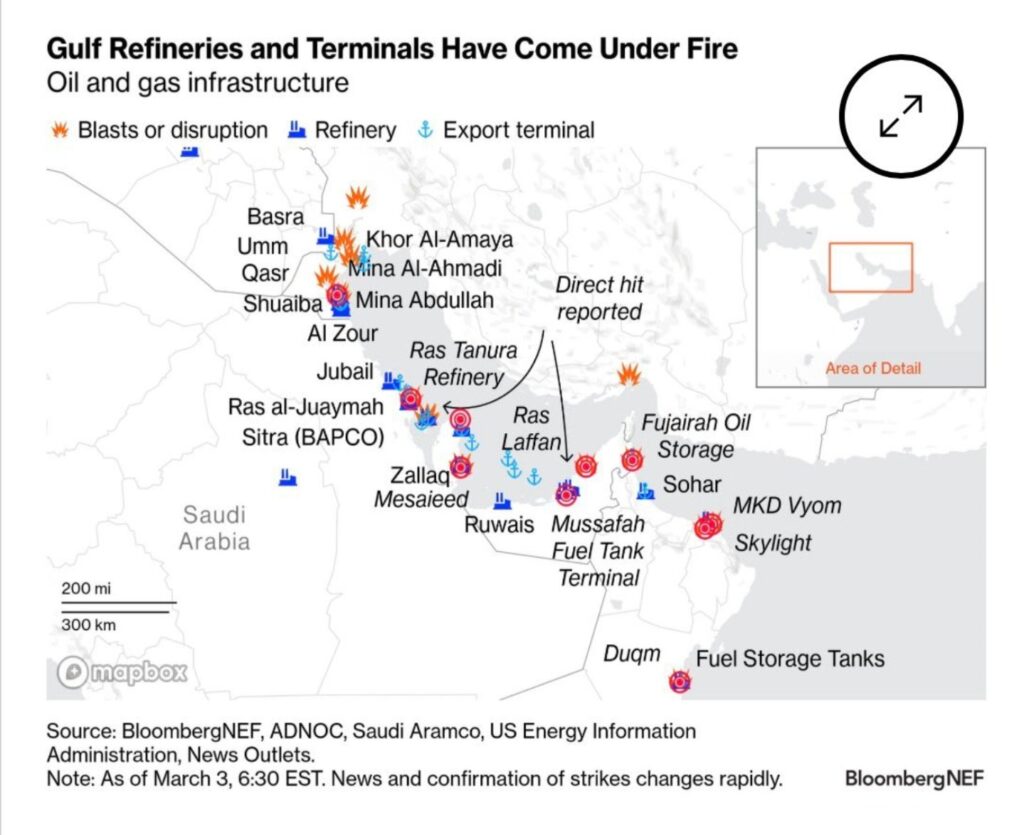
Image: from Richard X @ricwe123
By Open Chronicle Staff | Wednesday, March 4, 2026
DUBAI/LONDON — The world’s primary energy artery has effectively been severed. Following the Iranian Revolutionary Guard Corps’ (IRGC) official declaration to close the Strait of Hormuz, real-time maritime data reveals a staggering 90% collapse in oil tanker traffic compared to just one week ago.
Data provided by Marine Traffic, a leading ship-tracking service, confirms that the narrow waterway, which typically handles over 20% of the world’s daily oil consumption, has become a maritime “no-go zone.” In a statement released on X, the service noted that vessel activity has almost entirely evaporated as the conflict between the U.S., Israel, and Iran escalates into a total blockade.
Tanker traffic through Strait of Hormuz down by 90%
Analysis of vessel activity indicates tanker transits are now around 90% lower than last week. Matt Wright, Principal Freight Analyst at Kpler, explains: "Unlike several other vessel segments where movements have largely… pic.twitter.com/JIhFoAkQKO
— MarineTraffic (@MarineTraffic) March 4, 2026
“Dark” Transits and Silent Seas
Despite the official closure and the looming threat of military strikes, a handful of vessels are still attempting to run the gauntlet. Matt Wright, principal freight analyst at Kpler, noted a distinct pattern of “dark” transits.
“Unlike other ship segments where movement has ceased entirely, some tankers are still pushing East and West through the Strait,” Wright explained. “These voyages are occurring under AIS (Automatic Identification System) blackouts, with crews disabling their tracking transponders to avoid detection by patrolling forces.”
This “ghost traffic” represents a desperate attempt to maintain global supply lines, though the volume is a mere fraction of the usual 20 million barrels of oil that transit the point daily.
The Economic Fallout
The paralysis of the Strait is sending shockwaves through global markets. With the IRGC enforcing the closure through anti-ship missile batteries and fast-attack craft, insurance premiums for the few remaining ships in the region have reached prohibitive levels.
The 90% drop in traffic signals an immediate threat to energy security in Europe and Asia, which rely heavily on crude exports from Saudi Arabia, Iraq, Kuwait, and the UAE. Analysts warn that if the blockade persists, the global economy could face a supply shock unseen since the 1970s.
Military Standoff
The U.S. Navy’s Fifth Fleet, currently engaged in “Operation Epic Fury,” has not yet attempted to forcibly reopen the Strait, focusing instead on neutralizing Iranian naval assets like the IRIS Dena in the Indian Ocean. However, as tankers vanish from the horizon and oil prices soar, the pressure for a confrontation within the Persian Gulf reaches a breaking point.