
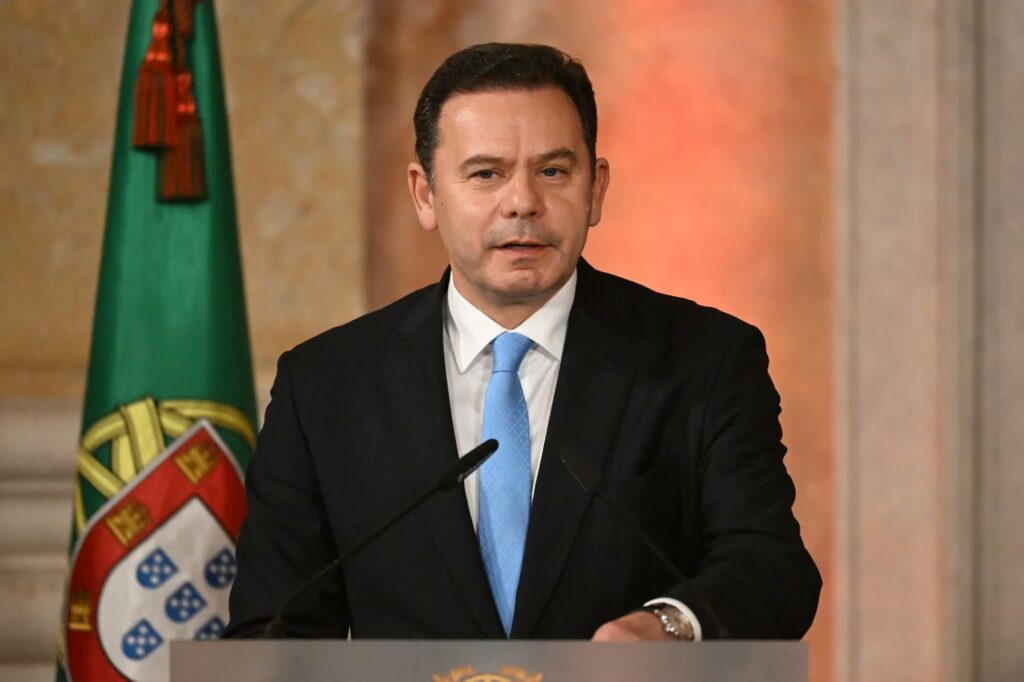
Image: from Clash Report X @clashreport

By Open Chronicle Staff with Agencies
LISBON – In a high-stakes political gamble aimed at silencing internal dissent, Prime Minister Luís Montenegro has challenged his predecessor, Pedro Passos Coelho, to a formal leadership contest.
Speaking during a tense PSD National Council meeting on Wednesday night, Montenegro proposed moving the party’s internal direct elections forward to May. The move is widely seen as an attempt to force a “put up or shut up” moment for Passos Coelho, whose increasingly frequent public criticisms have cast a shadow over the current government’s reformist agenda.
A “Direct Recast” Without Naming Names
Throughout a 30-minute speech, Montenegro avoided uttering Passos Coelho’s name but left no doubt as to his target. He addressed recent critiques—specifically those suggesting his government is merely a “second version” of the previous Socialist administration, with uncharacteristic bluntness.
“I like to be clear and direct: if there is an alternative and different path, let it be presented for the appreciation of the party and its members,” Montenegro declared. “It would be a giant mistake for us to doubt what we are doing, the depth of our ambition, and the scope of our reforms.”
The Prime Minister emphasized that he refuses to lead both the party and the country without the explicit “existential confidence” of his base, challenging those who “incentivize change” to step into the arena.
The “Picturesque Plot” Thickens
The friction between the two Social Democratic heavyweights intensified last week when Passos Coelho suggested that Montenegro should have secured a formal legislative agreement with the right-wing Chega and Liberal Initiative parties.
While Montenegro initially dismissed the commentary as a “picturesque plot” and insisted his role was to be an “executor, not a commentator,” his tone shifted on Wednesday. By proposing May elections, he aims to synchronize the party’s internal calendar with his original 2022 mandate, effectively daring challengers to disrupt the government’s momentum before the summer.
Passos Coelho: The Return of the Shadow?
Pedro Passos Coelho, who served as Prime Minister during the Troika years, has broken a decade of relative silence with a series of high-profile media appearances. In a recent interview with Eco, he refused to close the door on a political comeback.
“When I want to run, I will run, and I will announce it,” Passos Coelho stated, maintaining an ambiguous stance that has kept the PSD rank-and-file on edge.
Strengthening the Mandate
By calling for early elections, Montenegro is betting that the party will choose stability over a return to the past. He underscored that the PSD “cannot have doubts” about the path chosen at the ballot box, framed as an “honor and privilege” granted by the Portuguese people.
The ball is now firmly in Passos Coelho’s court. Whether the former leader will accept the challenge or continue to exert influence from the sidelines remains the defining question of Portuguese center-right politics heading into the spring.