
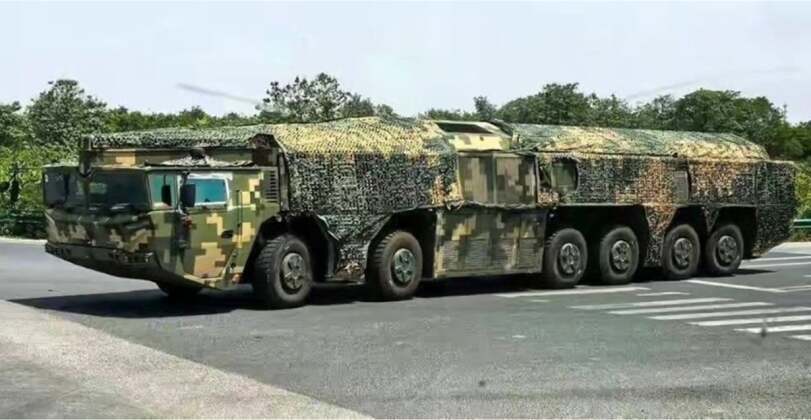
Image: from Global Surveillance X @Globalsurv
By Open Chronicle Staff | Monday, March 9, 2026
CANBERRA / EXMOUTH — For decades, Australia’s distance from the world’s flashpoints was its greatest strategic asset. That “tyranny of distance” has officially evaporated. According to recent defense assessments and the Pentagon’s late-2025 China Military Power Report, the People’s Liberation Army (PLA) has operationalized the DF-27, a conventional intercontinental ballistic missile (ICBM) capable of striking any point on the Australian mainland with pinpoint accuracy.
The development fundamentally alters the calculus of regional deterrence. Unlike the nuclear-tipped missiles of the Cold War, the DF-27 allows Beijing to strike vital joint facilities without crossing the “nuclear threshold,” potentially paralyzing U.S. and Australian warfighting capabilities while avoiding a total atomic exchange.
❗️🇨🇳❌🇺🇸 China has reportedly conducted a successful test of its DF-27 hypersonic missile, with recorded performance reaching around Mach 10, corresponding to an actual speed of approximately 12,300 km/h
See the latest updates with us: @NSTRIKE1231 pic.twitter.com/qKRdKeICSV
— NSTRIKE (@NSTRIKE1231) December 24, 2025
Targets of “High Value, Low Sanctuary”
Strategic analysts point to three primary installations now at extreme risk:
-
Pine Gap (NT): The top-secret “jewel in the crown” of U.S.-Australian intelligence. It provides critical satellite downlinks for missile warnings and battlefield surveillance.
-
Harold E. Holt Station (WA): A vital node for communicating with submerged nuclear submarines in the Indian and Pacific Oceans.
-
Fleet Base West (WA): Future home to AUKUS nuclear-powered submarines (SSNs). Analysts warn that an attack on these vessels at the pier near Perth would not only be a military disaster but a radiological environmental catastrophe for a city of 2 million people.
The Conventional ICBM: A Tactical Paradox
The DF-27 represents a “game-changer” because it utilizes Hypersonic Glide Vehicle (HGV) technology.
-
Speed & Maneuverability: Traveling at roughly Mach 22, the missile is too fast for traditional Patriot systems and too maneuverable for many mid-course interceptors.
-
The “Grey Zone” of War: By using conventional (non-nuclear) warheads, Beijing can “punish” Canberra for supporting U.S. operations in the South China Sea or Taiwan Strait without necessarily triggering a global thermonuclear war.
Canberra’s Expensive Dilemma
The Australian Defence Force (ADF) faces a “staggering” bill to mitigate these risks. Current options are described by experts as “unsatisfactory and expensive”:
-
Missile Defense: Procuring the U.S. SM-3 Block IIA interceptors costs approximately A$40 million per unit, a price tag that could quickly drain the national defense budget given the volume of China’s missile inventory.
-
Geographic Redundancy: Moving the $8 billion AUKUS submarine infrastructure to more remote locations would cost multiples of the original investment and face massive logistical hurdles.
-
Operational Resilience: Training forces to fight “blind” and “disconnected”, assuming that sites like Pine Gap will be destroyed in the opening minutes of a conflict.
Silence from the Hotline
Compounding the threat is Beijing’s documented lack of interest in conflict-moderation tools. Reports from 2025 indicate that China has routinely ignored the military “hotline” with Washington during periods of tension, raising fears that a conventional strike on an Australian base could be misinterpreted, leading to the very nuclear escalation both sides claim to want to avoid.
As the regional arms race accelerates, Australia finds itself no longer a “back-area” supporter, but a frontline target in a high-tech, long-range theater of war.