
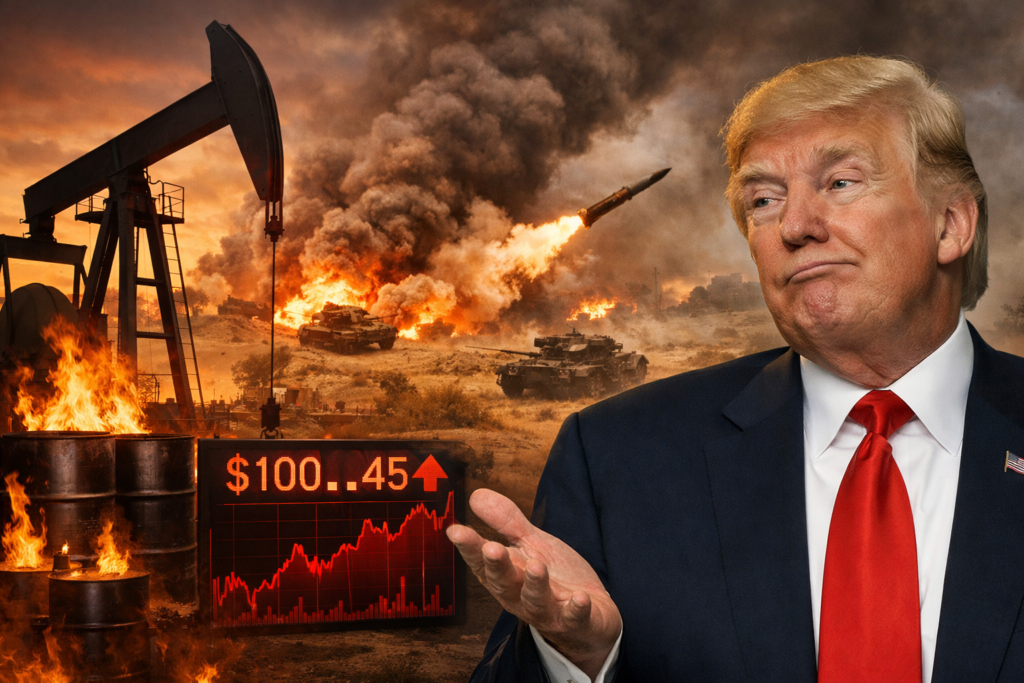
Image Credentials: Image Title: Global Oil Prices Surge Past $100 as Iran War Sparks Supply Fears; Trump Dismisses Economic Fallout Source: (sora.openai) Date: March 2026. Attribution: This image was created using AI-generated imagery (sora.openai) and does not depict a real-world scene.
By Open Chronicle Staff with Agencies | Monday, March 9, 2026
NEW YORK / LONDON — Global energy markets were thrown into turmoil Sunday evening as oil prices surged above $100 a barrel for the first time in four years. The spike, exceeding 15 percent at market open, comes as the war between the U.S.–Israeli coalition and Iran enters a critical phase, threatening the stability of the world’s most vital energy corridors.
The benchmarks for West Texas Intermediate (WTI) and Brent crude reached levels not seen since the early months of the 2022 Ukraine conflict. The rally was driven by the near-total halt of maritime traffic through the Strait of Hormuz, a strategic chokepoint responsible for 20 percent of global oil and gas shipments.
“A Small Price to Pay”
President Donald Trump responded to the market volatility with characteristic defiance, characterizing the price hike as a necessary but temporary consequence of the military campaign.
“Short-term oil prices, which will drop rapidly when the destruction of the Iran nuclear threat is over, are a very small price to pay for the U.S.A. and the world, Safety and Peace,” Trump wrote on social media. He added that “ONLY FOOLS WOULD THINK DIFFERENTLY!”
While the rise in crude has already begun to impact retail gasoline costs in the United States—a politically sensitive issue ahead of the November midterm elections, U.S. Energy Secretary Chris Wright echoed the President’s optimism. Wright stated that the world remains “very well supplied” and predicted that disruptions would last “weeks, not months.”
Protecting the Flow
To stabilize markets and ensure the safety of maritime transit, Washington is taking unprecedented steps:
-
Military Escorts: Secretary Wright indicated that the U.S. military may provide direct protection for tankers attempting to navigate the Strait of Hormuz.
-
War Reinsurance: The U.S. International Development Finance Corporation announced a $20 billion reinsurance mechanism to cover the risks associated with shipping in the conflict zone.
-
Sanction Easing: Treasury Secretary Scott Bessent suggested that the U.S. may temporarily ease sanctions on Russian oil to offset potential shortages, following a recent authorization for India to purchase Russian crude.
Infrastructure Under Fire
The supply concerns are compounded by active hostilities. Recent Israeli airstrikes on fuel depots in Tehran and an overnight strike on the Shahran oil refinery have raised fears of retaliatory strikes against energy infrastructure in neighboring Gulf states.
In Bahrain, the Sitra area was targeted by an Iranian drone on Monday, while Saudi Arabia reported intercepting drones headed for the Shaybah oil field. As the conflict widens, the “risk premium” on global energy looks set to remain high, testing the resolve of both Western consumers and regional producers.