
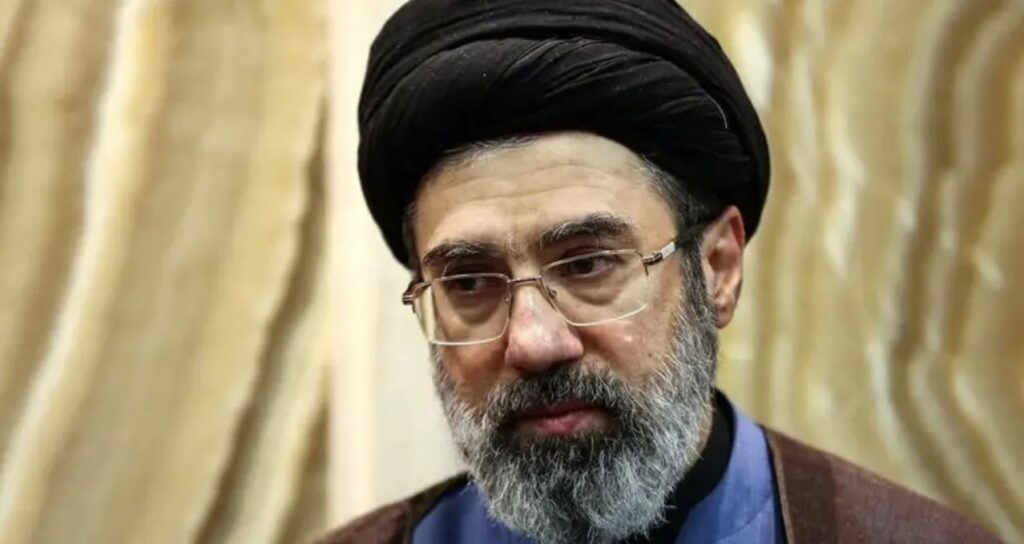
Image: from David Patrikarakos X @dpatrikarakos
By José Carlos Palma | The Grand Strategy Institute
War often produces strange political moments, but few are as revealing as the one now unfolding between Donald Trump and Iran’s newly appointed supreme leader Mojtaba Khamenei. As the conflict between the United States, Israel and Iran enters its second week, the question is no longer simply about battlefield victories. It is about political survival, legitimacy and the dangerous logic of escalation.
The phrase “Marked for Death” captures the brutal clarity of the moment. In modern warfare, particularly when leadership itself becomes a strategic target, the line between military operations and regime change dissolves. The death of Iran’s longtime leader Ali Khamenei in early strikes transformed the conflict overnight from a confrontation over security issues into a crisis over who will control the future of the Iranian state.
Iran’s decision to elevate Mojtaba Khamenei as the new supreme leader signals continuity rather than compromise. Analysts widely interpret the move as a deliberate rejection of external pressure and a consolidation of hardline control inside the Islamic Republic.
For Washington, that outcome appears unacceptable. Trump has openly stated that Iran’s next leader would need the approval of the United States and warned that anyone chosen without it “is not going to last long.”
Those comments are extraordinary in modern diplomacy. Leadership selection in Iran is traditionally the responsibility of the Assembly of Experts, a clerical body designed to keep the process internal to the Islamic Republic. The suggestion that a foreign power should approve the result effectively frames the conflict not merely as a war against Iran’s military capabilities but as a struggle over the country’s political structure itself.
This is where the logic of “Marked to Death” begins to emerge. Once leadership becomes the central battlefield objective, the war shifts from containment to elimination.
Iran’s response has been predictable. The country’s leadership insists that foreign governments have no role in determining its political future. At the same time, Tehran continues retaliatory strikes across the region, targeting Israeli positions and sites associated with American interests.
The result is a feedback loop. Each new escalation strengthens hardliners on both sides.
In Washington, the argument grows that only decisive pressure can prevent Iran from rebuilding its military and nuclear capabilities. In Tehran, the argument grows that compromise would only invite further intervention.
In this sense, Mojtaba Khamenei’s rise may represent less a strategic choice than a political inevitability. During wartime, states rarely choose moderation. They choose continuity and defiance.
There is also a deeper question behind Trump’s rhetoric. Can outside powers actually shape the internal leadership of a country like Iran?
History suggests the answer is rarely straightforward.
Foreign interventions aimed at engineering political outcomes often produce the opposite effect. They strengthen nationalist sentiment, legitimize hardline factions, and reduce the space for moderates. Even if a leadership change occurs, it rarely produces the stable political transformation its architects imagine.
In Iran’s case, the attempt to influence the succession may reinforce exactly the forces Washington seeks to weaken.
Another risk lies in the personalization of the conflict.
When wars become defined by individual leaders rather than strategic objectives, they become harder to end. Negotiations become politically toxic, compromises appear as weakness, and every escalation feels like a test of credibility.
The appointment of Mojtaba Khamenei has already raised fears that the conflict could become more ideological and less negotiable. His close ties to the country’s security establishment and reputation as a hardliner suggest a leadership style built on resistance rather than accommodation.
That dynamic is precisely what the phrase “marked to death” warns about. When leaders themselves become the targets, war becomes less about resolving disputes and more about removing opponents.
As the second week of fighting unfolds, the Middle East stands at a dangerous crossroads.
Oil prices are climbing, regional militias are mobilizing, and global powers are watching closely as the conflict spreads across multiple fronts.
Yet beneath the military developments lies a deeper strategic question.
If the objective is no longer simply deterrence or containment but the reshaping of Iran’s leadership, then the war has entered a far more unpredictable phase. Regime transformation is rarely quick, rarely controlled, and rarely limited to the intentions of those who begin it.
In that sense, “marked to death” is not merely a phrase about leadership targeting. It is a warning about the trajectory of the conflict itself.
Once a war reaches that stage, the endgame becomes far harder to define and far more dangerous to escape.
The Grand Strategy Institute
Continue Exploring Strategic Analysis
Return to The Grand Strategy Institute for strategic assessments, long-form analysis and research examining geopolitics, military affairs, international security, emerging technologies and the changing international order.
← Back to The Grand Strategy Institute