
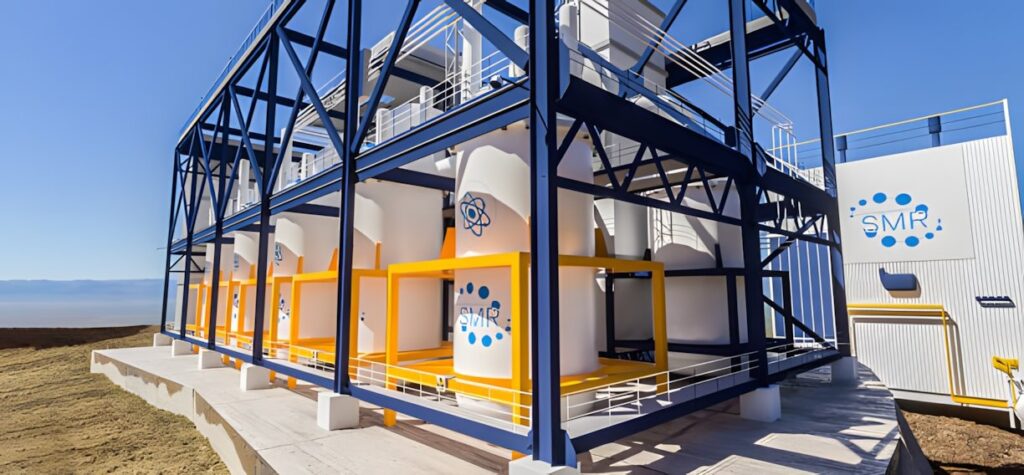
Image: from Varun Karthikeyan X @Varun55484761
By Open Chronicle Staff | March 11, 2026
BRUSSELS / PARIS — In a major strategic pivot aimed at securing the continent’s energy independence, European Commission President Ursula von der Leyen has announced a sweeping new framework to accelerate the deployment of Small Modular Reactors (SMRs). Speaking at the World Summit on Nuclear Energy in Paris, von der Leyen characterized the move as a correction of a “strategic mistake” that saw Europe turn its back on nuclear power decades ago.
The center-piece of the initiative is a €200 million ($232 million) financial guarantee designed to de-risk private investment in innovative nuclear technologies. Funded through revenues from the EU Emissions Trading System, the guarantee aims to catalyze the development of next-generation reactors that could be operational as early as the 2030s.
Today we are presenting a new European strategy for Small Modular Reactors.
Our goal is simple.
We want this new technology to be operational in Europe by the early 2030s.
And to back this we will create a €200M guarantee, to support private investment in innovative nuclear… pic.twitter.com/BnVNZd6RWO
— Ursula von der Leyen (@vonderleyen) March 10, 2026
BEYOND TRADITIONAL NUCLEAR
Small Modular Reactors represent a paradigm shift in nuclear engineering. Unlike the massive, bespoke power plants of the 20th century, SMRs are:
-
Compact and Modular: Components are manufactured in factories and transported to sites for assembly, significantly reducing construction times and capital costs.
-
Versatile: Their smaller footprint allows them to be deployed near industrial hubs to provide heat for district heating or to power energy-intensive data centers.
-
Resilient: von der Leyen emphasized that while renewables are essential, nuclear provides a “reliable, all-year, around-the-clock” source of low-emission power that stabilizes the grid.
ENERGY AS A SECURITY BULWARK
The timing of the announcement is pointed. As the Middle East remains engulfed in a volatile conflict that has threatened global oil supplies and closed the Strait of Hormuz, the EU is feeling the “structural disadvantage” of being a net importer of fossil fuels.
“The current Middle East crisis gives a stark reminder of the vulnerability created by our dependence,” von der Leyen noted. In 1990, nuclear power provided roughly one-third of Europe’s electricity; today, that share has plummeted to 15%. The new strategy seeks to reverse this trend, aiming for an estimated SMR capacity of up to 53 GW by 2050.
NAVIGATING THE OBSTACLES
Despite the high-level backing, the strategy faces significant hurdles. Environmental groups and some member states remain skeptical, citing the high costs of nuclear development and unresolved questions regarding radioactive waste management. To address these concerns, the EU plan calls for “unprecedented” cooperation among member states to align regulatory frameworks and speed up permitting procedures—processes that traditionally take a decade or more.
By positioning SMRs as a “high-value export sector,” the Commission is not just looking to light up European homes, but to reclaim a leadership position in a global nuclear market that is increasingly contested by players in the East.