
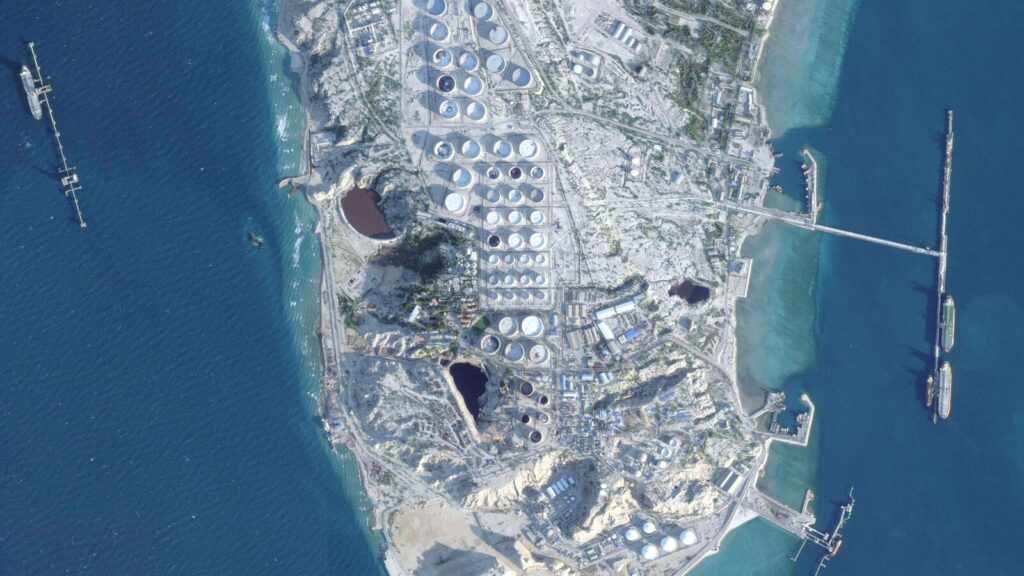
Image: from Mario Nawfal X @MarioNawfal
By Open Chronicle with Agencies
WASHINGTON/THE PERSIAN GULF — In a major escalation of Operation Epic Fury, U.S. President Donald Trump announced on Friday that American forces have executed one of the most devastating air campaigns in Middle Eastern history, targeting the Iranian strategic stronghold of Kharg Island.
The strikes, which the President described on Truth Social as having “destroyed all military targets” on the island, represent a direct warning to Tehran as the conflict enters its third week. Kharg Island serves as Iran’s primary oil export terminal, a facility the U.S. has notably spared, for now.
🚨 KHARG ISLAND STRUCK — IRAN’S OIL LIFELINE UNDER FIRE
President Donald Trump has confirmed that U.S. forces carried out a major bombing campaign on Iran’s Kharg Island, the tiny but critical hub through which around 90% of Iran’s oil exports flow.
The… pic.twitter.com/QAz6OwlaLp
— Jim Ferguson (@JimFergusonUK) March 14, 2026
A Measured Threat to Global Energy
“I chose not to destroy the island’s oil infrastructure,” Trump posted while preparing to depart for Florida. “However, if Iran, or any other country, does anything to prevent the safe and free passage of ships through the Strait of Hormuz, I will immediately reconsider my decision.”
Despite the President’s restraint regarding the oil rigs, the message is clear: the economic lifeline of the Islamic Republic is within the crosshairs of the U.S. Air Force. The Strait of Hormuz remains effectively closed, with Iranian forces utilizing mines and drones to halt a fifth of the world’s daily petroleum trade.
The Scale of the Campaign
At the Pentagon, Secretary of War Pete Hegseth provided staggering figures on the intensity of the air war. According to Hegseth:
-
Total Targets Hit: Over 15,000 enemy objectives since February 28.
-
Daily Tempo: An average of over 1,000 strikes per day.
-
Focus: Command centers, air defense batteries, and drone launch facilities.
Hegseth dismissed concerns over the persistent blockade of the Strait of Hormuz, telling reporters, “We are dealing with it, and you don’t have to worry about it.”
Troop Surge and Strategic Caution
The announcement of the Kharg strike coincided with the deployment of 2,500 additional Marines and an amphibious assault ship to the region, reinforcing the 31st Marine Expeditionary Unit already en route.
In an interview with Fox News, Trump adopted a characteristic tone regarding the conflict’s duration, stating the war would end “when I feel it in my bones.” He also expressed a more cautious outlook on a potential popular uprising within Iran, acknowledging the difficulty of an unarmed populace toppling a heavily armed regime. “I really think this is a big hurdle to be overcome by people who don’t have weapons,” the President remarked.
Regional Fallout
As U.S. and Israeli jets continue their bombardment, Iran has maintained a steady retaliation of missile and drone salvos against Israel and neighboring Gulf states. While military targets in Kharg lay in ruins, the global community remains braced for the potential destruction of the island’s oil facilities, a move that would likely send crude prices far beyond the current $120 per barrel mark.