
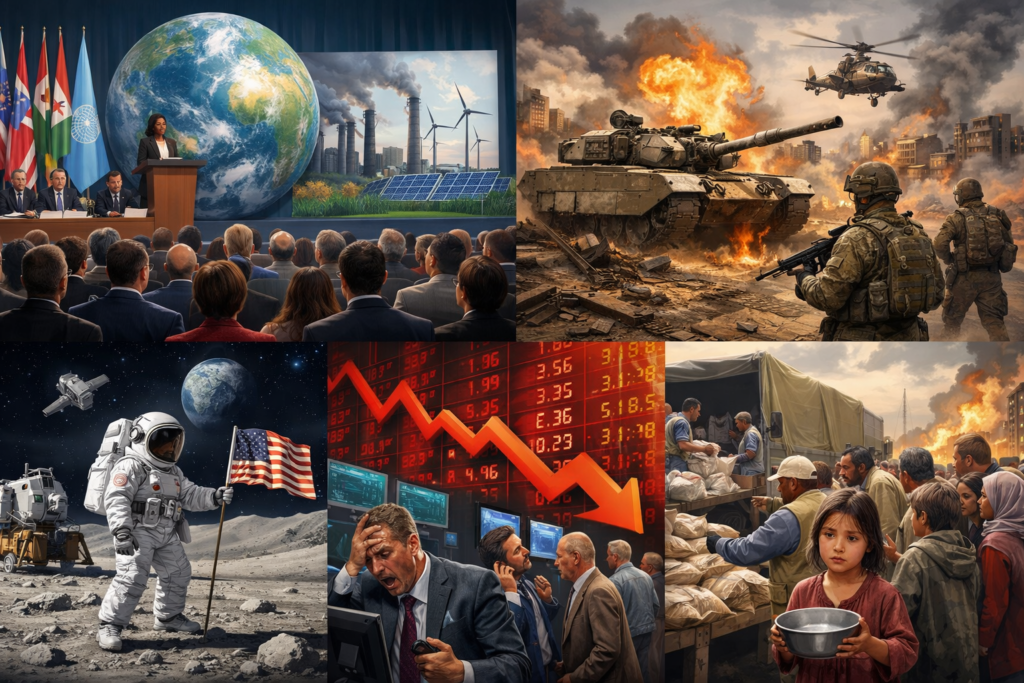
Image Credentials: Image Title: Global News Brief: Key Events and Developments for March 15, 2026 Source: (sora.openai) Date: March 2026. Attribution: This image was created using AI-generated imagery
By Open Chronicle with Agencies
Global tensions remain high as conflicts across the Middle East intensify and security concerns spread from East Asia to Europe. Missile launches, military threats and shifting alliances highlight a volatile geopolitical environment shaped by the ongoing confrontation involving Iran, Israel and the United States.
North Korea launches ballistic missiles toward East Sea
North Korea fired approximately ten ballistic missiles toward the East Sea, according to South Korea’s military. The launches were detected from the Sunan area at around 1:20 p.m. local time, Seoul’s Joint Chiefs of Staff said.
South Korea’s military stated that it remains on high alert while sharing intelligence with the United States and Japan. Officials warned that additional launches could occur as monitoring and surveillance operations continue.
The launches come amid heightened tensions in the region and follow reports that Pyongyang recently conducted a strike drill involving a 600 mm ultra precision multiple rocket launcher system, according to the state-run Korean Central News Agency.
Israel threatens to target medical facilities in Lebanon
The Israeli military has warned that medical facilities and ambulances in Lebanon could become targets if they are used for military purposes by Hezbollah.
The warning followed an Israeli strike on a health care center in southern Lebanon that killed 12 medical personnel, including doctors, paramedics and nurses. Israeli military spokesperson Avichay Adraee claimed that Hezbollah was making extensive military use of ambulances.
Lebanese authorities say the humanitarian toll continues to mount. The Lebanese Health Ministry reports that at least 26 paramedics have been killed and dozens more injured in Israeli strikes since early March, while the overall death toll from attacks across Lebanon has surpassed 825.
Iran highlights cooperation with Russia and China
Iran has emphasized its growing ties with Russia and China as the conflict with the United States and Israel intensifies. Iranian Foreign Minister Abbas Araghchi described Moscow and Beijing as strategic partners during an interview with MS Now TV.
Araghchi said cooperation between the three countries spans political, economic, and military sectors, and that the partnership remains active despite international pressure. His remarks came in response to questions about whether Russia and China might be assisting Iran with intelligence or military coordination during the conflict.
Escalating tensions across the Middle East
The broader regional situation remains unstable, with several incidents reported over the past 24 hours.
US President Donald Trump said Iran, which he described as “totally defeated,” is seeking a deal to end the war, but not one that he would accept.
Meanwhile, a group calling itself the Islamic Resistance claimed responsibility for eight attacks on US bases in Iraq in the past day. The United States Embassy in Baghdad also came under rocket fire, according to security sources cited by local media.
Bahrain’s defense forces said they had intercepted and destroyed 124 missiles and more than 200 drones launched by Iran since the beginning of hostilities.
Iran warned that ports and cities in the United Arab Emirates could become targets if they were used by US forces to launch attacks against Iranian territory.
Elsewhere, Israeli forces reportedly advanced into areas of southern Syria, while the Syrian Arab Army announced it had taken control of the Rumeilan base in northeastern Syria after the withdrawal of international coalition forces.
Diplomatic and international developments
Diplomatic efforts to contain the conflict are continuing. France has offered to host negotiations in Paris between Israel and Lebanon to ease tensions along their border.
According to reports, Russian President Vladimir Putin proposed transferring Iran’s enriched uranium to Russia during a phone call with President Trump as part of a possible agreement to end the war. The proposal was reportedly rejected by Washington.
Beyond the Middle East, protests took place in London condemning Israel’s closure of the Al-Aqsa Mosque to Muslim worshippers during Ramadan.
Meanwhile, Taiwan’s defense ministry reported increased Chinese military activity around the island, underscoring persistent tensions in the Indo Pacific.
Economic and global impacts
The conflict’s economic ripple effects are also becoming visible across multiple sectors.
Venezuela begins LPG shipments to Colombia
Venezuela has begun its first road shipment of liquefied petroleum gas to Colombia. Acting President Delcy Rodríguez announced that the delivery took place between the Colombian city of Cúcuta and Venezuela’s Táchira state following talks with Colombian Foreign Minister Rosa Yolanda Villavicencio.
The shipment represents a new phase of energy cooperation between the neighboring countries.
Iran says oil exports continue from Kharg Island
Iran says oil exports from Kharg Island, the country’s primary oil export hub in the Persian Gulf, remain uninterrupted despite recent US-Israeli strikes.
Bushehr provincial official Ehsan Jahanian said that export and import operations on the island continue normally and that energy companies operating there have not halted activity.
A world facing multiple flashpoints
From missile launches in East Asia to rising hostilities in the Middle East, the events of March 15 illustrate a rapidly evolving security landscape. With military actions, diplomatic initiatives and economic disruptions unfolding simultaneously, global leaders face increasing pressure to prevent regional crises from escalating into broader international conflict.