
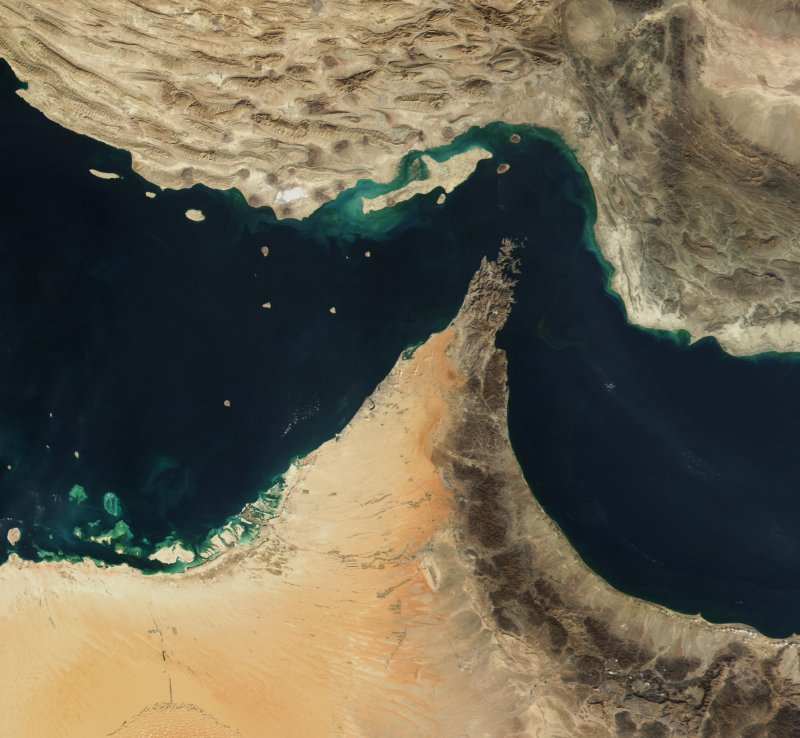
Image: from NOELREPORTS X @NOELreports
By José Carlos Palma *
The war with Iran is revealing a harsh geopolitical truth: even the most powerful militaries cannot easily control the strategic chokepoints that sustain the global economy.
The conflict began with a familiar assumption in Washington and Jerusalem. A rapid series of airstrikes against Iranian military infrastructure would weaken Tehran quickly, degrade its ability to retaliate, and force it into a position of strategic submission. Instead, the war has entered a more dangerous phase, one defined not by battlefield victories but by economic leverage.
At the center of that leverage lies the Strait of Hormuz.
Roughly one-fifth of the world’s oil normally flows through this narrow maritime corridor between Iran and Oman. Since the outbreak of the conflict, shipping traffic has been severely disrupted, and oil prices have surged beyond $100 per barrel as markets react to the threat of prolonged instability.
This moment illustrates a strategic paradox. The United States possesses the most powerful military in the world, yet even that dominance struggles against a geographically constrained but strategically positioned adversary. Iran does not need to defeat American forces in open battle. It simply needs to make the cost of normal commerce unbearable.
That is the essence of asymmetric strategy.
Iran’s leadership appears to understand this reality well. By threatening tankers, launching drone and missile attacks, and signaling its willingness to keep the waterway closed, Tehran has transformed the Strait of Hormuz into a geopolitical pressure point that extends far beyond the Middle East.
The consequences ripple globally. Energy markets tighten, supply chains wobble, and governments thousands of kilometers away are suddenly forced to consider naval deployments or emergency energy policies. The war ceases to be a regional conflict and becomes a global economic event.
This is where the limits of military power become most visible.
Airstrikes can destroy facilities, command centers, and missile sites. They cannot easily reopen a sea lane that insurers refuse to cover, shipping companies refuse to enter, and traders fear will become the next battlefield. Even if naval escorts are deployed, the risk of mines, drones, or missile attacks remains a constant threat.
History has shown that geography often defeats strategy.
The United States learned this lesson in the Persian Gulf during the tanker wars of the 1980s. It learned it again in Iraq and Afghanistan, where military superiority did not translate into political control. Now the lesson is returning in the form of a maritime chokepoint that cannot be easily neutralized from the air.
The danger is that policymakers may have underestimated how quickly the conflict would shift from military objectives to economic warfare. As long as the Strait of Hormuz remains unstable, the war’s most powerful weapon may not be missiles or bombers, but the disruption of energy flows that sustain the global economy.
In that sense, the crisis is not only about Iran or the United States. It is a reminder that in an interconnected world, geography can still shape power.
And sometimes, the narrowest waterways carry the greatest consequences.
The Grand Strategy Institute
Continue Exploring Strategic Analysis
Return to The Grand Strategy Institute for strategic assessments, long-form analysis and research examining geopolitics, military affairs, international security, emerging technologies and the changing international order.
← Back to The Grand Strategy Institute