
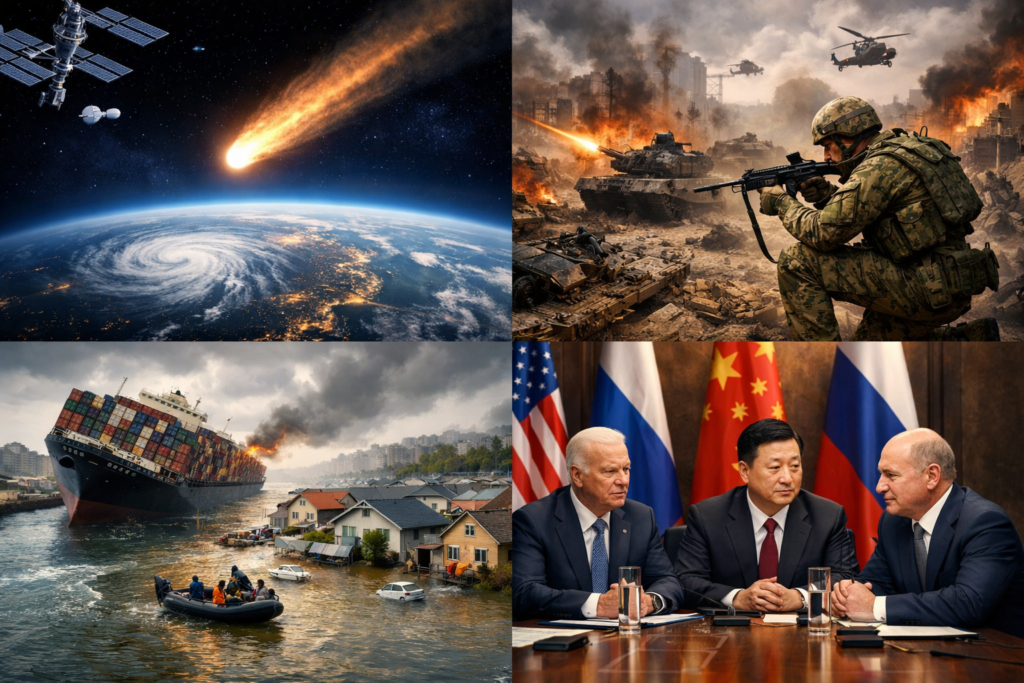
Image Credentials: Image Title: Global News Brief: Key Events and Developments for March 17, 2026 Source: (sora.openai) Date: March 2026. Attribution: This image was created using AI-generated imagery
By Open Chronicle with Agencies
As the war involving Iran, Israel, and the United States enters a critical phase, political messaging, humanitarian fallout, and economic shockwaves are intensifying across multiple regions. From shifting timelines in Washington to mass displacement in Lebanon and mounting global market disruption, the conflict is reshaping the international landscape.
Trump signals war will end “soon.”
US President Donald Trump said the war with Iran will not conclude within the week but insisted it will end “soon,” maintaining that the campaign remains on track.
Trump framed the military operation as a preventive measure, arguing that without US intervention, a nuclear escalation could have led to a broader global conflict. His remarks reflect evolving messaging from the administration, which has repeatedly adjusted expectations regarding the war’s duration.
The statement comes as Washington continues to balance military objectives with rising domestic and international pressure over the conflict’s economic and geopolitical consequences.
Mass displacement in Lebanon amid Israeli offensive
Israeli military operations in Lebanon have displaced more than one million people, according to Lebanese authorities, marking one of the largest humanitarian crises in the region in recent years.
Data from Lebanon’s Disaster Risk Management Unit indicates that over 1,049,000 individuals have fled their homes since early March. More than 130,000 are currently housed in shelters, while casualties continue to rise, with hundreds killed and thousands injured.
The escalation follows cross-border tensions involving Hezbollah and has expanded into a broader campaign that now includes ground operations, confirmed by Israeli Defense Minister Israel Katz.
The scale of displacement is placing severe strain on Lebanon’s already fragile infrastructure and raising concerns about long-term regional instability.
Iran denies direct contact with the US amid conflict
Iranian Foreign Minister Abbas Araghchi denied reports of recent communication with US officials, rejecting claims that he had exchanged messages with American envoy Steve Witkoff after the start of hostilities.
Araghchi stated that any such reports are misleading and aimed at influencing markets and public perception. His comments come amid speculation that backchannel diplomacy could be underway to de-escalate the conflict.
Tehran has continued to respond militarily, launching drone and missile strikes across the region, targeting locations in Israel, Jordan, Iraq, and Gulf states hosting US military assets.
Regional escalation and security concerns
The conflict continues to expand geographically, with multiple incidents reported across the Middle East.
The United Arab Emirates General Civil Aviation Authority announced a temporary closure of national airspace as a precautionary measure following heightened security risks. A drone strike also triggered a fire in the Fujairah Oil Industries Zone.
In Iraq, the United States Embassy in Baghdad was targeted by drones, while Iran-aligned groups claimed dozens of attacks on US bases across the region within 24 hours.
Air defense systems in Kuwait and Saudi Arabia intercepted multiple drones, underscoring the growing threat to critical infrastructure and civilian areas.
Meanwhile, Antonio Guterres condemned civilian casualties in the occupied West Bank, reflecting broader international concern over the humanitarian dimensions of the conflict.
European leaders have signaled caution. German Chancellor Friedrich Merz called for a swift end to the war and ruled out deploying naval forces to escort oil tankers in the Gulf.
Economic shockwaves intensify
The economic consequences of the war are becoming increasingly severe, particularly in energy and financial markets.
Dubai markets enter bear territory
The Dubai Financial Market General Index has fallen more than 20% from its February peak, officially entering bear market territory. The decline reflects investor anxiety over prolonged instability, with banking, real estate, and travel sectors among the hardest hit.
Record oil disruption triggers emergency response
The International Energy Agency has announced a record release of strategic oil reserves in response to what it describes as the largest supply disruption in modern history.
IEA Director Fatih Birol warned that the volume of disrupted supply has already surpassed the 1973 oil crisis, highlighting the unprecedented scale of the current shock.
With the Strait of Hormuz effectively blocked and energy flows severely constrained, global markets are facing sustained volatility and rising uncertainty.
A conflict reshaping the global order
The developments of March 17 underscore the widening scope of the crisis. What began as a military confrontation is now a multidimensional conflict affecting humanitarian conditions, global markets, and geopolitical alignments.
As diplomatic efforts remain uncertain and military operations continue, the trajectory of the war will likely define not only the future of the Middle East but also the stability of the global economic system.