
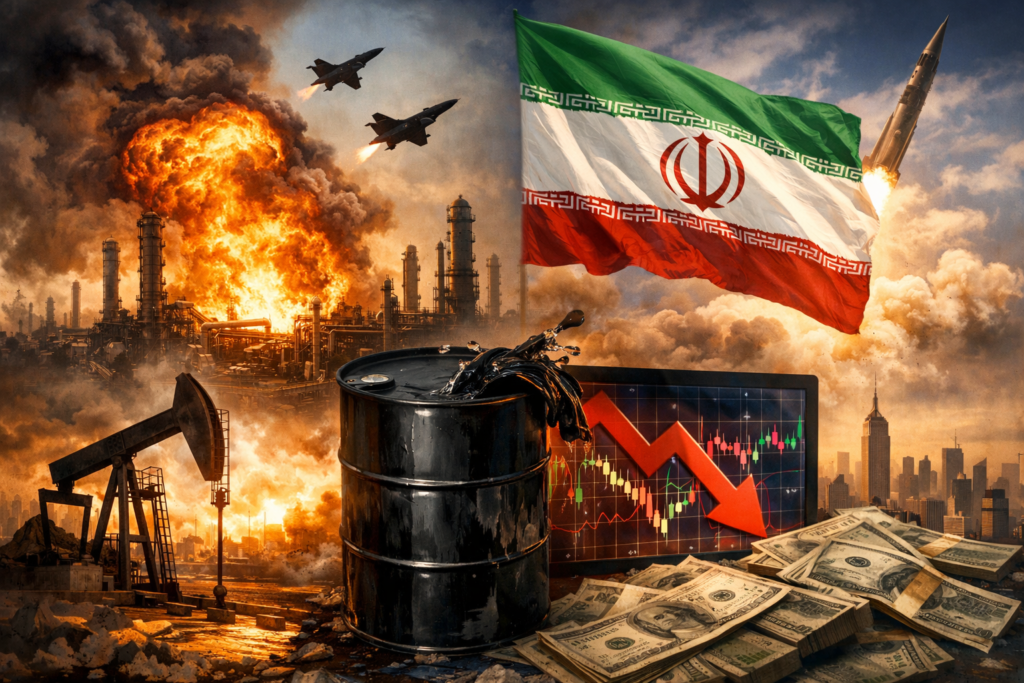
Image Credentials: Image Title: THE IRAN SHOCK: OIL BREACHES $100 AS U.S. ECONOMY FACES “WARTIME” VOLATILITY Source: (sora.openai) Date: March 2026. Attribution: This image was created using AI-generated imagery
GAS PRICES JUMP 20% IN THREE WEEKS; FED “BETWEEN A ROCK AND A HARD PLACE” ON RATES
By OPEN CHRONICLE STAFF with Agencies
NEW YORK — The “roaring” economic narrative of the early Trump administration is facing its severest test yet as the conflict in the Middle East sends global energy markets into a tailspin. On Tuesday, Brent crude held firmly above the $100-per-barrel mark following reports of fresh Iranian strikes on regional energy infrastructure, sparking fears of a prolonged inflationary spike that could derail the U.S. economic recovery.
The ripple effects are being felt immediately by American consumers. According to AAA, the national average for a gallon of regular gasoline has surged to $3.58, a nearly 20% increase since the outbreak of hostilities on February 28. Analysts warn that if the Strait of Hormuz remains effectively closed to tanker traffic, prices at the pump could exceed $4.00 by the April planting season.
A Complicated Balance Sheet
Despite the energy shock, the U.S. Bureau of Economic Analysis (BEA) released data this week showing a “fundamentally sound” domestic core. Real GDP grew at an annual rate of 4.4% in the third quarter of 2025, and February’s Consumer Price Index (CPI) remained steady at 2.4%, though economists note these figures reflect the “calm before the storm.”
“The U.S. is in a unique position compared to 2022,” said one senior market analyst. “We are now the world’s top producer of oil and gas. While higher prices hurt the commuter, they provide a massive boost to domestic production and non-residential investment. We are seeing a tug-of-war between a consumer tax at the pump and a boom in the American shale patch.”
The “Stagflation-Lite” Threat
The Federal Reserve, scheduled to meet on Wednesday, finds itself in a precarious position. While soft labor data, including the loss of 92,000 jobs last month, would typically argue for a rate cut, the energy-driven surge in inflation risk has many traders betting the Fed will hold steady at 3.75%.
“The path toward disinflation has become murkier,” analysts at Deutsche Bank warned in a Tuesday note. They suggest that the “front-loading” of imports to bypass 2025 tariffs, combined with the current oil shock, could push headline inflation toward 3.5% by early summer.
Fertilizer and the Farm Belt
The crisis is also hitting the American heartland. With the Strait of Hormuz blocked, roughly 20% of the U.S. fertilizer supply is currently at risk just as spring planting begins.
White House National Economic Council Director Kevin Hassett confirmed on Tuesday that the administration is moving to establish “insurance licenses” for Venezuela to increase production and is in high-level talks with Morocco for phosphate rock reserves. “We’ve been all over the fertilizer problem,” Hassett told reporters, insisting the war’s impact would be “short-term.”
Trump: “A Small Price to Pay”
In Washington, President Trump has remained defiant, dismissing concerns over the stock market’s recent 5% dip. In a social media post, the President characterized high oil prices as a “very small price to pay” for the elimination of the “Iranian nuclear threat.”
However, the administration is reportedly working behind the scenes to find a “gasoline release valve.” Rumors of the U.S. Treasury taking short positions in paper crude to moderate the spike have circulated through Wall Street, though no official confirmation has been provided.
As the 2026 midterms approach, the administration’s ability to stabilize the “energy-inflation-growth” triangle will likely define the political landscape for the remainder of the year. For now, the “30-trillion-dollar beast” that is the U.S. economy is holding its breath, waiting to see if the war in the Gulf is a matter of weeks or months.