
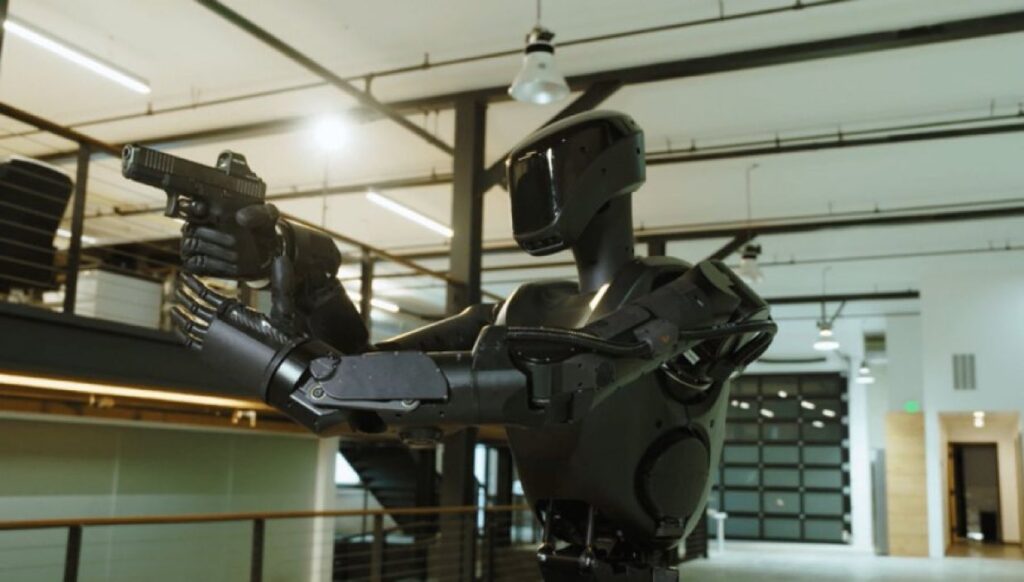
Image: from распад и неуважение X@VictorKvert2008
AUTONOMOUS COMBATANTS JOIN TRENCH WARFARE AS ARTIFICIAL INTELLIGENCE TRANSFORMS BATTLEFIELD TACTICS
By OPEN CHRONICLE STAFF
KYIV — In a development that signals a profound and unsettling shift in modern conflict, humanoid robots have been officially documented engaging in combat operations along the frontlines of the Ukrainian war. Emerging reports and video evidence suggest that these autonomous and semi-autonomous “metal soldiers” are no longer the stuff of science fiction, but a functional reality in the brutal war of attrition between Ukrainian and Russian forces.
The deployment of these bipedal machines marks a significant escalation from the use of aerial drones and remote-controlled tracked vehicles, introducing a new variable into the claustrophobic environments of trench warfare and urban combat.
Mechanical Infantry
The robots, reportedly being tested in high-risk zones, are designed to mimic human movement, allowing them to traverse uneven terrain, climb over debris, and enter buildings that would be too dangerous for human infantry. Sources indicate that these machines are equipped with advanced sensors, thermal imaging, and, in some instances, mounted weaponry.
“We are witnessing the birth of robotic infantry,” said a defense analyst monitoring the conflict. “These machines don’t feel fear, they don’t get tired, and they don’t bleed. They are being used to lead assaults on fortified positions where the casualty rate for human soldiers would be nearly 100 percent.”
The robots are reportedly being used for a variety of roles, including reconnaissance, mine clearing, and direct engagement. While many are still controlled via high-speed data links by remote operators—similar to drone pilots—there are growing concerns regarding the level of autonomy granted to their onboard AI systems.
A Technological Arms Race
The introduction of humanoid combatants has sparked a frantic technological arms race. While Ukraine has benefited from a surge in Western-funded AI startups and private defense contractors testing prototypes in “live” conditions, Russia is reportedly accelerating its own “Project Uran” and other robotic initiatives to counter the threat.
The battlefield has become a laboratory for global tech firms. Analysts suggest that the data gathered from these mechanical skirmishes will dictate the future of global defense procurement for decades to come.
“The feedback loop is instantaneous,” said a technical advisor to the Ukrainian Ministry of Defense. “A software patch can be sent to the front line faster than a shipment of ammunition. We are fighting with code as much as we are fighting with lead.”
Ethical and Legal Ambiguity
The presence of humanoid robots on the battlefield has reignited the international debate over “Lethal Autonomous Weapons Systems” (LAWS). Human rights organizations warn that the lack of clear international regulations regarding robots in combat creates a dangerous legal vacuum.
“Who is responsible when a robot commits a war crime?” questioned a representative for a global human rights watchdog. “If an algorithm misidentifies a civilian as a combatant, do we court-martial the programmer, the commander, or the machine itself? We are crossing a Rubicon without a map.”
Furthermore, the psychological impact on human soldiers facing a machine that cannot be reasoned with or intimidated is profound. Reports from the front describe a “haunting” atmosphere where the sounds of hydraulic servos and metal footsteps signal an approaching assault.
The Future of the Frontline
As the conflict persists, the density of robotic systems is expected to increase. Military strategists are already envisioning “mixed units” where human officers command squads of specialized robots, further distancing the human element from the direct lethality of the “zero line.”
While the number of humanoid robots currently deployed remains relatively small compared to conventional forces, their successful integration suggests that the era of the human-only battlefield is drawing to a close. As night falls over the trenches of eastern Ukraine, the red glow of robotic optical sensors is a grim reminder that the future of war has arrived, and it is made of steel.