
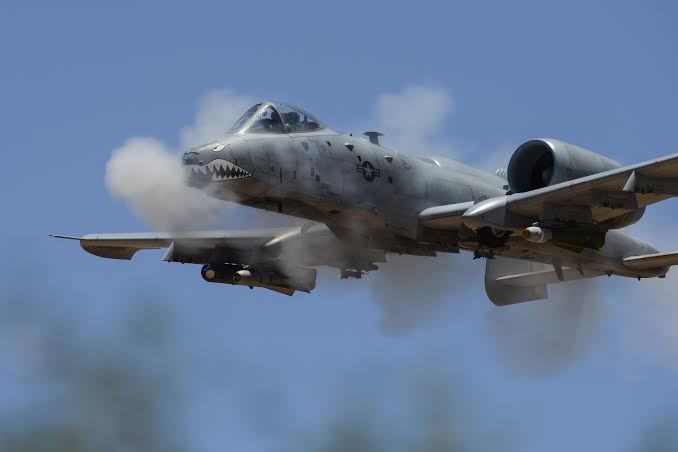
Image: from Red Intel X @RedIntelHQ
By The Open Chronicle Editorial Staff
WASHINGTON, D.C. — The venerable A-10 Thunderbolt II, an aircraft the U.S. Air Force has tried to retire for over a decade, has found a lethal new lease on life in the waters of the Persian Gulf. In a pivot from its traditional role as a “tank killer,” the jet affectionately known as the “Warthog” is now leading the charge to dismantle Iran’s mosquito fleet in the Strait of Hormuz.
During a Pentagon briefing on Thursday, General Dan Caine, Chairman of the Joint Chiefs of Staff, confirmed that A-10s are actively “hunting and killing” Iranian fast-attack watercraft (FACs) and mine-laying vessels. The announcement comes as part of the broader “Operation Epic Fury,” a joint U.S.-Israeli campaign aimed at neutralizing Iranian military capabilities.
General Dan "Razin" Caine reveals that A-10 WARTHOGs and Apache Gunships are being used to destroy Iranian Speed Boats and Drones.
"The A-10 Warhog is now in the fight across the southern flank, hunting and KILLING fast attack water craft in the Strait of Hormuz."
"In… pic.twitter.com/vhiVg3TZI4
— Major Anthony Jones (@majorbrainpain) March 19, 2026
A Maritime Predator
While the A-10 is famous for its “BRRRRRT”, the distinctive sound of its 30mm GAU-8/A Avenger cannon, its success in the Gulf is being driven by a high-tech makeover.
-
Precision in the Littorals: Pilots are utilizing the Advanced Precision Kill Weapon System II (APKWS II), which transforms standard Hydra 70 rockets into laser-guided munitions. This allows the A-10 to pick off small, agile boats with surgical precision and minimal collateral damage.
-
The Loiter Advantage: Unlike faster stealth fighters, the A-10 can stay over the battlefield for hours. Armed with 600-gallon external fuel tanks, these jets are providing persistent “overwatch” for commercial shipping and U.S. Navy assets like the Littoral Combat Ship USS Santa Barbara.
-
Drone Hunter: Beyond naval targets, A-10s, including one nicknamed “Ares,” have been credited with downing Iranian Shahed-style suicide drones using a combination of Sidewinder missiles and their iconic nose gun.
The Retirement Debate Reignited
The Warthog’s performance has created a political headache for Air Force leadership, which had hoped to divest the entire remaining fleet of 162 aircraft by fiscal year 2026.
“The A-10’s continued use goes against the narrative that it’s obsolete on the modern battlefield,” noted one defense analyst. Supporters in Congress are already using the successes in the Strait of Hormuz as a “wake-up call” to pause retirement plans. Current legislation now prohibits the Air Force from dropping below an inventory of 103 aircraft, effectively forcing the “Warthog” to stay in the fight.
Critics of the platform argue that the A-10 only excels because Iran’s air defenses have already been heavily degraded by F-35s and F-22s. However, for the sailors and merchant mariners navigating the world’s most dangerous chokepoint, the presence of the low-flying, heavily armored jet is a welcome sight.
As the conflict enters a critical phase, the A-10—an aircraft built for a Cold War that never happened, is proving to be the perfect tool for a 21st-century war it was never supposed to fly.