
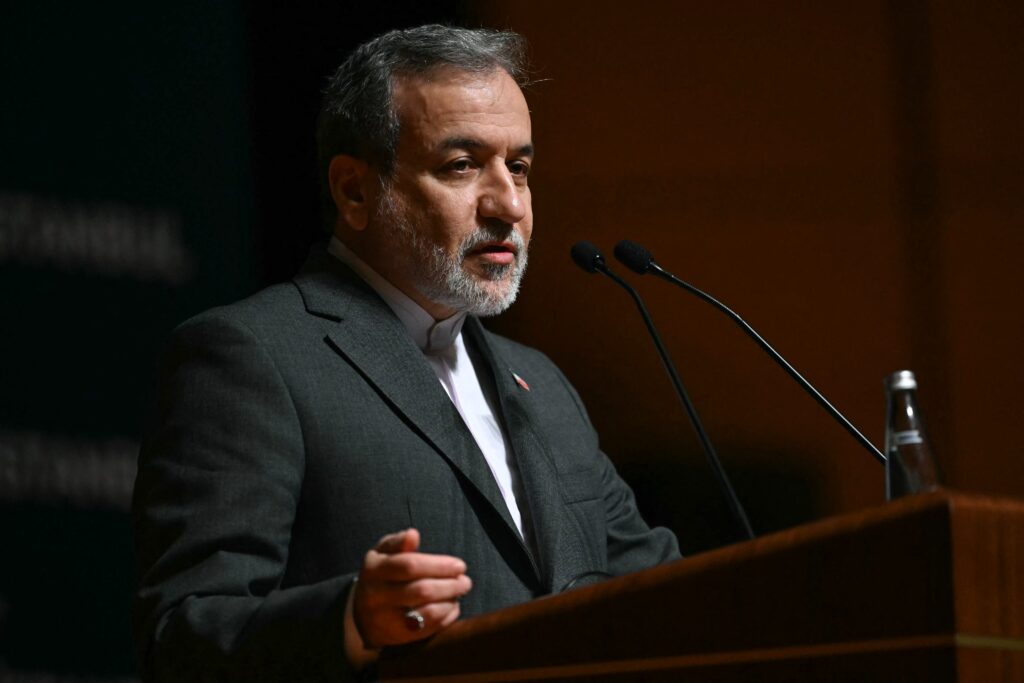
Image: from The New Region X @thenewregion
By Open Chronicle with Agencies |March 22, 2026
ISTANBUL — A war of words has erupted over the world’s most critical maritime chokepoint as Iranian officials insist the Strait of Hormuz remains “open,” even as commercial traffic grinds to a halt under the shadow of a U.S.-Israeli offensive.
On Sunday, Iranian Foreign Minister Abbas Araghchi took to social media to push back against claims of a total blockade, shifting the blame for the global energy crisis onto the West. “The Strait of Hormuz is not closed,” Araghchi stated. “Ships hesitate because insurers fear the war of choice you initiated—not Iran.”
The statement follows a week of mounting panic in international markets. Since the escalation of hostilities on February 28, the narrow waterway, which typically handles 20% of the world’s liquefied natural gas and 20 million barrels of oil per day, has become a ghost town for major tankers. While Tehran maintains that freedom of navigation is legally intact for “non-hostile” parties, the Iranian Foreign Ministry warned that any vessels belonging to “aggressor parties” will be intercepted and dealt with under the “legal framework arising from the conflict.”
A 48-Hour Ultimatum
The diplomatic maneuvering comes at a moment of extreme peril. On Saturday, U.S. President Donald Trump issued a blistering ultimatum, threatening to “obliterate” Iran’s power plants, starting with its largest facilities, if the passage is not fully reopened and secured within 48 hours.
The White House view remains clear: Iran has “effectively closed” the route through the deployment of mines and drone strikes, an act of economic warfare that has sent oil prices skyrocketing and insurance premiums into the stratosphere. “Freedom of Navigation cannot exist without Freedom of Trade,” Araghchi countered, suggesting that until U.S.-led strikes on Iranian soil cease, the safety of the strait cannot be guaranteed.
The “Insurance Blockade”
For the global shipping industry, the distinction between a “legal” closure and a “de facto” one is irrelevant. Major maritime insurers have reportedly pulled coverage for transits through the Gulf of Oman, citing the “unacceptable risk” of being caught in the crossfire of “Operation Epic Fury.”
“No insurer—and no Iranian, will be swayed by more threats,” Araghchi added, calling for “respect” over military posturing.
As the clock ticks on the U.S. ultimatum, the world watches the 21-mile-wide passage with bated breath. With NATO missions evacuating from Iraq and U.S. Navy assets reportedly preparing for escort missions, the line between a trade route and a front line has all but vanished.