
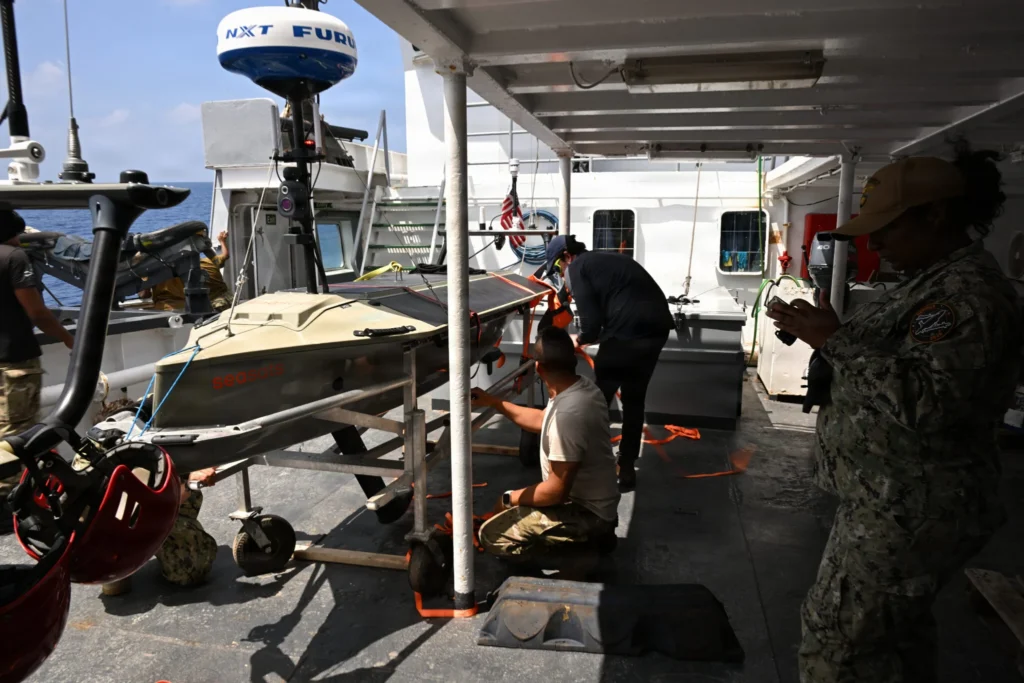
Image: OS2 Melissa Adams and Shane Condon, with Commander Task Force 66 and Seychelles Coast Guardsman Captain Julian Morel prepare the launch of the Lightfish, an unmanned surface vessel (USV), marking for the first time the system has been deployed from a partner surface vessel, as part of Cutlass Express 2026 (CE 26), Feb. 9, 2026. US Navy photo
By Harrison Vane | Open Chronicle Defense Correspondent
SAN DIEGO, CA — The U.S. Navy has taken a significant step toward its goal of a “hybrid fleet” with the operational deployment of the Lightfish, an ultra-endurance, solar-powered autonomous surface vessel (ASV). Developed by San Diego-based startup Seasats, the 305-pound drone is currently proving that the future of maritime surveillance isn’t just unmanned, it’s virtually inexhaustible.
Measuring just over 11 feet, the Lightfish may lack the imposing silhouette of a destroyer, but its ability to patrol the open ocean for up to six months without human intervention has made it a centerpiece of the Navy’s 2026 strategic objectives.
Breaking Records on the High Seas
The Lightfish is fresh off a series of historic milestones. In late 2025, the vessel completed the fastest known transatlantic crossing for an unmanned surface vehicle, traveling 4,000 miles from South Carolina to Portugal in just over two months. More recently, a trans-Pacific journey saw the drone cover 7,500 miles over 150 days, arriving in Japan after surviving a “shadowing” encounter with a Chinese Nanchang-class destroyer near Guam.
These aren’t just publicity stunts; they are rigorous stress tests. “Every nautical mile that Lightfish sails autonomously pushes us closer to a global unmanned fleet architecture,” says David Bate, an engineer with the Naval Information Warfare Center (NIWC) Atlantic.
The Science of Persistence
The secret to the Lightfish’s endurance lies in its hybrid power system. While its deck is covered in high-efficiency monocrystalline silicon solar panels, it also carries a supplemental methanol fuel cell. This combination allows the drone to maintain a “positive energy balance” even in cloudy conditions or during high-power sensor operations.
Despite its small size, the Lightfish is a modular powerhouse. It can carry up to 66 pounds of high-tech payload, including:
-
Intelligence & Surveillance: Five high-definition cameras and EO/IR (Electro-Optical/Infrared) sensors for real-time maritime domain awareness.
-
Electronic Warfare: Subsurface and surface-level SIGINT (Signals Intelligence) devices to detect and jam adversary communications.
-
Resilient Navigation: Onboard AI and physics models that allow it to navigate even in “GPS-denied” environments, making it immune to common electronic spoofing tactics.
Democratizing the Ocean
One of the most disruptive aspects of the Lightfish is its ease of use. Seasats claims that its browser-based control interface allows any sailor to master navigation within five days—no specialized “drone pilot” training required. Furthermore, the unit is small enough to be deployed by two people from a community boat ramp or the back of a pickup truck, and it can be shipped globally via standard military or commercial aircraft.
In February 2026, the U.S. Sixth Fleet successfully tested the Lightfish during Exercise Cutlass Express in the Indian Ocean, launching it from a Seychelles Coast Guard vessel. This “deploy to employ” approach allows the Navy to pre-position low-cost, high-intelligence assets in sensitive regions without the political or logistical footprint of a full carrier strike group.
A New Defensive Philosophy
As the Navy moves toward a target of having 50% of its surface fleet unmanned by 2045, the Lightfish represents the “eyes and ears” of this transition. By handling the tedious, months-long work of patrolling for illegal fishing, drug trafficking, and submarine signals, these “solar sentinels” free up multi-billion-dollar warships for high-intensity missions.
In an era of “grey-zone” warfare, where adversaries operate just below the threshold of open conflict, the Lightfish offers a persistent, low-risk way for the U.S. and its allies to ensure that no corner of the ocean remains unobserved.