
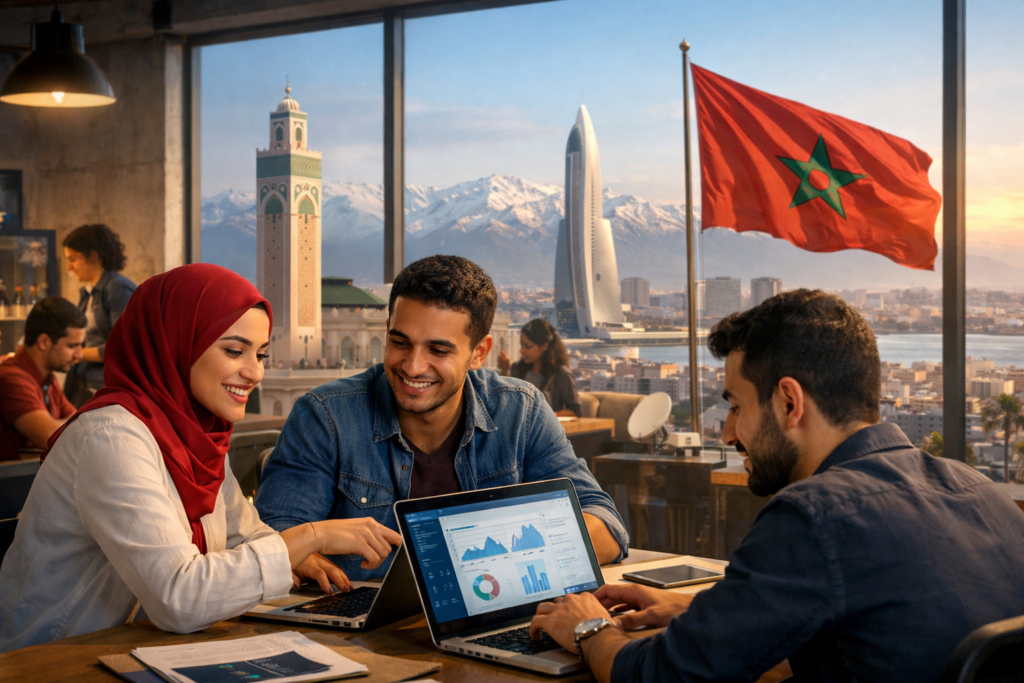
Image Credentials: Image Title: Morocco Climbs to Africa’s Top Three for Tech Entrepreneurship Source: (sora.openai) Date: March 2026. Attribution: This image was created using AI-generated imagery (sora.openai) and does not depict a real-world scene.
By Julian Thorne | Open Chronicle Technology Columnist
CASABLANCA — Morocco has officially cemented its status as a premier continental powerhouse for innovation, ranking among the top three countries in Africa for tech entrepreneurship according to the latest 2025 year-end industry reports. The North Kingdom now trails only South Africa and Egypt, leapfrogging traditional heavyweights like Nigeria and Kenya in several key metrics, including regulatory ease and infrastructure reliability.
The ranking, highlighted by Morocco World News, marks the culmination of a decade-long “Digital Morocco” strategy aimed at diversifying the economy away from agriculture and phosphate mining toward high-value knowledge services.
1. The “Technopark” Effect
A central pillar of Morocco’s success is its network of specialized business hubs. The expansion of the Technopark system, now operating in Casablanca, Rabat, Tangier, and Agadir, has provided a critical ecosystem for over 3,000 startups. These hubs offer more than just office space; they provide tax incentives, mentorship, and a direct pipeline to the “Digital Transition” government grants.
“We aren’t just building buildings; we are building a community,” said a spokesperson for the Moroccan Agency for Digital Development (ADD). “The goal is to ensure that a founder in Agadir has the same access to venture capital as one in Casablanca.”
2. A Gateway to Two Continents
Morocco’s unique geographical position has become its greatest competitive advantage. Positioned as a bridge between Europe and the rest of Africa, the Kingdom has attracted a surge of “nearshoring” investments from French and Spanish tech firms.
This dual-market access allows Moroccan startups to develop products that are culturally and linguistically tailored for the Francophone African market while meeting the stringent regulatory and quality standards of the European Union.
3. The Rise of “Deep Tech” and Fintech
While initial growth was driven by e-commerce and logistics, 2025 saw a pivot toward Deep Tech and Fintech.
-
Green Energy Tech: Leveraging the world’s largest concentrated solar power plant in Ouarzazate, a new generation of startups is developing AI-driven energy management software.
-
Financial Inclusion: With a significant portion of the population still underbanked, Moroccan fintechs are leading the charge in mobile payment solutions and micro-insurance, backed by a supportive “regulatory sandbox” from Bank Al-Maghrib.
4. Talent and the “Brain Gain.”
One of the most significant shifts noted in the report is the reversal of the “brain drain.” High-speed internet (now covering 95% of urban areas) and a competitive cost of living compared to Paris or Dubai have encouraged members of the Moroccan diaspora to return home to launch their ventures.
Furthermore, the “1337” and “YouCode” coding schools—which utilize peer-to-peer learning models, are churning out thousands of world-class developers annually, ensuring that the tech sector has the human capital to sustain its 20% year-over-year growth.
Challenges on the Horizon
Despite the “Top Three” ranking, hurdles remain. Access to late-stage (Series B and C) venture capital is still limited compared to global hubs, and the “legal framework for crowdfunding” is still in its infancy. However, with the 2030 World Cup on the horizon, the government is expected to further accelerate infrastructure spending.
As 2026 begins, the message from the streets of Casablanca is clear: the Maghreb is no longer just a destination for tourism; it is a destination for the future of the global digital economy.