
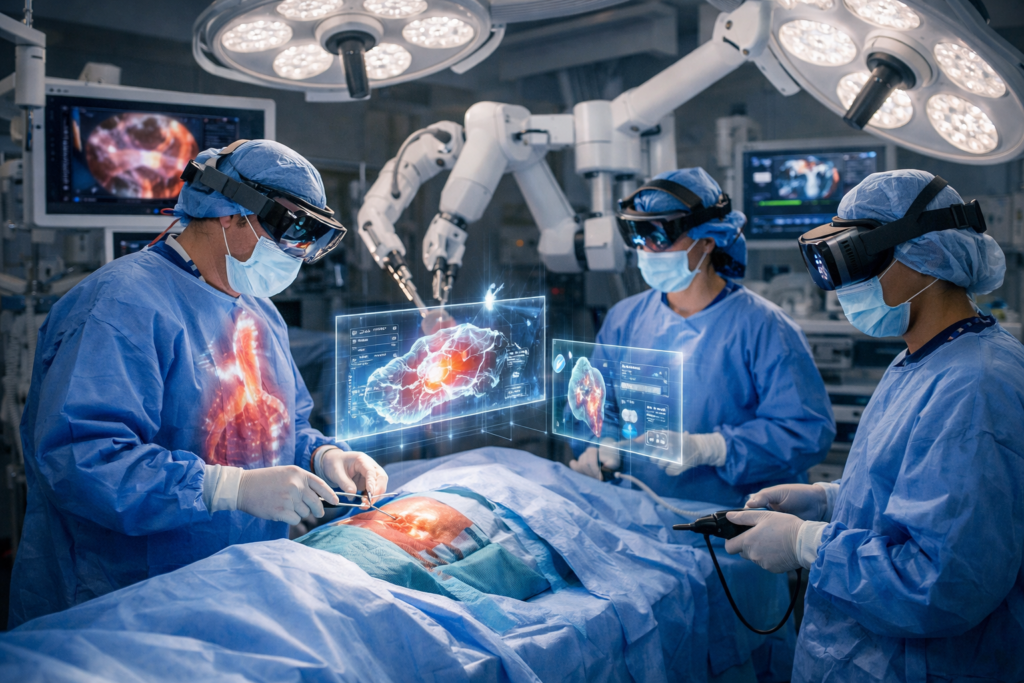
Image Credentials: Image Title: How AR and VR Are Transforming the Operating Room Source: (sora.openai) Date: March 2026. Attribution: This image was created using AI-generated imagery (sora.openai) and does not depict a real-world scene.
By Julian Thorne | Open Chronicle Technology Columnist
WASHINGTON, D.C. — While the “Metaverse” may have faded from the headlines of social media, its core technologies, Augmented Reality (AR) and Virtual Reality (VR), are quietly staging a revolution in the one place where precision is a matter of life and death: the hospital. A major report from the Information Technology and Innovation Foundation (ITIF) highlights that extended reality (XR) is no longer a futuristic gimmick but a critical tool for improving patient outcomes and lowering healthcare costs.
From “X-ray vision” for surgeons to immersive therapy for chronic pain, the medical community is moving rapidly to integrate these digital layers into standard care.
1. Surgical Precision: The AR Overlay
The most immediate impact of XR is found in the operating theater. Augmented Reality allows surgeons to see “through” a patient’s skin by overlaying 3D digital models, derived from MRI or CT scans, directly onto the surgical site.
“Instead of looking away at a 2D screen, the surgeon sees the exact location of a tumor or a blood vessel in three dimensions while they work,” explains an ITIF analyst. This reduces the risk of accidental tissue damage and can shorten complex procedures by as much as 30%.
2. Medical Training: The Virtual Cadaver
The traditional “see one, do one, teach one” model of medical education is being upended by Virtual Reality. VR simulations allow residents to practice high-stakes procedures, such as orthopedic surgery or emergency trauma response, thousands of times in a risk-free environment.
Data suggests that surgeons trained using VR are significantly more accurate and faster than those trained using traditional methods. Furthermore, VR “cadaver labs” are proving to be a cost-effective alternative to the expensive and ethically complex use of human remains in medical schools.
3. Patient Care: Distraction and Rehabilitation
Beyond the scalpel, XR is proving to be a powerful tool for patient recovery.
-
Pain Management: VR “distraction therapy” is being used to treat burn victims and patients undergoing painful procedures. By immersing the brain in a vivid, calming virtual environment, the perception of pain can be reduced by up to 50%, often providing a non-pharmacological alternative to opioids.
-
Physical Therapy: AR-guided exercises allow stroke survivors or orthopedic patients to see “ghost” versions of their movements, helping them correct their form and track progress in real-time from the comfort of their homes.
4. The Barriers to Entry
Despite the potential, the ITIF report identifies significant hurdles to widespread adoption:
-
Interoperability: Most hospitals use fragmented data systems. For AR to work, patient data must move seamlessly from the scanner to the headset—a “digital thread” that does not yet fully exist.
-
Regulatory Lag: Current FDA approval processes are designed for physical hardware or simple software, not the complex, AI-driven algorithms found in the latest XR devices.
-
Cost of Hardware: While prices are falling, the initial investment for enterprise-grade headsets and custom software remains a barrier for smaller rural hospitals.
The Path Forward
The ITIF calls for a national strategy to support XR in healthcare, including expanded federal research grants and modernized Medicare reimbursement codes. As the technology matures, the report predicts that XR will move from a specialized luxury to a fundamental “standard of care,” turning every hospital into a high-tech center for digital medicine.