
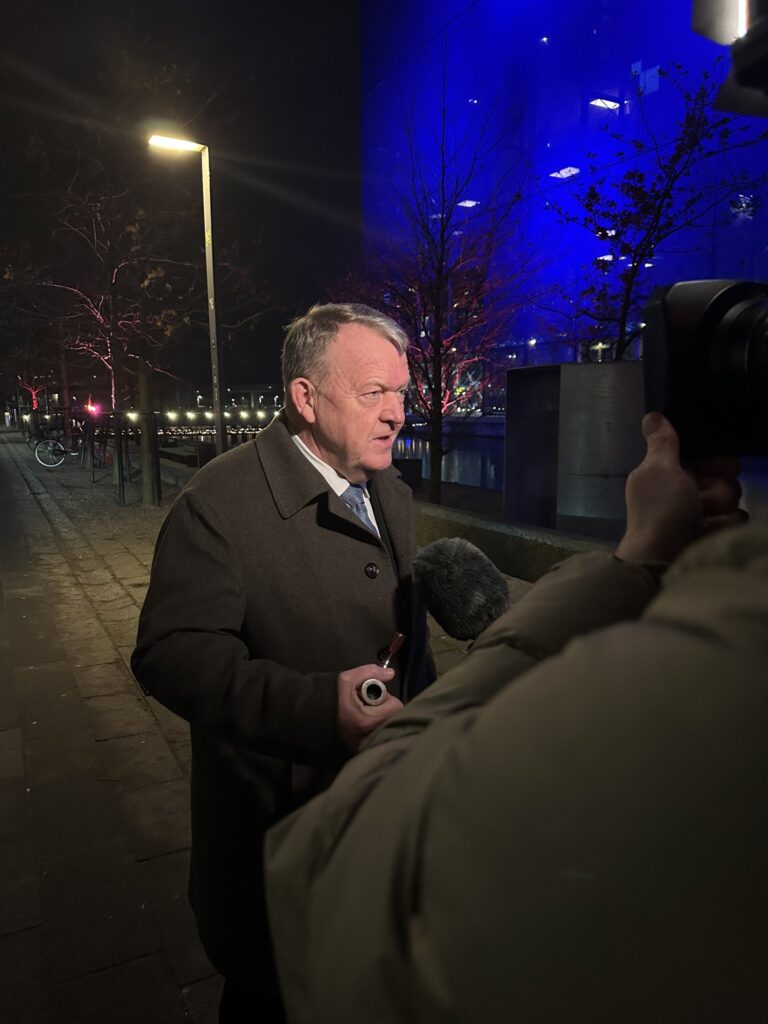
Image: from Lars Løkke Rasmussen X @larsloekke
By Harrison Vane with Agencies | Open Chronicle Political Correspondent
COPENHAGEN — Denmark has been plunged into a period of intense political horse-trading following a general election on Tuesday that left the country’s traditional power blocs in a dead heat. With no clear majority for either the left-wing “Red Bloc” or the right-wing “Blue Bloc,” the nation’s future now rests in the hands of a familiar veteran: former Prime Minister and current Foreign Minister Lars Løkke Rasmussen.
Rasmussen’s centrist Moderates party secured 14 seats in the 179-seat Folketing, effectively crowning him the “kingmaker” of Danish politics.
1. A Bruising Night for the Incumbent
Prime Minister Mette Frederiksen officially submitted her government’s resignation to King Frederik X on Wednesday morning. While her Social Democrats remained the largest single party with 38 seats, the result was a historic low—the party’s weakest showing since 1903.
Frederiksen had called the snap election in February, hoping to capitalize on a “Greenland bounce” following her firm stance against U.S. interests in the territory. However, the gamble failed to yield a majority. “The world is unsettled… Denmark needs a stable government,” Frederiksen told supporters, signaling her readiness to lead a new coalition if a path can be found.
2. The “Pipe-Smoking” Kingmaker
Lars Løkke Rasmussen emerged from the night as the clear winner of the political landscape. By refusing to align his Moderates with either the Red or Blue blocs during the campaign, he has positioned himself as the essential bridge for any viable government.
“Come and play with us,” Rasmussen urged his rivals during a jubilant post-election speech, pipe in hand. “We must not be red. We must not be blue. We must work together.” Rasmussen is pushing for a broad “cross-center” coalition, similar to the outgoing government, though his former partners in the Liberal Party (Venstre) have already signaled a desire to move toward a purely right-leaning administration.
3. The Greenland Shadow and Domestic Reality
While the international headlines focused on the “Greenland Crisis” and tensions with the Trump administration, Danish voters appeared more concerned with “bread-and-butter” issues.
-
Cost of Living: Inflation and energy prices remained the top priority for the electorate.
-
Environmental Crisis: A significant campaign issue involved the contamination of drinking water by pesticides from Denmark’s massive pig farming sector, fueling gains for the Green Left (SF), which became the second-largest party with 20 seats.
-
Far-Right Resurgence: The Danish People’s Party (DF) saw a dramatic comeback, securing 16 seats as it capitalized on persistent anxieties over immigration and national identity.
4. What Happens Next?
The process of “Dronningrunde” (now “Kongerunde” or Royal Round) has begun. Each party leader will meet with King Frederik to nominate a “Royal Investigator”—the person tasked with leading the negotiations to form a government.
Political analysts suggest negotiations could stretch for weeks. Rasmussen holds the ultimate leverage: he can either return Frederiksen to the Prime Minister’s office in a centrist pact or flip his support to the Blue Bloc to install a center-right leader.
“No government can be formed without his at least tacit approval,” noted Rune Stubager, a professor at Aarhus University. For now, the “cunning power player” of Danish politics is exactly where he wants to be: in the center of the storm.