
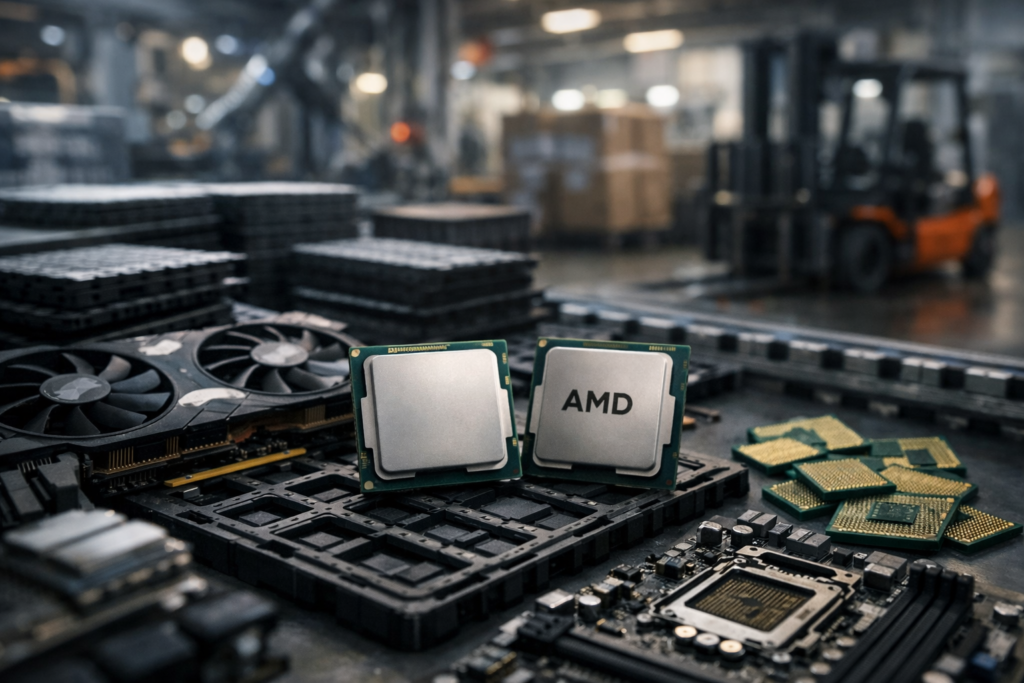
Image Credentials: Image Title: The Silicon Squeeze Intel and AMD Processor Shortages Cripple PC Manufacturers Source: (sora.openai) Date: March 2026. Attribution: This image was created using AI-generated imagery (sora.openai) and does not depict a real-world scene.
By Julian Thorne | Open Chronicle Tech & Business Correspondent
SANTA CLARA, CA — The global personal computer market has been blindsided by a severe supply chain contraction as both Intel and AMD report significant production shortfalls for their latest generation of processors. The shortage is sending shockwaves through major hardware vendors like Dell, HP, and Lenovo, who are now warning of delayed product launches and inevitable price hikes for the 2026 back-to-school season.
Unlike previous “crypto-mining” shortages, this crisis is being driven by a “perfect storm” of geopolitical instability, specialized raw material scarcity, and the sudden diversion of fabrication capacity toward the booming military-AI sector.
The ‘Epic Fury’ Diversion
A primary factor in the shortage is the Pentagon’s recent mandate for “magazine depth” in the wake of Operation Epic Fury. As Lockheed Martin quadruples production of the Precision Strike Missile (PrSM) and other high-end munitions, the specialized high-performance chips required for their guidance systems are being prioritized at the foundry level.
“We are seeing a ‘Defense First’ allocation at major fabrication plants,” noted one supply chain analyst. “When the government demands thousands of chips for missile guidance and tactical AI, the consumer laptop market is the first to be pushed to the back of the line.”
The Substrate Bottleneck
Intel and AMD are also grappling with a critical shortage of ABF (Ajinomoto Build-up Film) substrates—a thin, insulating layer essential for packaging high-performance CPUs.
-
The Logistics Trap: Most ABF production is concentrated in regions currently experiencing maritime transit delays due to the “Hormuz Toll” and the resulting global shipping reroutes.
-
Yield Issues: Attempts to ramp up production at newer facilities in Southeast Asia have been plagued by lower-than-expected yields, leaving manufacturers with a surplus of silicon “brains” but no “bodies” to house them in.
Impact on the Consumer
For the average buyer, the “Silicon Squeeze” translates to three immediate realities:
-
The “Premium-Only” Market: To maximize margins with limited stock, Intel and AMD are prioritizing their most expensive, high-end chips (Core i9 and Ryzen 9), leaving the budget and mid-range “Core i5” tiers virtually empty.
-
Refurbished Resurgence: Market analysts predict a 30% increase in the value of used and refurbished PCs as consumers look for immediate alternatives to out-of-stock new models.
-
The “Laptop Tax”: Preliminary data suggests that the average price of a mid-tier Windows laptop could rise by as much as $150 by July 2026.
The “Sovereign Silicon” Solution?
The crisis has reignited calls for “Sovereign Silicon” initiatives in Europe and the United States. While the CHIPS Act has funded new domestic factories, most are not yet at full operational capacity.
“We are learning the hard way that you cannot build a digital economy on a fragile, long-distance supply chain,” said a spokesperson for the European Semiconductor Board. “Until we have end-to-end domestic packaging and substrate production, we are at the mercy of every global tremor.”
What’s Next?
As PC manufacturers scramble to secure whatever inventory remains, some are reportedly considering a pivot to ARM-based processors for their lower-end lineups to reduce dependency on the x86 duopoly. However, for those requiring the raw power of Intel or AMD, the remainder of 2026 looks to be a year of “patience or overpayment.”