
Image: from CGTN X @CGTNOfficial
By Open Chronicle Staff with Agencies
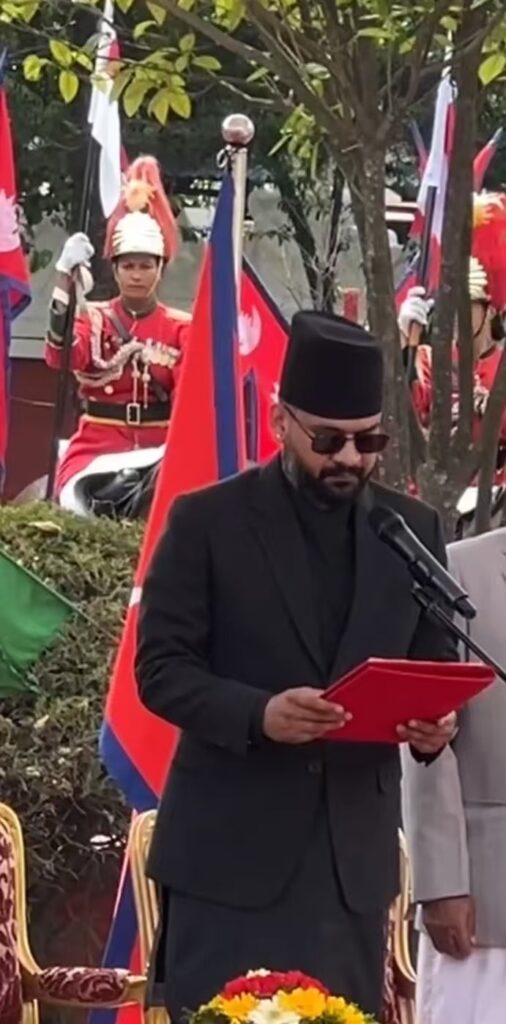
KATHMANDU — In a ceremony that blended ancient Vedic hymns with the pulsating energy of a generational shift, Balendra Shah, the 35-year-old structural engineer and former hip-hop artist, was sworn in Friday as the 47th Prime Minister of Nepal.
Popularly known as “Balen,” Shah is the first person of Madheshi origin to lead the Himalayan nation. His ascent to the top executive post follows a historic landslide victory by his Rastriya Swatantra Party (RSP) in the March 5 general elections, the first held since a violent “Gen Z” uprising toppled the previous establishment last September.
A Ritual of Unity
The swearing-in took place at 12:34 p.m. at the President’s House, Sheetal Niwas, a time selected by the RSP for its auspiciousness. The ceremony featured a unique fusion of Hindu and Buddhist traditions, including the blowing of conch shells by seven Brahmins and chants performed by over 100 lamas and Vedic priests.
Dressed in traditional daura suruwal and topi, the young leader stood in stark contrast to the septuagenarian “old guard” that has dominated Nepali politics for decades. “This is not my victory; it is the victory of every young Nepali who refused to accept that corruption is our destiny,” Shah said in a brief statement following his oath, administered by President Ram Chandra Paudel.
Decimating the Establishment
The scale of Shah’s mandate has sent shockwaves through the region. The RSP secured 182 out of 275 seats in the House of Representatives, a supermajority that effectively sidelines the traditional powers. The Nepali Congress was reduced to just 38 seats, while the once-dominant CPN-UML, led by ousted Prime Minister K.P. Sharma Oli, collapsed to 25.
Shah’s personal victory was equally symbolic. Contesting in Jhapa-5, a rural stronghold of the communist movement, he defeated Oli by a massive margin, proving his appeal transcends his urban base in Kathmandu, where he previously served as mayor.
The Challenges Ahead
Prime Minister Shah assumes office with a “compact” cabinet of 14 ministers, including noted economist Swarnim Wagle as Finance Minister and educationist Shishir Khanal as Foreign Minister. Shah himself will oversee the Defense, Commerce, and Industries portfolios.
His immediate hurdles are formidable. Beyond internal promises to prosecute former leaders for corruption and to investigate the deaths of protesters during the September uprising, Shah must navigate a delicate geopolitical landscape. Landlocked between India and China, Nepal has long been a theater for the competing interests of its giants. Indian Prime Minister Narendra Modi was among the first to extend “warm congratulations,” expressing a desire to take bilateral cooperation to “greater heights.”
From Lyrics to Legislation
Critics have long questioned whether a “social media populist” can manage the complexities of statecraft. During his tenure as Mayor of Kathmandu, Shah was praised for his transparency and waste management initiatives but faced backlash for his heavy-handed demolition of unauthorized structures and fiery online rhetoric against foreign powers.
However, for the millions of young Nepalis who grew up on his socially conscious rap lyrics, Shah’s rise represents the ultimate fulfillment of a movement that began on Discord servers and ended at the ballot box. As he enters Singha Durbar, the seat of government, the “rapper-premier” carries the weight of a nation hungry for a fresh start in the face of economic stagnation and regional instability.