
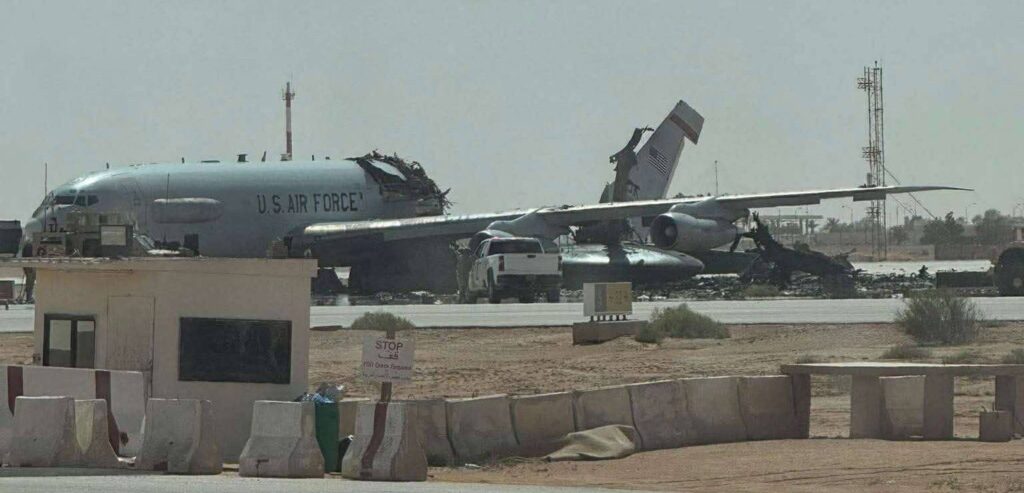
Image: from Visegrád 24 X @visegrad24
By Open Chronicle Staff with Agencies
PRINCE SULTAN AIR BASE, Saudi Arabia — A critical U.S. Air Force E-3G Sentry Airborne Warning and Control System (AWACS) aircraft has been destroyed following a precision missile and drone strike by Iranian forces, marking one of the most significant technological losses for the United States since the regional conflict began.
Images and satellite footage circulating Sunday confirmed the destruction of the aircraft, serial number 81-0005, at Prince Sultan Air Base (PSAB). The strike, which occurred in the early hours of March 27, reportedly targeted the rear fuselage of the aircraft, where its signature rotating radar dome and mission-critical battle management systems are housed.
Initial assessments from the Pentagon indicate that at least one Iranian ballistic missile and a swarm of one-way attack drones penetrated the base’s air defense perimeter. The attack wounded between 10 and 15 U.S. service members, with at least two reported in critical condition. In addition to the E-3G, at least three KC-135 Stratotanker refueling planes were destroyed or severely damaged, further straining the coalition’s ability to maintain long-range air operations.
New image reportedly showing the USAF E-3 Sentry destroyed in an Iranian attack at Prince Sultan Airbase on Friday.
Matches 81-0005, an E-3C seen deployed to the base in recent weeks. pic.twitter.com/zRVzzkEPeU
— OSINTtechnical (@Osinttechnical) March 29, 2026
Military analysts describe the loss of the E-3G as “catastrophic” for regional situational awareness. The aircraft, operated by the 552nd Air Control Wing, serves as a “flying radar station,” coordinating airstrikes, tracking incoming threats, and managing complex battlespace deconfliction.
“This is a decapitation strike against the command-and-control layer of our airpower,” said a retired Air Force official. “You cannot simply replace an AWACS. These are aging, low-density assets that are the backbone of every sortie we fly in the Gulf.”
The destruction comes just days after U.S. Central Command (CENTCOM) suggested that Iranian missile capabilities had been significantly degraded. The precision of the strike has led to speculation among intelligence circles regarding potential foreign assistance in targeting, with some pointing toward Russian or Chinese satellite reconnaissance.
The loss is particularly acute as the U.S. Air Force has already reduced its aging E-3 fleet to just 16 airframes while awaiting the arrival of the E-7 Wedgetail replacement, which is not expected to be fully operational until the end of the decade.
While the White House has yet to issue a formal statement on the loss, the incident has fueled domestic calls for more hardened aircraft shelters and improved point-defense systems for forward-deployed assets. For now, the “flying radar” that once provided a total view of the Iranian threat has been silenced, leaving a significant gap in the coalition’s digital eyes over the Middle East.