
Image: from Argonaut X @FapeFop90614
By Open Chronicle Staff with Agencies
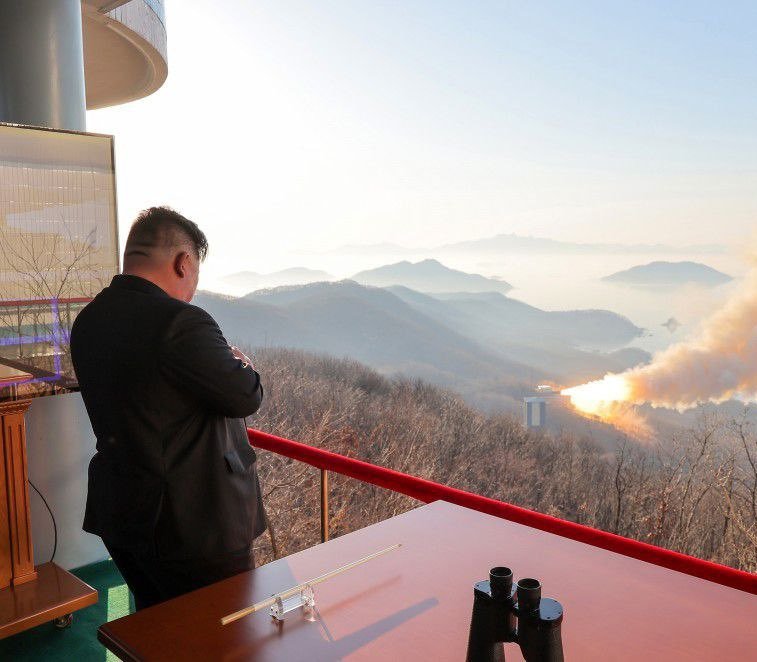
PYONGYANG, North Korea — State media reported Sunday that leader Kim Jong Un oversaw a successful ground test of an upgraded solid-fuel engine, a development Pyongyang claims significantly bolsters its ability to strike the United States mainland.
The Korean Central News Agency (KCNA) stated that the test involved a high-thrust engine constructed with composite carbon fiber materials. According to the report, the engine achieved a maximum thrust of 2,500 kilonewtons, a marked increase from the 1,970 kilonewtons recorded during a similar test in September. Kim Jong Un reportedly characterized the event as of “great significance” in elevating the country’s strategic military muscle to the highest level.
🇰🇵 State news agency KCNA reported that North Korean leader Kim Jong Un supervised a ground test of an upgraded high-thrust solid-fuel rocket engine that will increase range, carry a larger payload and launch faster. pic.twitter.com/rQvYzigRaN
— Argonaut (@FapeFop90614) March 29, 2026
The Solid-Fuel Advantage
The transition from liquid to solid propellants is a critical goal for North Korea’s five-year arms build-up. Unlike liquid-fuel missiles, which require a lengthy fueling process before liftoff and are highly volatile, solid-fuel weapons are more stable. They can be moved, concealed, and launched with far greater agility, making them significantly harder for U.S. and allied intelligence to detect and preempt.
Military analysts suggest that the push for increased engine power is likely tied to Pyongyang’s efforts to develop smaller Intercontinental Ballistic Missiles (ICBMs) capable of being launched from submarines or mobile land-based trucks. Furthermore, the increased thrust could support the deployment of multiple warheads on a single missile, a tactic designed to overwhelm sophisticated U.S. missile defense systems.
Expert Skepticism and Potential Russian Ties
Despite the triumphant tone of state media, some international experts remain cautious. Lee Choon Geun, an honorary research fellow at South Korea’s Science and Technology Policy Institute, suggested the report could be “bluffing.” He noted that North Korea failed to disclose critical technical data, such as the total combustion time of the engine.
There is also growing speculation regarding foreign assistance. Some observers believe the sudden leap in engine performance may be the result of deepening cooperation with Moscow. In recent years, North Korea has reportedly supplied troops and conventional weaponry to support Russia’s war in Ukraine, leading to concerns that Russia may be providing advanced missile technology in exchange.
Stalled Diplomacy
The latest military posturing comes as diplomatic channels between Pyongyang and Washington remain frozen. While Kim Jong Un left the door open for dialogue during a Workers’ Party congress in February, he has remained firm that nuclear disarmament will not be a precondition for talks.
As the “Hwasong-20” ICBMs—labeled by state media in late 2025 as the country’s “most powerful nuclear strategic weapon system”- continue to be refined, the international community remains on high alert. While technological hurdles like atmospheric reentry survival persist, the frequency and scale of these tests suggest a regime determined to finalize its nuclear delivery capabilities.