
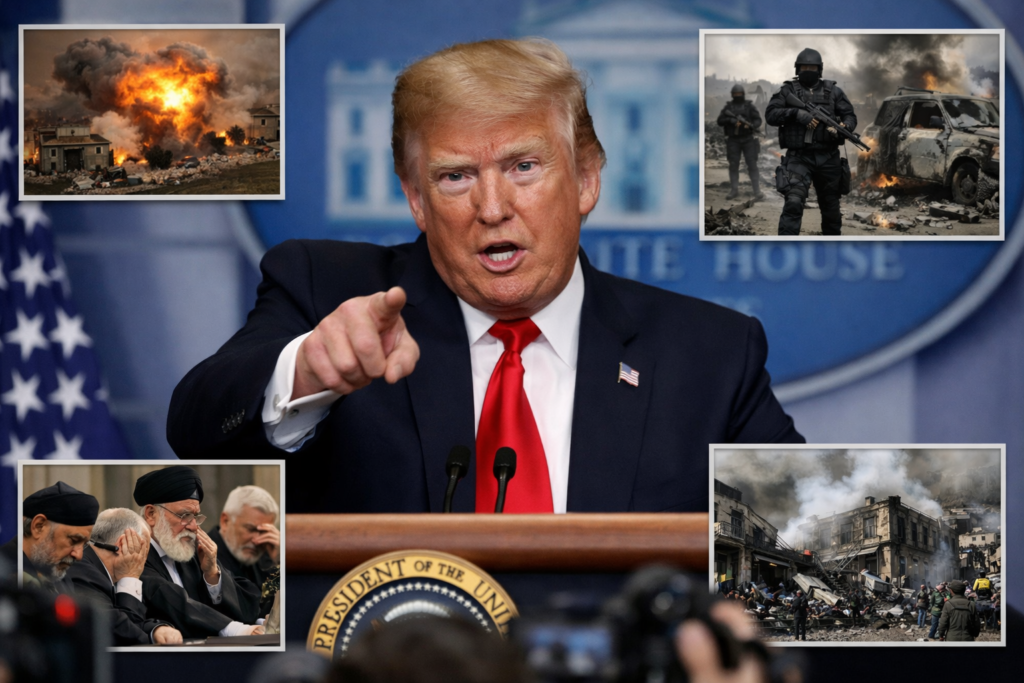
Image Credentials: Image Title: Trump Issues Renewed Nuclear Threat Against Iran as Conflict Enters “Critical Phase” Source: (sora.openai) Date: April 2026. Attribution: This image was created using AI-generated imagery (sora.openai) and does not depict a real-world scene.
By Open Chronicle Staff with Agencies
WASHINGTON – President Donald Trump has significantly escalated his rhetoric against Tehran, warning of “unprecedented consequences” if the Iranian leadership does not immediately agree to a comprehensive nuclear disarmament deal. The President’s latest ultimatum comes amid a deepening regional war and reports of severe disruption within the Iranian government following a series of high-level targeted strikes.
According to a Tuesday report by The New York Times, the administration is weighing expanded military options as a March 27 deadline for a diplomatic “off-ramp” passed without a formal agreement. White House officials indicated that the President’s patience is “nearly exhausted,” with Trump telling reporters that he is prepared to ensure Iran “never, ever” possesses a nuclear weapon, regardless of the military cost.
Decapitation Strikes and Leadership Vacuum
The escalation follows a weekend of intense kinetic operations. Intelligence reports suggest that decision-making in Tehran has been “severely hampered” after joint U.S.-Israeli strikes reportedly killed dozens of Iranian military and political leaders. Among the casualties is the commander of the IRGC Navy, Rear Admiral Alireza Tangsiri, who was killed in Bandar Abbas.
Despite the loss of several top officials, including some reports suggesting the Supreme Leader’s inner circle has been hit, the Iranian regime remains defiant. Iranian Parliament Speaker Mohammad Bagher Ghalibaf recently rejected claims of secret negotiations, insisting that Iran would not “capitulate” to American pressure.
Nuclear Stakes and “Toll Booth” Tactics
The conflict has now reached what observers call a “critical phase.” While the White House has focused on neutralizing Iran’s nuclear and missile infrastructure, having reportedly struck over 10,000 sites since the war began, Tehran has pivoted to unconventional economic warfare.
Analysts from Lloyd’s List Intelligence report that Iran is effectively using Larak Island in the Strait of Hormuz as a “toll booth,” selectively allowing “shadow fleet” vessels and ships with Iranian ties to pass while blocking those linked to the U.S. and Israel. This maritime blockade continues despite President Trump’s earlier claims that Tehran had offered a “present” by allowing several tankers through the waterway.
International Reaction and the Path Ahead
The threat of a nuclear-scale escalation has sent shockwaves through international capitals. Spain recently moved to shut its airspace to U.S. military aircraft involved in the Iran campaign, while Pakistan and Egypt continue to float 15-point peace proposals in a desperate bid to prevent a total regional collapse.
Domestically, the Trump administration remains steadfast. Secretary of State Marco Rubio defended the intervention, arguing that the risk of a nuclear-armed Iran outweighs the legal and diplomatic fallout of the current strikes. Meanwhile, satellite imagery shows a continued buildup of U.S. air assets in Jordan and Saudi Arabia, signaling that the administration is preparing for a “much bigger attack” if the regime does not fold.