
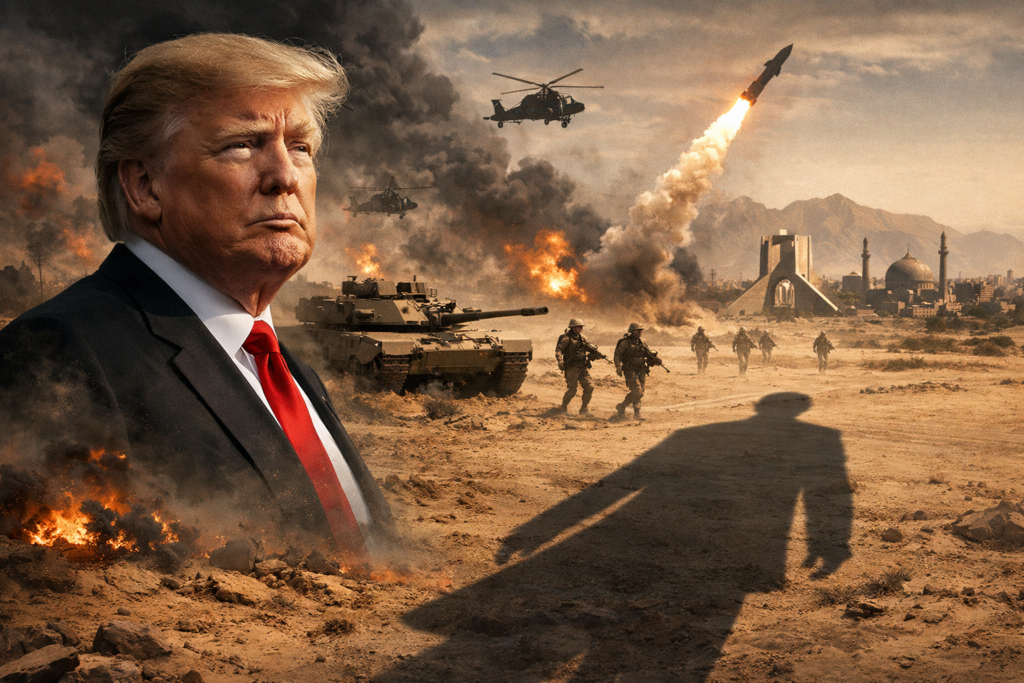
Image Credentials: Image Title: Trump Issues ‘Conquest’ Warning to Tehran; Ceasefire Stability in Question Source: (sora.openai) Date: March 2026. Attribution: This image was created using AI-generated imagery
By Open Chronicle Staff with Agencies
Thursday, April 9, 2026
WASHINGTON/TEHRAN/ISLAMABAD — U.S. President Donald Trump has cast a long shadow over a fragile, Pakistan-brokered ceasefire, warning that American military forces will remain “in and around Iran” and are prepared for their “next Conquest” should Tehran fail to meet strict U.S. conditions.
The rhetoric comes only 48 hours into a planned two-week truce intended to pause six weeks of devastating regional conflict. In a late-Wednesday post on Truth Social, the President insisted that a “REAL AGREEMENT” must be fully complied with before any military withdrawal occurs.
“If for any reason it is not… the ‘Shootin’ Starts,’ bigger, and better, and stronger than anyone has ever seen before,” Trump wrote, adding that the U.S. military is currently “Loading Up and Resting.”
Mine Danger in the Strait of Hormuz
Compounding the tension, Iranian state-linked media outlets ISNA and Tasnim published a chart on Thursday suggesting that the Islamic Revolutionary Guard Corps (IRGC) may have heavily mined the Strait of Hormuz during the peak of the fighting.
The chart identifies a “danger zone” covering the standard Traffic Separation Scheme, the primary route for global shipping. It suggests that vessels instead hug the Iranian coastline near Larak Island. It remains unclear if any mines have been cleared since the ceasefire began, leaving the vital energy corridor, which handles 20% of the world’s oil supply, in a state of high-risk limbo.
Diplomacy Under Fire
While the ceasefire was intended to facilitate high-level talks in Islamabad, the atmosphere remains toxic. Residents in Tehran expressed deep skepticism to Al Jazeera, with some describing the truce as a “theatrical show” while others pointed to the ongoing violence in Lebanon as proof that the agreement is hollow.
Key Obstacles to a Permanent Deal:
-
Conflicting Proposals: Tehran has rejected Washington’s initial sweeping proposal, offering instead a 10-point plan that demands an immediate end to Israeli attacks on Lebanon and the lifting of U.S. sanctions.
-
The “Lebanon Gap”: While the U.S. and Iran have paused direct hostilities, Israel has significantly intensified its bombardment of Lebanon, killing at least 182 people in a single day.
-
Domestic Opposition: In the United States, Senator Cory Booker announced that Democrats would invoke the War Powers Resolution to force a vote on curbing what he called Trump’s “unauthorised military action.”
Uncertainty in Islamabad
The logistics of the peace talks remain shrouded in confusion. Iranian Ambassador to Pakistan, Reza Amiri Moghadam, posted on X that a delegation would arrive in Islamabad tonight for “serious talks.” However, the post was later deleted without explanation.
Meanwhile, Islamabad has declared two days of local holidays on short notice, a move many interpret as a security measure for the arrival of high-level American and Iranian delegations.
As the two-week clock on the ceasefire ticks down, the “parallel war” in Lebanon and the threat of sea mines in the Gulf suggest that the path from a temporary pause to a “REAL AGREEMENT” remains fraught with peril.