
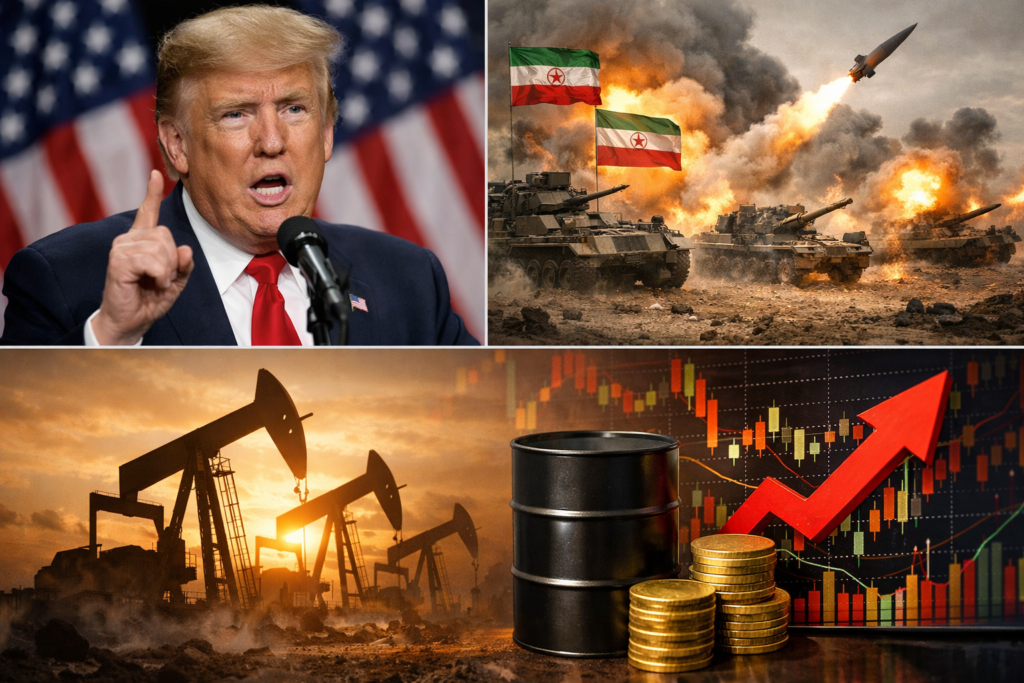
Image Credentials: Image Title: Trump Warns of ‘Shootin’ Starts’ if Iran Peace Process Fails; Oil Prices Surge Source: (sora.openai) Date: March 2026. Attribution: This image was created using AI-generated imagery
By Open Chronicle Staff with Agencies Thursday, April 9, 2026
WASHINGTON/DUBAI/TEL AVIV — U.S. President Donald Trump issued a blunt ultimatum to Tehran on Thursday, vowing to maintain a massive military presence in the Middle East until a definitive peace deal is reached. In a series of social media posts, the President warned of a major war escalation if Iran fails to comply with U.S. demands, even as a fragile five-week conflict remains at a precarious standstill.
President Trump asserted that U.S. warships, aircraft, and personnel—bolstered by fresh munitions—would remain stationed to dismantle what he described as a “substantially degraded enemy” should negotiations collapse.
“If for any reason [a deal] is not [agreed], which is highly unlikely, then the ‘Shootin’ Starts,’ bigger, and better, and stronger than anyone has ever seen before,” Trump stated. He further claimed that Iran has already agreed to forgo nuclear weapons and reopen the Strait of Hormuz, though he noted the U.S. military is currently “Loading Up and Resting” for any potential “next Conquest.”
Strait of Hormuz and Global Markets
The President’s rhetoric, combined with ongoing restrictions in the Strait of Hormuz, sent shockwaves through global energy markets. Brent crude futures climbed over 2% to $96.71 a barrel, while West Texas Intermediate (WTI) rose to $97.01.
Despite the ceasefire announcement, there has been little evidence of “free” navigation through the Strait, a vital artery for 20% of the world’s oil and LNG. Iran continues to assert control over the waterway, reportedly demanding tolls for safe passage. This stance drew a sharp rebuke from British Foreign Secretary Yvette Cooper, who is expected to declare in an upcoming speech that “freedom of navigation means navigation must be free.”
Diplomatic Friction and Israeli Strikes
The path to peace is further complicated by conflicting agendas and renewed violence. On Wednesday, Israel conducted its largest coordinated strike of the war, killing over 250 people in Lebanon. The escalation prompted Iran’s parliament speaker, Mohammed Bager Qalibaf, to label bilateral negotiations “unreasonable” under current conditions.
Primary Points of Contention:
-
The Lebanon Gap: The U.S. and Israel maintain that Lebanon is excluded from the current truce. Conversely, Iranian President Masoud Pezeshkian insists a halt in hostilities in Lebanon is a prerequisite for any permanent deal.
-
Hezbollah Activity: Early Thursday, Hezbollah fired rockets at the Manara kibbutz, citing Israeli ceasefire violations.
-
Nuclear Ambitions: Washington continues to demand that Tehran permanently abandon its nuclear program, a point Iran’s negotiators warn could jeopardize the Islamabad talks scheduled for Saturday.
The Road to Islamabad
Despite the skepticism and “repeated ceasefire violations,” the Iranian delegation is expected to arrive in Islamabad, Pakistan, on Thursday night. They carry a 10-point proposal aimed at ending a conflict that has already claimed thousands of lives.
As world leaders look toward the Saturday talks, the contrast between Trump’s “America is Back” triumphalism and the reality of a volatile, mine-laden Strait of Hormuz suggests that any lasting peace remains a distant prospect.