
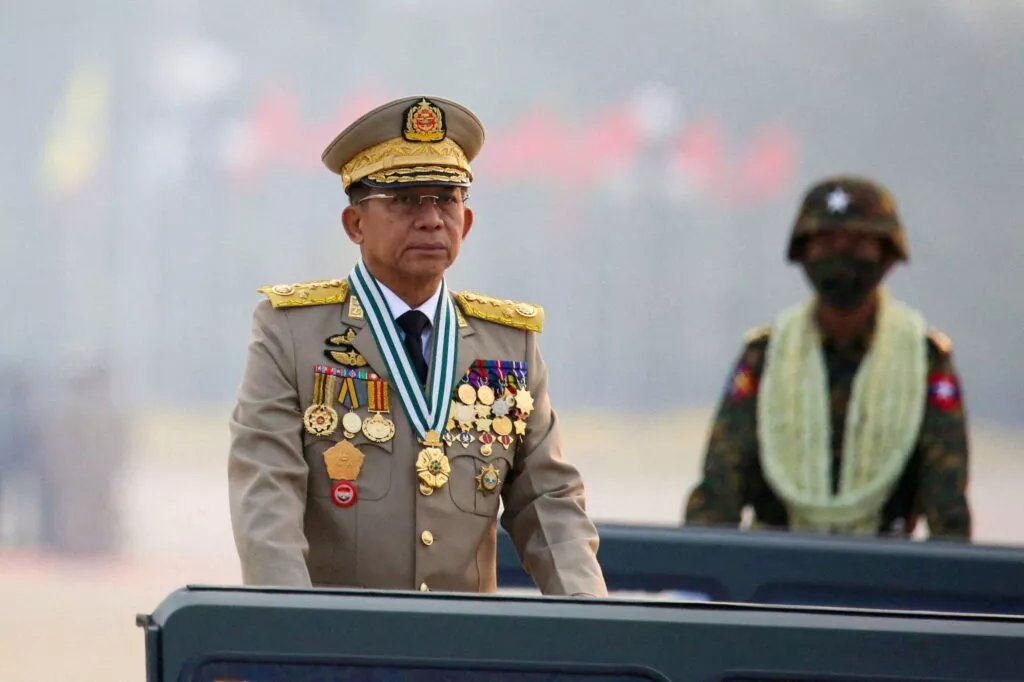
Image: Visegrád 24 X @visegrad24
By Open Chronicle Staff with Agencies | Thursday, April 9, 2026
NAYPYITAW — Myanmar’s military-controlled Parliament on Thursday approved a list of 30 ministers to serve in the Cabinet of junta chief Min Aung Hlaing. The move follows his appointment as president last week and reinforces the military’s absolute dominance over the nation’s governance despite a theoretical transition to civilian rule.
The formation of the new Cabinet comes in the wake of a widely disputed election victory by the military-backed Union Solidarity and Development Party. While the junta has framed the process as a return to democratic norms, the United Nations and numerous Western nations have dismissed the transition as a “sham” designed to legitimize military rule.
Reshuffling the Old Guard
The approved Cabinet list signals a “business-as-usual” approach, characterized by retired military officers and loyalists from the previous administration. Analysts note that while some names have changed, the underlying power structure remains entrenched in the Tatmadaw (the Myanmar military).
Key appointments include:
-
Ministry of Defence: General Tun Aung, the former air commander-in-chief, replaces the retiring Maung Maung Aye.
-
Ministry of Border Affairs: Lt-Gen Hpone Myat, previously the Home Affairs Minister, takes over from Lt-Gen Yar Pyae.
-
Ministry of Foreign Affairs: Tin Maung Swe, a former ambassador to China and military attaché to Britain, has been tapped to lead the nation’s diplomacy.
Several high-ranking figures from the 2021 coup era, including retired generals Mya Tun Oo and Tin Aung San, were also reappointed to the Cabinet.
Centralized Control
President Min Aung Hlaing’s nominations extend military influence across the legislative, executive, and judicial branches. Beyond the core security ministries, former military generals and police chiefs were appointed to head an additional 14 ministries.
Independent analyst Aung Kyaw Soe described the new government as a cosmetic shift rather than a structural one.
“Min Aung Hlaing has established a political system where military officers wear traditional civilian attire to govern in a civilian capacity, while he continues to maintain centralised control,” Aung Kyaw Soe said.
A Nation in Turmoil
The political reshuffling does little to address the systemic violence that has gripped Myanmar since the February 2021 coup. The military’s seizure of power five years ago unseated the democratically elected government of Nobel laureate Aung San Suu Kyi, sparking a nationwide civil war and a humanitarian crisis.
With the “old guard” simply changing uniforms, international observers expect little progress toward genuine democratic reform or a cessation of the ongoing internal conflict.