
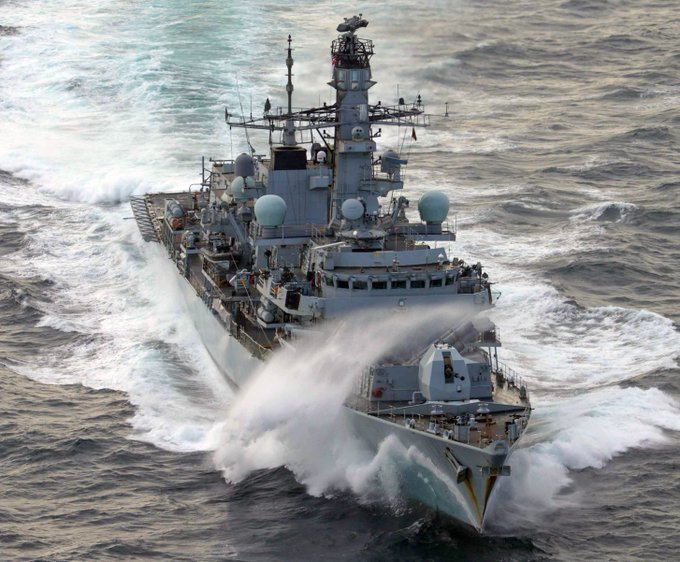
Image: from Washington Eye X @washington_EY
By Open Chronicle Staff with Agencies
Thursday, April 9, 2026
LONDON/OSLO — British and Norwegian naval forces have successfully exposed and deterred a month-long covert Russian operation aimed at critical undersea infrastructure in the North Atlantic. The mission, described by officials as a coordinated effort to map and potentially sabotage Western data cables and energy pipelines, was thwarted after a high-stakes cat-and-mouse game beneath the waves.
In a press conference at Downing Street on Thursday, British Defence Secretary John Healey revealed that an Akula-class nuclear attack submarine was used as a “diversion” to distract NATO forces while two specialized spy submarines from Russia’s secretive Main Directorate of Deep Sea Research (GUGI) conducted “nefarious activity” near essential subsea links.
“We See You”: A Direct Warning to Putin
Addressing Russian President Vladimir Putin directly, Healey emphasized that the clandestine nature of the mission had been compromised from the start.
“To Putin, I say this: we see you, we see your activity over our underwater infrastructure,” Healey stated. “You should understand that any attempt to damage it will not be tolerated and would have serious consequences.”
The Defence Secretary noted that while global attention has been fixed on the escalating conflict in the Middle East, the Russian Navy sought to exploit the distraction. “While the eyes of many were on the Middle East, our British Armed Forces were simultaneously responding to rising Russian threats north of the UK,” he added.
British and Norwegian militaries led a weekslong operation to deter Russian submarines suspected of “malign activity” in the North Atlantic, the U.K. military said Thursday. https://t.co/TzkQzE68a7
— ABC News (@ABC) April 9, 2026
The Month-Long Standoff
The joint UK-Norwegian operation involved an intensive 24/7 tracking effort. To signal that the “covert” mission had been exposed, allied forces utilized:
-
Maritime Patrol Aircraft: RAF P-8 Poseidons logged over 450 flight hours.
-
Warships: Frigates, including HMS St Albans and Norwegian vessels, tracked the subs for thousands of miles.
-
Acoustic Deterrence: Allied forces dropped sonobuoys regularly to demonstrate to the Russian crews that their every move was being monitored.
The Russian vessels eventually withdrew from the UK and Norwegian Exclusive Economic Zones (EEZ) and have since returned to their home base in Olenya Bay on the Kola Peninsula.
The GUGI Threat
Norwegian Defence Minister Tore O. Sandvik underscored the danger posed by the GUGI program, a high-priority Russian unit capable of operating at significant ocean depths. Sandvik confirmed that Russia is actively developing capabilities to map and sabotage infrastructure that handles 99% of global digital communications and vital energy flows.
“Norway has participated in a coordinated military operation with our allies to send a clear message: covert activities in our waters will not be tolerated,” Sandvik said in a statement.
British officials confirmed there is currently no evidence of physical damage to the infrastructure, but they remain on high alert. The UK has pledged an additional £100 million to bolster its submarine-hunting capabilities and announced that a carrier strike group will be deployed to the High North later this year to reinforce regional deterrence.