
Analysis by Open Chronicle Editor Elliot Hayes | The Grand Strategy Institute
Friday, April 10, 2026
The recent rhetoric from Senator Marco Rubio and other proponents of the “America First” doctrine has reignited a debate that has simmered since the end of the Cold War: Why is the U.S. military still in Europe, and who is truly paying for it?
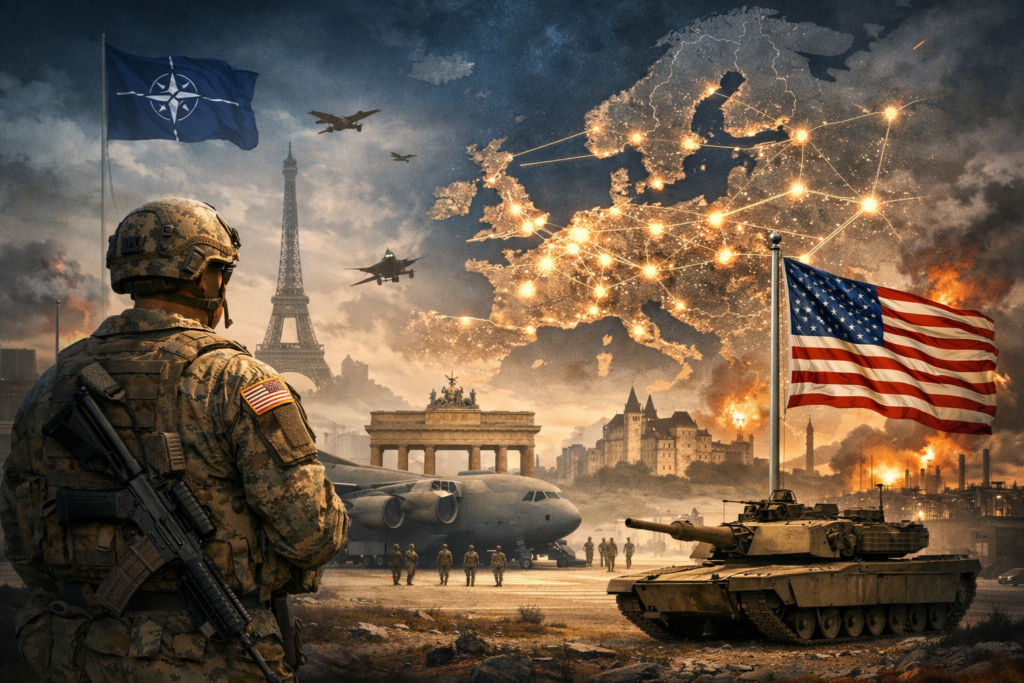
As the U.S.-Iran conflict strains traditional alliances, the threat to “close down and remove troops” highlights a fundamental misunderstanding, or perhaps a strategic misrepresentation, of what these bases represent. Far from being a mere act of charity toward Europe, the U.S. military footprint is a cornerstone of American global hegemony.
Power Projection: The “Unsinkable Aircraft Carriers”
If the United States were to withdraw its 100,000+ troops from Europe, it would not merely be “saving money”; it would be amputating its own reach.
-
Logistical Hubs: Bases like Ramstein (Germany) and Mildenhall (UK) are not just defensive shields for Europeans; they are the essential “gas stations” and hospitals for U.S. operations in the Middle East and Africa.
-
Intelligence Dominance: Sites like RAF Menwith Hill and Croughton provide the NSA and CIA with a “front-row seat” to global communications that cannot be replicated from within the borders of the continental United States.
-
Nuclear Deterrence: Bases in Belgium, Italy, Germany, Turkey, and the Netherlands house U.S. tactical nuclear weapons, ensuring that the U.S. remains the primary arbiter of European security and prevents the emergence of an independent European nuclear superpower.
The Hidden Subsidies: Who Pays?
The argument that the U.S. “gives everything and gets nothing” ignores the massive economic and logistical contributions made by host nations. Under the Cost Sharing Arrangements (CSA):
-
Rent-Free Sovereignty: The UK and other European nations provide thousands of acres of prime land and multi-billion dollar infrastructure (runways, hangars, barracks) to the U.S., completely rent-free.
-
The Tax “Black Hole”: As noted, U.S. forces operate in a tax-exempt vacuum. By not paying business rates, VAT, or income tax, the U.S. military avoids billions in costs that it would otherwise incur if it had to operate these facilities as commercial or domestic entities.
-
External Costs: Host nations often shoulder the “dirty work” of security, policing the perimeters, and managing the political fallout of hosting foreign troops on sovereign soil.
The “Avignon” Paradox
The tension has reached such a fever pitch that some Pentagon officials have reportedly alluded to the “Avignon Papacy”, suggesting that if allies (or even the Pope, as seen in recent reports) do not align with White House foreign policy, the U.S. is prepared to use its “military power to do whatever it wants.”
This “with us or against us” approach to basing overlooks a critical reality: The U.S. needs these bases to remain a superpower. Without them, the U.S. reverts to being a regional power, isolated by two oceans, while China and Russia fill the vacuum in the Eastern Hemisphere.
Where Does the Path Lead?
The current standoff over the war with Iran has brought this to a head. If Europe refuses to allow RAF Fairford to be used for B-52 strikes or Souda Bay for naval incursions, the U.S. faces a choice:
-
Acknowledge Multilateralism: Accept that host nations have a say in how their territory is used.
-
Retreat: Bring 100,000 troops home to a country that currently lacks the infrastructure to house them and a budget that would struggle to maintain them without European subsidies.
As the world waits for the current administration’s term to conclude in 2029, the “base debate” remains the most visible symptom of an America struggling to reconcile its desire for absolute control with its reliance on global cooperation.
U.S. Strategic Assets in the UK
UK Bases
- RAF Lakenheath: The largest U.S. Air Force base in the UK; home to the 48th Fighter Wing (F-15s and F-35s).
- RAF Mildenhall: A major air refueling and special operations hub; home to the 100th Air Refueling Wing.
- RAF Alconbury: Part of the “Tri-Base Area,” primarily providing intelligence and support services.
- RAF Molesworth: A center for military intelligence (U.S. European Command’s Joint Intelligence Operations Center).
- RAF Croughton: A major global communications and command hub.
- RAF Fairford: A standby “Forward Operating Location” used for strategic bombers (B-52, B-1, B-2).
- RAF Menwith Hill: A major electronic monitoring and intelligence site (NSA facility).
- RAF Welford: One of the largest ammunition compounds for the U.S. Air Force in Europe.
- RAF Feltwell: Primarily used for housing, support services, and a radar tracking station.
- RAF Blenheim Crescent (London): A small administrative site supporting U.S. Naval Forces Europe.
European Bases
| Country | Estimated Major Bases/Sites | Primary Presence |
| Germany | 38+ | Largest presence in Europe (Ramstein AB, Patch Barracks, Baumholder). |
| Italy | 7–10 | Aviano AB, Vicenza (Army), Sigonella (Navy), and Naples. |
| United Kingdom | 8–10 | Primarily Air Force and Intelligence |
| Poland | 5–6 | Rapidly expanding; includes US Army Garrison Poland (Poznań) and Redzikowo (Aegis Ashore). |
| Spain | 2 | Naval Station Rota and Morón Air Base. |
| Belgium | 3 | SHAPE (NATO HQ), Chièvres Air Base, and Brussels. |
| Netherlands | 1–2 | Volkel Air Base (storage) and Schinnen (logistics). |
| Greece | 1–2 | Souda Bay (major naval/air hub) and Larissa. |
| Portugal | 1 | Lajes Field (The Azores). |
| Turkey | 2 | Incirlik Air Base and Kürecik (Radar site). |
| Romania | 2 | Mihail Kogălniceanu Air Base and Deveselu (Aegis Ashore). |
| Norway | 1–2 | Cooperative Security Locations (mostly pre-positioned Marine gear). |
| Bulgaria | 1 | Novo Selo Training Range (rotational). |
The Grand Strategy Institute
Continue Exploring Strategic Analysis
Return to The Grand Strategy Institute for strategic assessments, long-form analysis and research examining geopolitics, military affairs, international security, emerging technologies and the changing international order.
← Back to The Grand Strategy Institute