
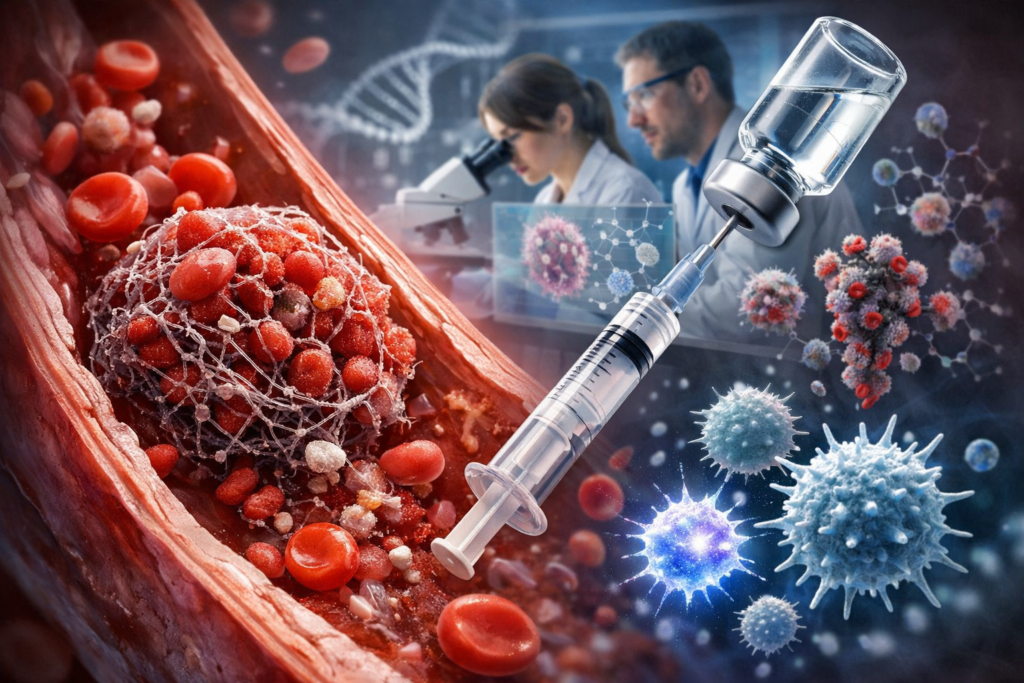
Image Credentials: Image Title: Scientists Solve the Mystery of Rare Vaccine-Linked Blood Clots Source: (sora.openai) Date: April 2026. Attribution: This image was created using AI-generated imagery (sora.openai) and does not depict a real-world scene.
By Open Chronicle Staff
ADELAIDE, AUSTRALIA — A global research effort led by Flinders University has finally cracked the molecular code behind a rare but serious blood-clotting disorder associated with certain COVID-19 vaccines and common viral infections. The discovery, published in the New England Journal of Medicine, provides a “blueprint” for developing a new generation of ultra-safe vaccines.
The Culprit: “Molecular Mimicry”
For years, scientists have struggled to explain why a tiny fraction of people developed Vaccine-induced Immune Thrombocytopenia and Thrombosis (VITT) after receiving adenovirus-vector vaccines, such as those from Oxford-AstraZeneca and Johnson & Johnson.
The breakthrough reveals a case of “mistaken identity” by the human immune system. Using advanced mass spectrometry sequencing, researchers found that a specific protein in the adenovirus (known as pVII) looks almost identical to a human blood protein called Platelet Factor 4 (PF4).
How the Reaction Triggers
When the vaccine (or a natural adenovirus infection) enters the body, the immune system creates antibodies to fight the viral pVII protein. However, because of the structural similarity, these antibodies mistakenly attack the body’s own PF4 protein.
-
The Activation: The rogue antibodies bind to PF4, creating large immune complexes.
-
The Clot: These complexes activate platelets—the cells responsible for clotting—causing them to clump together uncontrollably while simultaneously dropping the overall platelet count (thrombocytopenia).
“This was the missing link that explains how a normal immune response can, in very rare cases, become harmful,” explained Dr. Jing Jing Wang, lead researcher at Flinders University.
A Shared Risk: Vaccines vs. The Common Cold
Significantly, the study confirms that this reaction isn’t unique to vaccines. Identical clotting disorders have been documented in patients suffering from natural adenovirus infections (the common cold).
-
2021-2022: Scientists identified the PF4 antibody and a specific genetic risk factor (IGLV3-21*02) that makes some individuals more susceptible.
-
2023-2024: Research showed that antibodies from vaccine cases and natural infection cases were indistinguishable, proving the adenovirus itself was the trigger.
Engineering a Safer Future
The identification of the specific pVII protein as the trigger means the “mystery” phase of VITT is over. Vaccine developers can now use this molecular map to “edit” the adenovirus vector. By modifying or removing the specific part of the protein that mimics PF4, future vaccines can maintain their effectiveness against diseases like COVID-19, Ebola, and HIV without the risk of triggering this autoimmune response.
Professor Tom Gordon, Head of Immunology at SA Pathology, called the discovery the culmination of a “fascinating journey” that will translate directly into safer medical interventions worldwide.
Story Source:
Materials provided by Flinders University. Note: Content may be edited for style and length.
Journal Reference:
- Jing Jing Wang, Linda Schönborn, Theodore E. Warkentin, Luisa Müller, Thomas Thiele, Lena Ulm, Uwe Völker, Sabine Ameling, Sören Franzenburg, Lars Kaderali, Ana Tzvetkova, Alex Colella, Tim Chataway, Chee Wee Tan, Bridie Armour, Alexander Troelnikov, Lucy Rutten, James McCluskey, Roland Zahn, Tom P. Gordon, Andreas Greinacher. Adenoviral Inciting Antigen and Somatic Hypermutation in VITT. New England Journal of Medicine, 2026; 394 (7): 669 DOI: 10.1056/NEJMoa2514824