
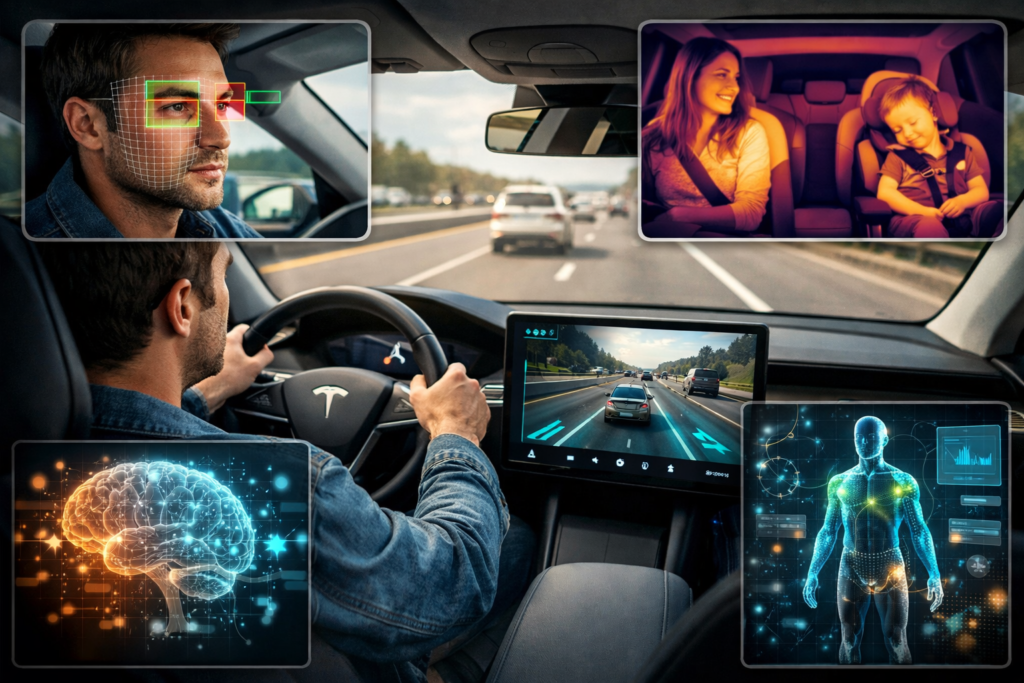
Image Credentials: Image Title: Tesla’s Cabin Camera Gains Groundbreaking New AI Capabilities Source: (sora.openai) Date: April 2026. Attribution: This image was created using AI-generated imagery (sora.openai) and does not depict a real-world scene.
By Open Chronicle Staff with Agencies
PALO ALTO, CA — Tesla is significantly expanding the utility of its internal cabin cameras, evolving them from simple monitoring tools into a central hub for road safety and driver personalization. New software code reveals that the electric vehicle giant is leveraging artificial intelligence to “understand” the human behind the wheel more deeply than ever before.
Beyond Basic Monitoring
Internal cameras in Tesla vehicles are not a new fixture, but their purpose is shifting rapidly. Initially designed to ensure driver attentiveness while using Autopilot, the cameras primarily flagged distractions such as mobile phone use or eyes straying from the road.
The latest updates, however, integrate biometric analysis to grant the vehicle a level of situational awareness that goes beyond mere surveillance.
Age Estimation: A New Safety Tier
One of the most provocative features discovered in recent software code is the system’s ability to estimate the driver’s age. This capability opens the door for several practical safety applications:
-
Unauthorized Access: Preventing minors or unlicensed individuals from operating the vehicle.
-
Adaptive Performance: Automatically applying speed or acceleration limits for younger, less experienced drivers.
-
Tailored Assistance: Adjusting the sensitivity of driver-assist systems based on the driver’s profile.
An Adaptive Driving Experience
The evolution extends to real-time adjustments. Industry analysts suggest Tesla may use this data to create a more “empathetic” driving environment. For instance, the vehicle could default to a smoother driving mode for elderly users or implement a higher sensitivity threshold for distractions when it detects an inexperienced operator.
This fits into a broader automotive trend where the vehicle doesn’t just react to the environment, but actively “comprehends” the occupant.
The Robotaxi Foundation
The timing of these updates is no coincidence. As Tesla pivots toward a future of Robotaxis and autonomous mobility, the internal camera serves as a vital validation mechanism.
“The car must be able to verify if a passenger is authorized or if a driver meets the legal requirements for Full Self-Driving (FSD) in specific jurisdictions,” noted one industry expert.
Health and Emergency Response
Looking further ahead, the system is expected to transition into a health monitoring tool. Code snippets suggest the AI will eventually detect signs of extreme fatigue or sudden medical emergencies. In such cases, the vehicle could theoretically trigger emergency protocols, such as safely pulling over and contacting first responders.
The Privacy Trade-off
Despite the technological leaps, the “always-on” nature of cabin cameras remains a point of contention. Tesla has previously faced scrutiny regarding how interior data is collected and stored. However, the industry consensus suggests that as cars become more autonomous, the need for the vehicle to “know” its driver is becoming an irreversible necessity for safety and insurance purposes.