
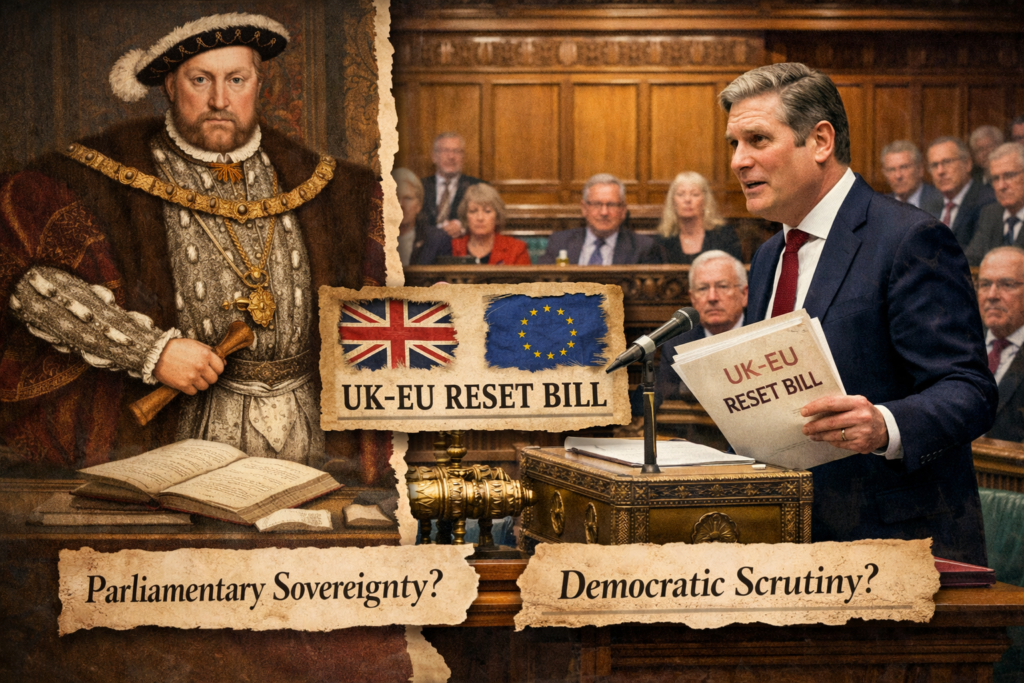
Image Credentials: Image Title: Explained: The ‘Henry VIII’ Powers at the Heart of Starmer’s EU Reset Source: (chatgpt.com) Date: April 2026. Attribution: This image was created using AI-generated imagery (chatgpt.com) and does not depict a real-world scene.
By Open Chronicle Staff with Agencies
April 13, 2026
LONDON — As Prime Minister Sir Keir Starmer prepares to unveil the “UK-EU Reset Bill” in next month’s King’s Speech, a centuries-old constitutional mechanism has returned to the forefront of British politics. The proposed use of “Henry VIII powers” to align UK regulations with Brussels has ignited a fierce debate over parliamentary sovereignty, democratic scrutiny, and the legacy of Brexit.
But what exactly are these powers, and why do they provoke such intense opposition?
What are Henry VIII’s powers?
In the British legal system, most significant changes occur through primary legislation, which undergoes rigorous debate and amendment in both the House of Commons and the House of Lords.
Henry VIII’s powers are specific clauses tucked into primary bills that grant government ministers the authority to amend or repeal existing laws using secondary legislation (often called Statutory Instruments).
-
The Catch: Secondary legislation is a “take it or leave it” affair. MPs can either accept or reject the change in its entirety; they cannot suggest amendments or engage in the lengthy line-by-line scrutiny typical of a standard Bill.
-
The Origin: The nickname refers to the Statute of Proclamations (1539), which gave King Henry VIII the power to govern by royal decree, effectively bypassing Parliament to enforce his will.
Why is the Government Using Them Now?
The Starmer administration argues that in a “volatile world” defined by the ongoing war in Iran and economic instability, the UK must be able to move at pace. The Reset Bill intends to facilitate “dynamic alignment” with the EU in specific sectors like food standards and chemicals.
By using Henry VIII’s powers, ministers could “tweak” UK law to match new EU regulations instantly, rather than bringing a fresh, time-consuming Bill to Parliament every time Brussels updates a directive.
“We are making a sovereign choice to reduce trade barriers,” a Labour source said, framing the move as a way to “get rid of the Brexit paperwork tax” that has driven up the cost of the weekly shop.
The Controversy: ‘Rubber-Stamping’ Brussels
The use of these powers has drawn fire from across the political spectrum, including from those who point out a perceived hypocrisy in the Prime Minister’s previous stance.
1. The “Democratic Deficit” Conservative leader Kemi Badenoch accused Starmer of asking the EU to “do his homework,” arguing that the UK would become a “rule-taker” without the veto power it possessed as an EU member. Shadow Business Secretary Andrew Griffith warned that Parliament would be “reduced to a spectator while Brussels sets the terms.”
2. The 2017 Precedent In a notable irony, Sir Keir Starmer—then the Shadow Brexit Secretary, fiercely opposed the Conservative government’s use of Henry VIII powers in the 2017 “Great Repeal Bill.” At the time, he labeled the move a “legislative blank cheque” and a “flawed” attempt to bypass democratic control. Critics now ask why a mechanism he once deemed “deeply disappointing” is now the cornerstone of his own European strategy.
3. The Sovereignty Argument For Reform UK leader Nigel Farage, the powers represent a “backdoor attempt” to reverse Brexit. He argued that allowing ministers to align with EU laws via secondary legislation removes the “meaningful input” of British voters and their elected representatives.
The Road to May 13
The government maintains that the Reset Bill itself will go through “the normal way” with full scrutiny before it becomes law. However, once the “Henry VIII” clauses are active, the executive branch will hold a level of power over trade and regulation not seen since the height of the withdrawal process.
As the King’s Speech approaches, the debate remains centered on a fundamental question: Is the efficiency gained by alignment worth the price of bypassed parliamentary oversight?