
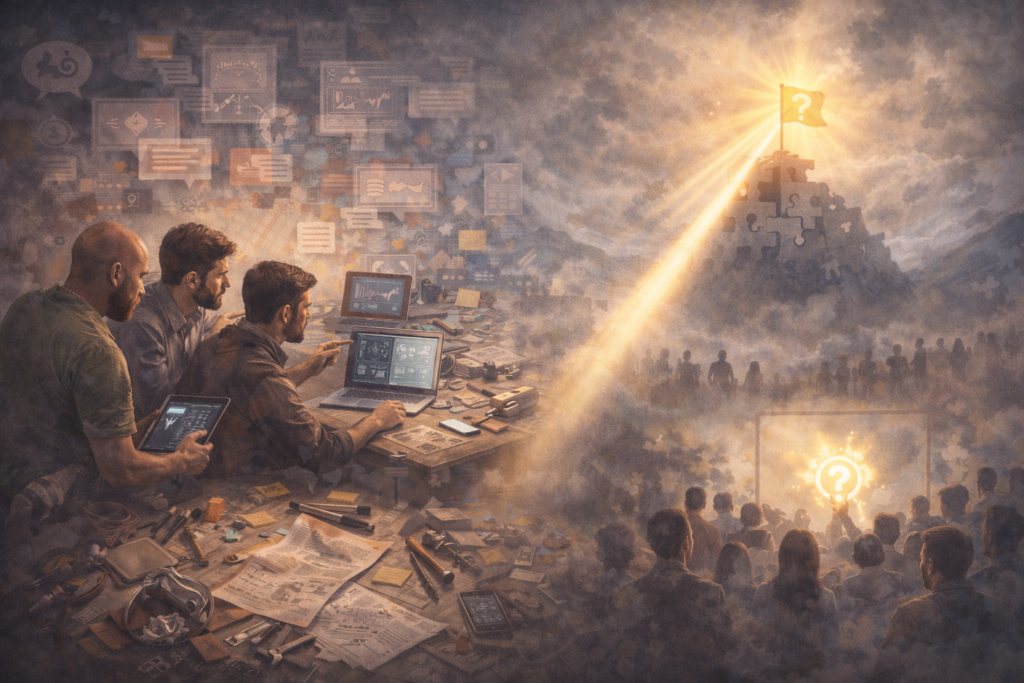
Image Credentials: Image Title: The Hardest Part of Building Isn’t the Product, It’s Finding the Right Problem Source: (chatgpt.com) Date: April 2026. Attribution: This image was created using AI-generated imagery (chatgpt.com) and does not depict a real-world scene.
By Open Chronicle Staff
In the world of startups, creators, and digital builders, there is a persistent myth that success begins with a great idea.
It does not.
It begins with a problem.
And more often than not, that is exactly where most people get stuck.
The Illusion of Ideas
Scroll through any online community for founders or creators and you will see the same pattern repeated endlessly.
People searching for ideas.
People asking what they should build.
People waiting for inspiration to strike.
But ideas, in isolation, are almost meaningless.
A strong idea is simply a well-defined response to a real problem. Without that foundation, even the most creative concepts tend to collapse under scrutiny.
Why Problem Discovery Is So Difficult
Identifying meaningful problems is not as straightforward as it seems.
Many aspiring builders fall into one of three traps:
They focus on problems that are too vague
They choose problems that are not painful enough
They pick problems they do not fully understand
The result is predictable. Products are built around assumptions rather than reality.
And when reality does not match the assumption, the product fails.
The Difference Between Ideas and Opportunities
There is a crucial distinction between an idea and an opportunity.
An idea is something you can imagine.
An opportunity is something people are already struggling with.
The best opportunities share a few characteristics:
They are frequent
They are frustrating
They are expensive, either in time, money, or effort
They are currently solved in inefficient ways
When you find a problem that meets these criteria, you are no longer guessing. You are building on solid ground.
A Structured Way to Find Problems
Most people try to find problems by thinking harder.
That rarely works.
A more effective approach is to use structure. To break down a niche or audience and systematically explore where friction exists.
This is the thinking behind the Problem Finder Tool.
Rather than starting from nothing, the tool prompts you to define a niche and then surfaces different types of problems within it.
General inefficiencies
Pain points
Growth challenges
Time related bottlenecks
Each category reveals a different layer of opportunity.
Introducing the Problem Finder Tool
The Problem Finder Tool was designed to help builders move from vague thinking to concrete insight.
With a simple input, a niche, audience, or industry, the tool generates a set of real-world problems that can be used as starting points for:
Product ideas
Content strategies
Service offerings
Digital tools
The goal is not to produce random suggestions, but to guide the user toward patterns of friction that are common, repeatable, and actionable.
Why This Matters More Than Ever
We are operating in a time where building is easier than ever.
No-code tools, AI systems, and global distribution have removed many of the traditional barriers.
But this has created a new problem.
There are now more products than ever, but not necessarily more meaningful ones.
In such an environment, the advantage no longer comes from the ability to build. It comes from the ability to choose what to build.
From Problems to Products
Once a clear problem is identified, everything else becomes easier.
Ideas emerge naturally
Positioning becomes clearer
Marketing becomes more focused
Execution becomes more efficient
Instead of forcing a product into the market, you are aligning it with an existing need.
That shift changes everything.
A Tool for Builders, Not Dreamers
The Problem Finder Tool is not designed for passive inspiration.
It is built for action.
For founders who want to validate ideas before investing time.
For creators looking to produce relevant content.
For freelancers aiming to package services around real demand.
It is a starting point, but a powerful one.
Final Thought
If you are struggling to find your next idea, you are likely asking the wrong question.
Do not ask, what should I build.
Ask, what is broken?
Because the best ideas are not invented.
They are discovered.
👉 Try the Problem Finder Tool and start with what actually matters.