
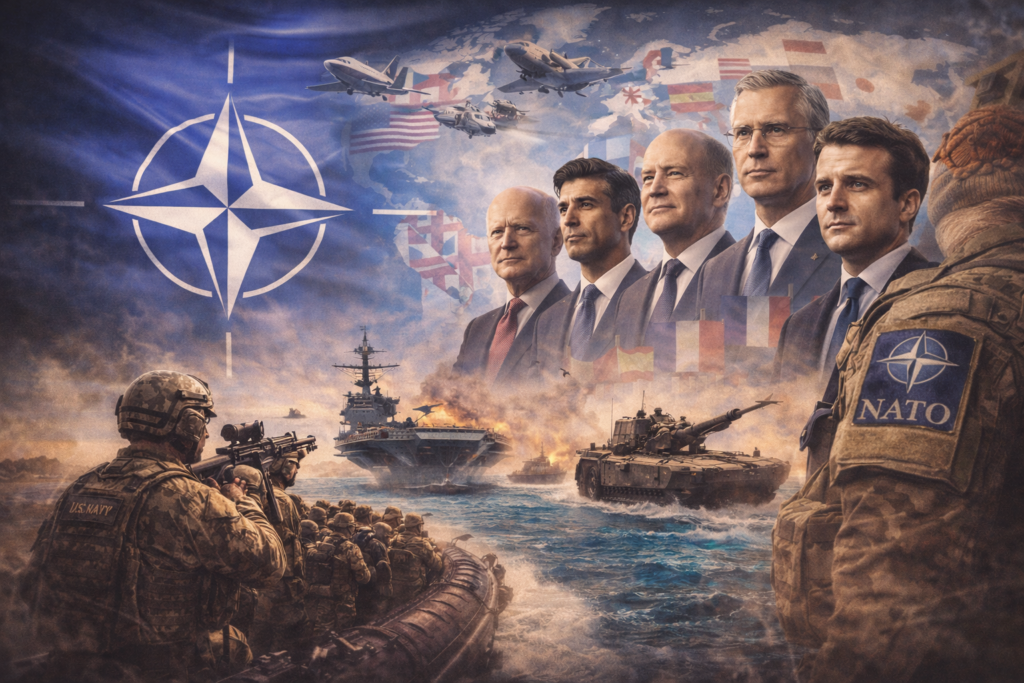
Image Credentials: Image Title: NATO in Focus: Test Your Knowledge of the World’s Most Powerful Military Alliance Source: (chatgpt.com) Date: April 2026. Attribution: This image was created using AI-generated imagery (chatgpt.com) and does not depict a real-world scene.
By Open Chronicle Quizzes
In an era defined by shifting alliances, renewed great power competition, and persistent regional instability, few institutions remain as central to global security as NATO.
Formed in the aftermath of World War II, NATO was designed as a collective defense pact, a strategic guarantee that an attack against one member would be treated as an attack against all. More than seven decades later, that principle, enshrined in Article 5, continues to shape the security architecture of Europe and the wider transatlantic space.
But beyond headlines and policy debates, how well is NATO really understood?
From Cold War Shield to Global Security Actor
NATO emerged in 1949 against the backdrop of rising tensions between Western powers and the Soviet Union. Its original purpose was clear, to deter aggression and ensure stability in Europe during the long shadow of the Cold War.
Yet the alliance did not fade with the collapse of the Soviet bloc. Instead, it adapted.
From peacekeeping operations in the Balkans to its long and complex mission in Afghanistan, NATO evolved into a broader security actor. Enlargement brought new members into the alliance, extending its reach eastward, while new challenges, cyber threats, hybrid warfare, and strategic competition forced further transformation.
Today, NATO operates at the intersection of deterrence, diplomacy, and military readiness.
Why NATO Still Matters
At its core, NATO is not just a military alliance; it is a political commitment.
Its credibility rests on deterrence, the ability to prevent conflict by demonstrating strength and unity. In recent years, that credibility has been tested, from tensions on Europe’s eastern flank to debates over defense spending and strategic autonomy.
For policymakers, analysts, and citizens alike, understanding NATO is no longer optional. It is essential to grasp the dynamics shaping international security in the 21st century.
Test Your Knowledge
To explore the alliance in a more engaging way, we’ve created a dedicated quiz that challenges your understanding of NATO’s history, structure, and strategic role.
👉 Take the quiz here:
https://openchronicle.org/how-well-do-you-know-nato/
Whether you are familiar with NATO’s inner workings or simply curious about global security, this quiz offers a concise way to test what you know and what you might have missed.
A New Way to Engage with Global Affairs
At Open Chronicle, the goal is not only to inform, but to engage.
Interactive formats like quizzes create space for readers to actively explore complex topics, bridging the gap between analysis and participation. In a world saturated with information, that engagement is what transforms knowledge into understanding.
Where Do You Stand?
Are you just beginning to explore NATO’s role in global security, or do you already think like a strategist?
There’s only one way to find out.