
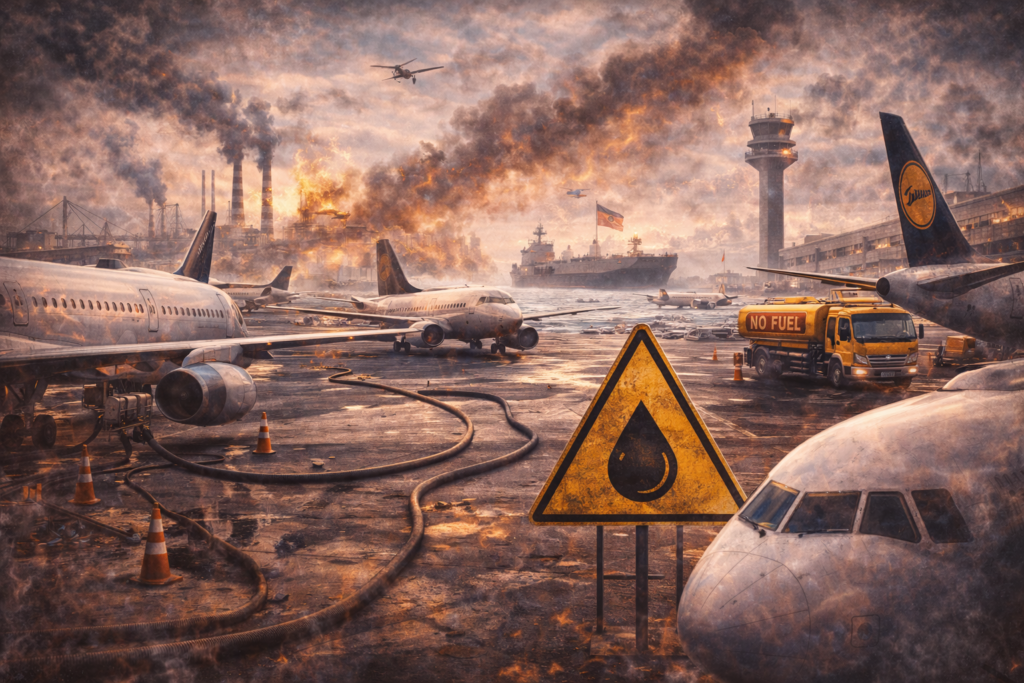
Image Credentials: Image Title: Europe Faces Jet Fuel Shortage Within Weeks as Iran War Disrupts Global Energy Flows Source: (chatgpt.com) Date: April 2026. Attribution: This image was created using AI-generated imagery (chatgpt.com) and does not depict a real-world scene.
Open Chronicle | With Agencies
Paris — Europe could run out of jet fuel within six weeks if current disruptions to global energy supplies continue, the head of the International Energy Agency has warned, raising the prospect of widespread flight cancellations and mounting economic strain.
Fatih Birol, the agency’s executive director, described the unfolding situation as “the largest energy crisis we have ever faced,” driven by the continued blockage of supplies through the Strait of Hormuz amid the ongoing Iran war.
Aviation Sector at Immediate Risk
Birol warned that Europe’s aviation sector could be among the first to feel the impact if fuel shortages intensify.
“If the situation continues, we will soon hear that flights between major cities may be canceled due to a lack of jet fuel,” he said, underscoring the speed at which the crisis could escalate.
Air travel relies heavily on consistent fuel supply chains, and disruptions at key chokepoints like the Strait of Hormuz can quickly ripple through global logistics networks.
A Global Energy Shock
The closure and instability around the Strait, a vital route for oil and gas shipments, has effectively choked a significant portion of global energy flows. The result is rising prices across multiple sectors, from gasoline to electricity.
Birol warned that the longer the disruption persists, the more severe its impact will be on economic growth and inflation worldwide.
“This is a crisis with major implications for the global economy,” he said, noting that the situation is likely to worsen over time if unresolved.
Uneven Impact Across Regions
While Europe faces imminent challenges, the burden of the crisis is expected to fall most heavily on developing nations.
Countries in Asia, including Japan, South Korea, India, China, Pakistan, and Bangladesh, are particularly exposed due to their dependence on imported energy supplies.
Birol emphasized that poorer nations in Asia, Africa, and Latin America will bear the brunt of the crisis, even though their voices often carry less weight in global policy discussions.
Rising Costs and Economic Pressure
The الأزمة is already translating into higher fuel prices, increased energy bills, and broader cost pressures for businesses and households.
As energy costs rise, industries reliant on transportation and manufacturing face growing challenges, while consumers are likely to encounter higher prices across a range of goods and services.
A Narrow Window for Action
The warning from the International Energy Agency highlights the urgency of restoring stability to global energy routes.
Without a reopening of the Strait of Hormuz or alternative supply solutions, the risk of cascading disruptions, from aviation to broader economic systems, will continue to grow.
For Europe, the timeline appears particularly tight. With only weeks of jet fuel potentially remaining, the coming period may prove critical in determining whether the crisis can be contained or escalates into a wider economic shock.